The short answer
A children’s electric ATV compliance program starts by classifying the exact product and destination market, identifying applicable rules, testing a representative configuration, preparing the required certificate or declaration and technical records, and controlling production against the tested sample. A CE mark, test-report cover page, or supplier statement alone is not enough; importers should verify model scope, component consistency, warnings, traceability, and current legal requirements.
Compliance questions often arrive too late in a sourcing project. A buyer finds an attractive model, negotiates a price, approves artwork, and only then asks whether the existing report can support the final private-label version. That sequence creates avoidable risk because battery, charger, materials, electronics, dimensions, intended age, warnings, or packaging can change the applicable assessment or the relevance of earlier evidence.
This guide provides a practical due-diligence workflow for U.S. and European Union buyers. It is educational rather than legal advice. Product classification and obligations depend on the exact vehicle, intended use, age grading, market, features, and current law. Confirm the final plan with qualified laboratories, customs or legal specialists, and the responsible economic operators before placing products on the market.
1. Define the exact product before requesting documents
A useful compliance review begins with product identity. “Kids ATV” is a sales category, not a complete technical definition. Record the model number and revision, intended age or user group, maximum design speed, dimensions, mass, battery and charger, motors, controller, wheels, braking or stopping behavior, control layout, materials, coatings, sound and lighting functions, accessories, and intended application.
Next, define the destination country and the entity that will manufacture, import, distribute, or sell the product. Obligations can attach to different economic operators. A report prepared for one configuration or company does not automatically establish that another branded version meets every responsibility.
Create a compliance identity sheet
- Product and factory model identifiers, including all variants proposed for the order.
- Clear photographs of the complete vehicle, rating labels, battery, charger, controls, warnings, and packaging.
- Bill of materials or controlled critical-component list for safety-relevant parts.
- Intended market, age grading, foreseeable use, sales channel, and language requirements.
- Requested logos, brand details, manuals, declarations, certificates, and importer information.
- A revision history showing changes after any test sample was submitted.
This identity sheet becomes the bridge between sourcing, the laboratory, factory production, artwork, and shipment inspection. Without it, teams may discuss the same model name while looking at different component combinations.
2. U.S. framework: ASTM F963, third-party testing, and the CPC
The U.S. Consumer Product Safety Commission explains that the toy safety standard is the version of ASTM F963 incorporated by 16 CFR part 1250. For ASTM F963-23, the CPSC states an effective date of April 20, 2024. Toys designed or intended primarily for children 12 and under generally require third-party testing by a CPSC-accepted laboratory and certification in a Children’s Product Certificate for applicable children’s product safety rules. See the current CPSC business guidance FAQ and third-party testing and CPC guidance.
This does not mean every section of the standard applies identically to every vehicle. The laboratory should review the exact product and determine the applicable sections and other rules. Depending on design and materials, considerations may include mechanical and physical hazards, accessible edges or points, small parts where relevant, surface coatings, substrates, phthalates, electrical or battery-related features, labeling, and instructions.
The importer or domestic manufacturer should understand who issues the CPC, which products and production lots it covers, what tests support it, which laboratory performed them, and where records are maintained. A supplier-provided PDF with a familiar standard number is not a substitute for checking whether the report sample matches the ordered product.
A report-to-product matching check
- Compare the report model number with the product, carton, manual, and purchase order.
- Review report photographs and descriptions against the final body, dimensions, components, battery, and charger.
- Check the test date, laboratory identity, accreditation or CPSC acceptance where applicable, and full report status.
- Identify tested variants and whether differences are technically covered.
- List every post-test customization and request a written impact review.
- Verify that the CPC cites the applicable rules and accurate manufacturer, importer, laboratory, and production information.
3. EU framework: manage the transition and product file
The European Commission identifies Regulation (EU) 2025/2509 as the new Toy Safety Regulation. It was adopted on November 26, 2025, entered into force on January 1, 2026, and is scheduled to apply from August 1, 2030 after the transition period. Buyers planning products today should review both the rules applicable when the product is placed on the market and the coming transition on the official European Commission toy-safety page.
For an EU program, clarify the conformity-assessment route, applicable harmonized standards or other technical specifications, safety assessment, technical documentation, EU Declaration of Conformity, CE marking, traceability, warnings, instructions, and responsibilities of the manufacturer, importer, and distributor. The exact file will depend on the product and applicable legislation.
Do not treat a CE mark as a third-party quality award. It is part of a regulatory conformity process and must be supported by the appropriate assessment and documentation. Buyers should verify the legal entity named as manufacturer, the product identification, applicable acts and standards, authorized signatory, date, and consistency between the declaration and technical file.

4. Understand how customization can change compliance scope
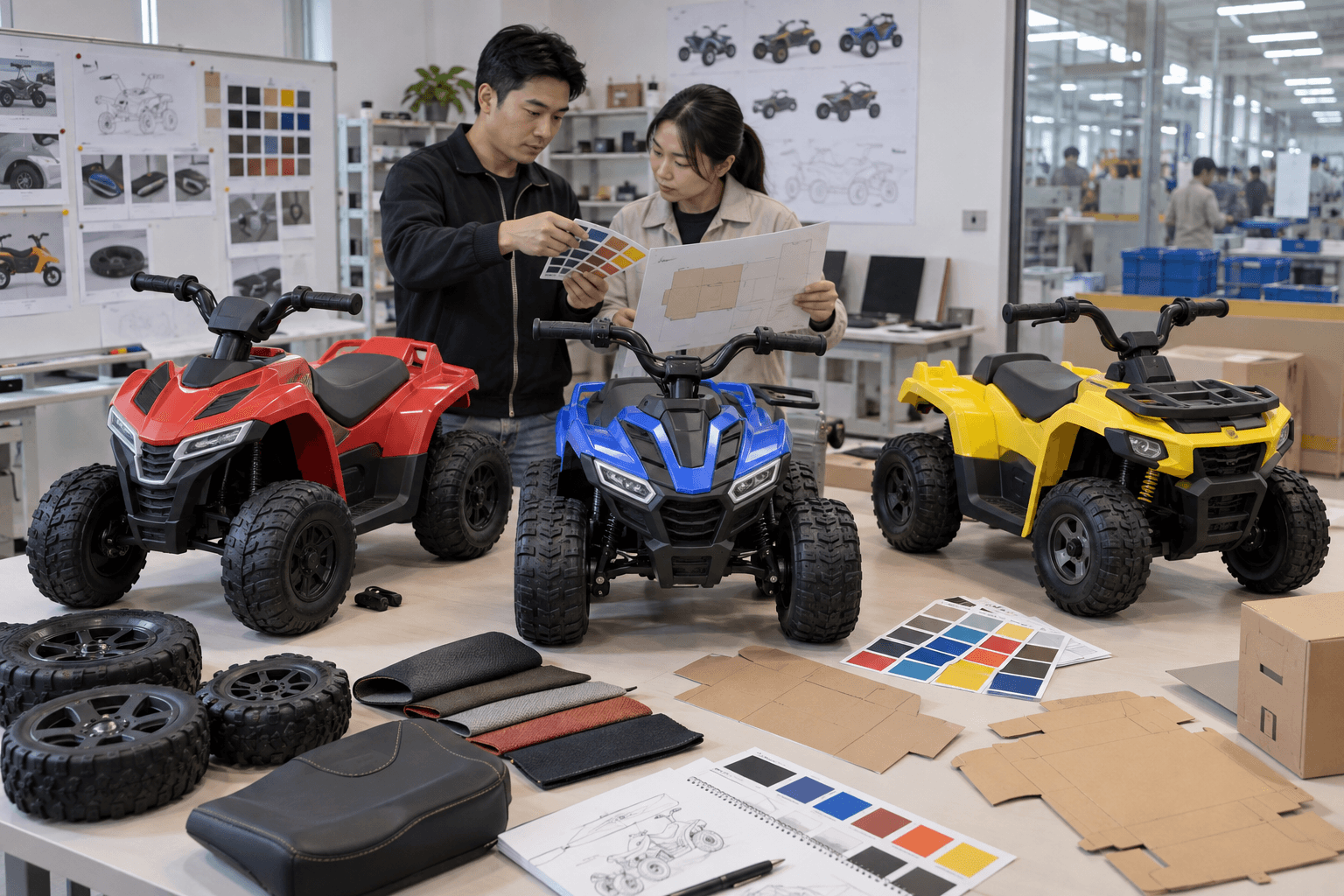
Private-label customization is rarely limited to a logo. Buyers may request a different body color, printed graphics, sound module, lights, remote control, battery capacity, charger plug, motor arrangement, wheel, seat, material, coating, carton, or manual. Some changes are primarily cosmetic; others may change hazards, performance, chemical exposure, electrical characteristics, or user behavior.
Create a change-control gate before the factory purchases materials. Each requested change should identify the affected component, original and proposed specifications, reason, supplier, visual difference, functional impact, documentation impact, and approval owner. The laboratory or compliance specialist—not a sales assumption—should determine whether existing evidence remains relevant or additional assessment is needed.
| Requested change | Possible review area | Evidence to update |
|---|---|---|
| New paint, plastic color, or printed graphic | Chemical limits, coating or substrate, artwork accuracy | Material declarations, test scope, approved color files |
| Different battery or charger | Electrical behavior, charging, heat, labeling, transport | Critical-component list, reports, labels, manual |
| Motor, controller, or speed-mode change | Performance, stopping, foreseeable use, wiring | Functional tests, risk assessment, specification |
| Added light, sound, or remote function | Components, wiring, EMC or radio rules where applicable | Technical file, reports, instructions |
| Carton or manual localization | Warnings, traceability, legal information, assembly | Approved artwork, translations, pack-out record |
A useful rule is simple: if a change can affect how the product behaves, what the user touches, what substances are present, how it is charged, or how it is understood, it deserves a documented compliance impact review.
5. Factory testing keeps the certified configuration repeatable
Laboratory testing evaluates submitted samples. Production control is what helps later units remain consistent with the assessed design. The factory should identify critical components and process checkpoints, control approved suppliers and substitutions, train assembly staff, retain relevant records, and isolate nonconforming material.
Incoming checks may confirm component identity, ratings, dimensions, material declarations, appearance, or supplier documentation. In-process checks may cover wire routing, connectors, fastener control, battery restraint, steering assembly, switches, and protective parts. End-of-line checks may cover operation, selectable functions, stopping behavior, charging accessories, labels, manuals, and pack-out.
Questions to ask during a factory audit or remote review
- Which components are designated critical, and how are their approved specifications controlled?
- How does the factory prevent an unapproved battery, charger, motor, controller, or material substitution?
- Which operations use work instructions or fixtures, and how are revisions issued to the line?
- What functional tests are performed on every unit, and which checks use sampling?
- How are defects, rework, concessions, and corrective actions identified and recorded?
- Can production and packing records be traced to an order, date, line, or component lot?
See the CubRover quality-control approach and manufacturing workflow for the checkpoints that can be adapted to a confirmed order.
6. Treat labels, warnings, and instructions as product components
A technically sound vehicle can still fail a buyer review if its warnings, rating label, traceability, manual, assembly instructions, or packaging statements are wrong. Artwork should be controlled with revision numbers and linked to the exact model and market. Avoid copying labels from a visually similar product.
Review the required languages, responsible company details, model or batch identification, electrical ratings, charger identification, age or user information, supervision statements, protective-equipment or use restrictions where applicable, assembly steps, charging instructions, maintenance, storage, cleaning, and disposal information. The exact content must follow the applicable law and risk assessment.
Installation preparation matters because many ride-on vehicles are partially assembled for shipping. If a wheel, handlebar, guard, battery connector, seat, or accessory must be fitted, the manual should make the sequence and hardware clear. A pre-production pack-out trial helps reveal missing tools, ambiguous diagrams, inaccessible fasteners, and label locations hidden after assembly.
7. Build compliance checks into shipment inspection
A final shipment inspection does not recreate laboratory testing, but it can verify that the order appears consistent with the approved configuration and that required documents and markings are present. The inspection plan should identify samples, acceptance criteria, photographs, functional checks, and release authority before production finishes.
Inspectors can compare model and batch identification, body and component appearance, battery and charger labels, controls, warnings, manual revision, carton artwork, barcodes, included accessories, and shipping marks. Functional checks can confirm agreed operation without making new regulatory conclusions. Any unexplained difference from the approved sample should be escalated before release.
Suggested shipment file
- Final signed specification and approved sample record.
- Applicable reports, declarations, certificates, or laboratory correspondence.
- Critical-component and artwork revision lists.
- Production and in-process quality records agreed for the order.
- Final inspection report with photos and issue disposition.
- Packing list, carton data, shipping marks, and loading record.
- Document owner and retention location for post-market follow-up.
From July 8, 2026, the CPSC states that importers of most regulated consumer products must electronically file certificate information with U.S. Customs and Border Protection. U.S. buyers should review current CPSC eFiling guidance and confirm their operational responsibilities rather than relying on old shipment routines.
8. Final importer due-diligence checklist
| Gate | Buyer evidence | Release question |
|---|---|---|
| 1. Classification | Product identity and intended use | Do we know which rules apply? |
| 2. Configuration | Controlled specification and sample | Is the exact product unambiguous? |
| 3. Testing | Complete relevant reports | Does evidence match the final configuration? |
| 4. Documentation | CPC, DoC, technical records as applicable | Are documents accurate and current? |
| 5. Artwork | Approved labels, warnings, manual, carton | Can the user and authorities identify the product? |
| 6. Production | Critical-component and process controls | Can the factory repeat the assessed design? |
| 7. Inspection | Shipment report and issue closure | Does the batch match the order? |
| 8. Retention | Named owners and accessible records | Can questions be answered after launch? |
Conclusion
Reliable compliance work is a chain of evidence. The market requirements must connect to the exact vehicle, the test sample must connect to production, and production must connect to labels, documentation, inspection, and traceability. If any link is unclear, resolve it before the shipment deadline removes your options.
CubRover can organize product specifications, sample records, factory checkpoints, artwork control, and shipment documentation for buyer review. Final legal responsibility and regulatory conclusions remain with the relevant economic operators and qualified specialists.
Frequently asked questions
Does every children’s electric ATV need ASTM F963 testing for the U.S.?
Children’s toys designed or intended primarily for children 12 and under are subject to the U.S. toy safety framework, but the applicable ASTM F963 sections and other rules depend on the exact product. Use a CPSC-accepted laboratory and current CPSC guidance to define the test plan.
Is a CE certificate enough to sell a kids ATV in the EU?
Do not rely on a generic “CE certificate.” CE marking must be supported by the applicable conformity process, technical documentation, declaration, risk assessment, labeling, and economic-operator responsibilities for the exact product. Confirm the route with qualified specialists.
Can one test report cover several colors or variants?
Sometimes a justified variant family can be covered, but it is not automatic. Materials, coatings, components, construction, dimensions, electrical parts, and functions can affect scope. Ask the laboratory to document which variants are covered and why.
Who should issue the Children’s Product Certificate?
Under CPSC guidance, the U.S. importer or domestic manufacturer is responsible for issuing the CPC based on passing test results from a CPSC-accepted laboratory for applicable requirements. Verify current guidance for your exact role and product.
When should compliance be reviewed during sourcing?
Start before quotation comparison, review again before sample approval, reassess every material or functional change, and confirm the final configuration before production and shipment release.
Does final inspection replace laboratory testing?
No. Final inspection checks production against agreed criteria and the approved configuration. It does not replace required conformity assessment or third-party laboratory testing.
Prepare a model-specific compliance review
Share your destination market, exact model, intended age grading, battery and charger, private-label changes, and required shipment date. CubRover will organize the factory-side information for your laboratory and compliance team.
Contact Us