Questions buyers ask before placing an order.
Practical answers for distributors, retailers, and private-label buyers reviewing children’s four-wheel ride-on products, factory controls, customization, and shipment preparation.
Products & platform selection
Start with the intended market, rider profile, retail position, and complete vehicle configuration—not voltage alone.
Which children’s four-wheel vehicle platforms does CubRover offer?
CubRover works with 6V mini electric quads, 12V electric ATV platforms, larger 24V adventure quads, and pedal-powered four-wheel vehicles. The suitable starting point depends on the intended age grading, vehicle size, target performance, retail positioning, and destination market.
How should I choose between a 6V, 12V, and 24V platform?
Voltage is only one part of product selection. Buyers should also compare dimensions, motor arrangement, battery, speed settings, controls, braking behavior, wheel construction, load assumptions, packaging volume, and the exact tested configuration.
Can I request different models for the same product range?
Yes. A range can be planned around different sizes, styling directions, voltage platforms, or price positions. Each model should still have its own confirmed specification, sample record, packaging details, and applicable compliance documentation.
Are the ages shown on the website final product age grades?
No. Website age references are planning guidance only. Final age grading must be confirmed for the exact model, design, performance, warnings, test results, and destination-market requirements.
OEM, ODM & sample development
A controlled sample process turns commercial ideas into a production reference that every team can follow.
Which specifications can be customized?
Depending on the selected platform, buyers can discuss body color, graphics, trim, selected components, manuals, labels, carton artwork, packaging method, and compatible accessories. Changes to electrical or structural systems require additional technical and compliance review.
What information should I provide for an OEM quotation?
Share the destination market, intended age range, preferred platform, target quantity, sales channel, required functions, branding scope, packaging expectations, target timing, and any mandatory documentation. Mark which requirements are fixed and which are open to recommendation.
How is a custom sample approved?
The approved sample should be supported by a dated specification covering model code, colors, graphics, components, functions, labels, manual, charger where applicable, accessories, carton artwork, and pack-out. Any accepted deviation should be recorded before production.
Will customization affect MOQ, price, or lead time?
It can. The impact depends on the model, component availability, color and material requirements, printing method, tooling, packaging, testing implications, and order quantity. CubRover reviews these points after receiving a specific buyer brief.
Quality control & documentation
Inspection criteria and supporting documents must match the exact model, configuration, order, and destination market.
Which checks can be included in the quality plan?
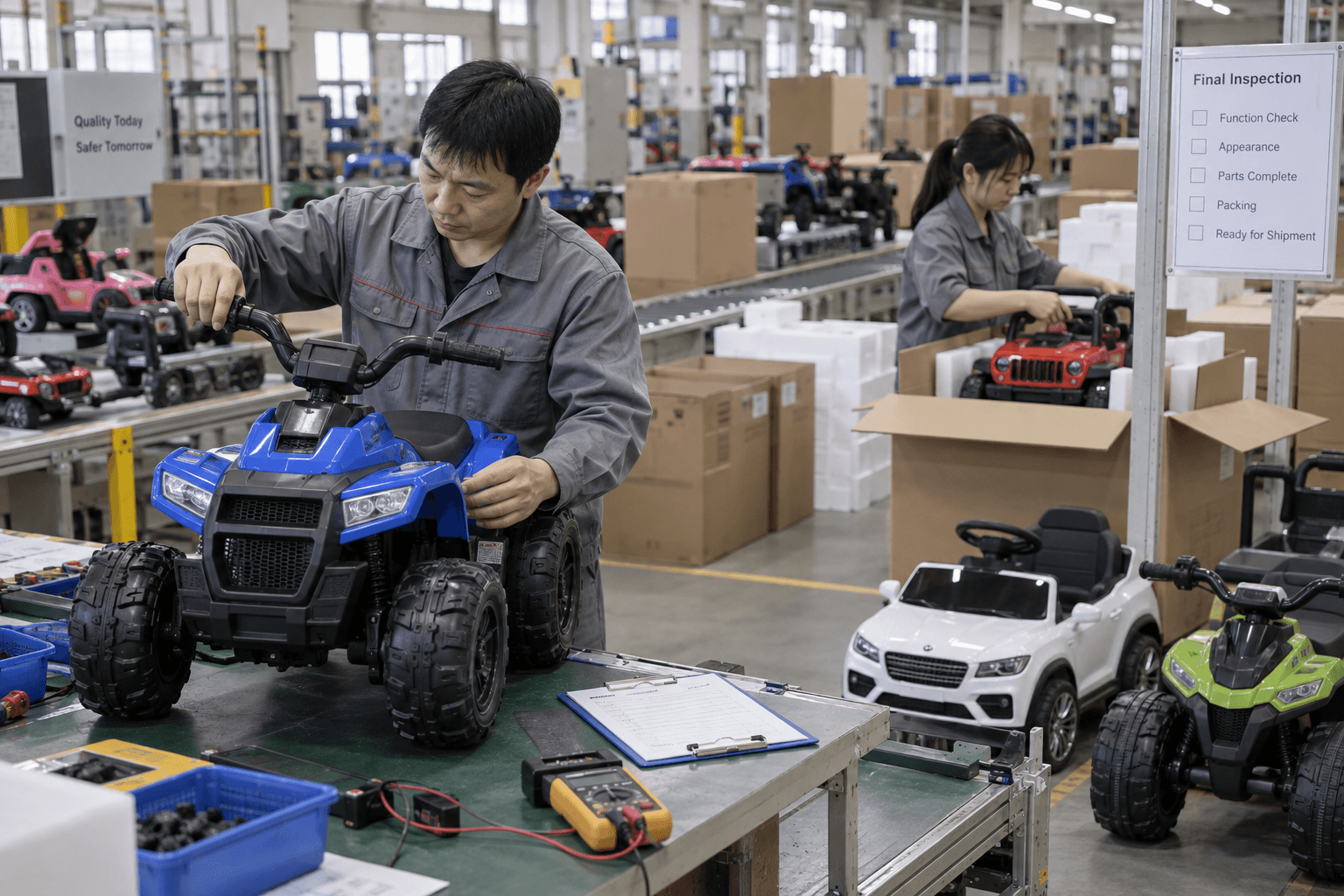
A model-specific plan can cover appearance, assembly, fasteners, steering, forward and reverse operation, stopping behavior, battery and charger identification, switches, lights, accessories, labels, manuals, carton condition, shipping marks, and quantity. The final method and acceptance criteria are agreed for the order.
What quality records can be supplied?
Records depend on the agreed inspection scope. They can include incoming or in-process check records, finished-product function checks, appearance review, battery and charging checks, carton and marking review, packing photos, and loading photos.
Can one test report cover every customized version?
Not automatically. Reports relate to a defined sample, construction, materials, components, and test scope. Changes to batteries, chargers, motors, electronics, materials, dimensions, speed, or age grading may affect applicability and should be reviewed by a qualified laboratory or compliance specialist.
How should buyers verify compliance documents?
Compare the report number, laboratory, issue date, model reference, sample description, photographs where available, standards covered, and tested configuration with the product being ordered. Compliance should be confirmed for the intended placing-on-market date and destination.
Orders, packaging & shipment
Commercial terms become more reliable when the quotation, packaging plan, inspection scope, and shipment handoff use the same order revision.
What determines the minimum order quantity?
MOQ depends on the model platform, component and color requirements, printed materials, carton artwork, customization depth, and current production plan. Share the expected quantity and program scope so the factory can review a realistic starting point.
When should packaging be confirmed?
Packaging should be reviewed during sample approval. Confirm carton dimensions, internal protection, accessory placement, manuals, warnings, barcode location, shipping marks, pack-out method, and any agreed carton test before production is released.
What is normally checked before shipment?
The release plan commonly covers quantity, appearance, functions, included parts, product and carton labels, manuals, accessories, carton condition, shipping marks, packing records, and loading arrangements. Exact checkpoints depend on the model and purchase agreement.
How can I start a product review with CubRover?
Send your destination market, intended age range, product platform, target quantity, required functions, customization scope, packaging needs, and desired timeline through the inquiry page or by email at info@CubRover.com.
Plan your next product program with CubRover.
Share your market, target age, quantity, feature priorities, and packaging requirements.