The short answer
A suitable children’s electric ATV manufacturer should connect five things: a product platform that fits the market, a controlled approved sample, visible production and inspection checkpoints, model-specific compliance documentation, and packaging that survives the intended distribution route. Evaluate the complete program—not only unit price or a catalog photo.
Choosing a supplier for children’s ride-on products is a product-development decision, a quality decision, and a market-access decision at the same time. A visually attractive quad can still create problems if its platform is wrong for the intended age group, the approved sample is poorly documented, or packaging and test files do not match the final production configuration.
Experienced buyers therefore evaluate the supplier’s process as carefully as the vehicle. The goal is not to collect the largest number of models. It is to identify a manufacturing partner that can translate a clear commercial brief into a repeatable product, explain what is and is not configurable, and provide evidence that the final shipment follows the confirmed order specification.
1. Define the buyer brief before comparing quotations
A useful sourcing project begins with the destination market and sales channel. The same vehicle may require different warnings, manuals, packaging languages, charger arrangements, age grading, or documentation depending on where and how it will be sold. If suppliers quote against different assumptions, the prices cannot be compared fairly.
Send every shortlisted factory the same written brief. At minimum, include the intended country or region, target age range, retail positioning, estimated order quantity, preferred voltage, must-have functions, packaging format, private-label scope, sample deadline, and expected shipment window. State which points are mandatory and which are open to recommendation.
Questions a clear buyer brief should answer
- Is the product planned for entry, core, or premium retail positioning?
- Will it be sold online, through mass retail, by specialist dealers, or through distributors?
- Which age range, rider size, and supervision assumptions are being considered?
- Are body color, graphics, accessories, manuals, and carton artwork part of the program?
- Which market documents must be available before the order is released?
Clear inputs help the manufacturer recommend an existing platform or explain where new development is required. They also reduce later changes that can affect cost, testing, tooling, lead time, or carton size.
2. Compare complete product platforms—not voltage labels
Voltage is useful shorthand, but it is not a complete specification. Two 12V products may differ in dimensions, motor arrangement, battery capacity, controls, wheel construction, maximum design speed, steering geometry, braking behavior, charger, load assumptions, and optional functions. Buyers should compare the complete tested configuration.
| Platform | Common commercial role | Points to verify |
|---|---|---|
| 6V mini quad | Compact introductory range | Vehicle size, single-motor layout, carton efficiency, intended age grading |
| 12V electric ATV | Core retail assortment | Motor options, speed settings, battery, controls, lighting and accessory mix |
| 24V adventure quad | Larger premium program | Output, dimensions, rider assumptions, braking, packaging volume and handling |
| Pedal quad | Battery-free assortment | Drive mechanism, ergonomics, steering, wheel construction and assembly method |
Use the supplier’s specification sheet as a starting point, then verify the physical sample. Ask the factory to identify which components and functions belong to the standard platform and which are optional. This prevents a quotation from combining attractive features that have never been produced or tested together.
For an overview of the available starting points, review the CubRover product platforms. Final specifications should always be confirmed by exact model and order.
3. Assess whether the factory can control repeat production
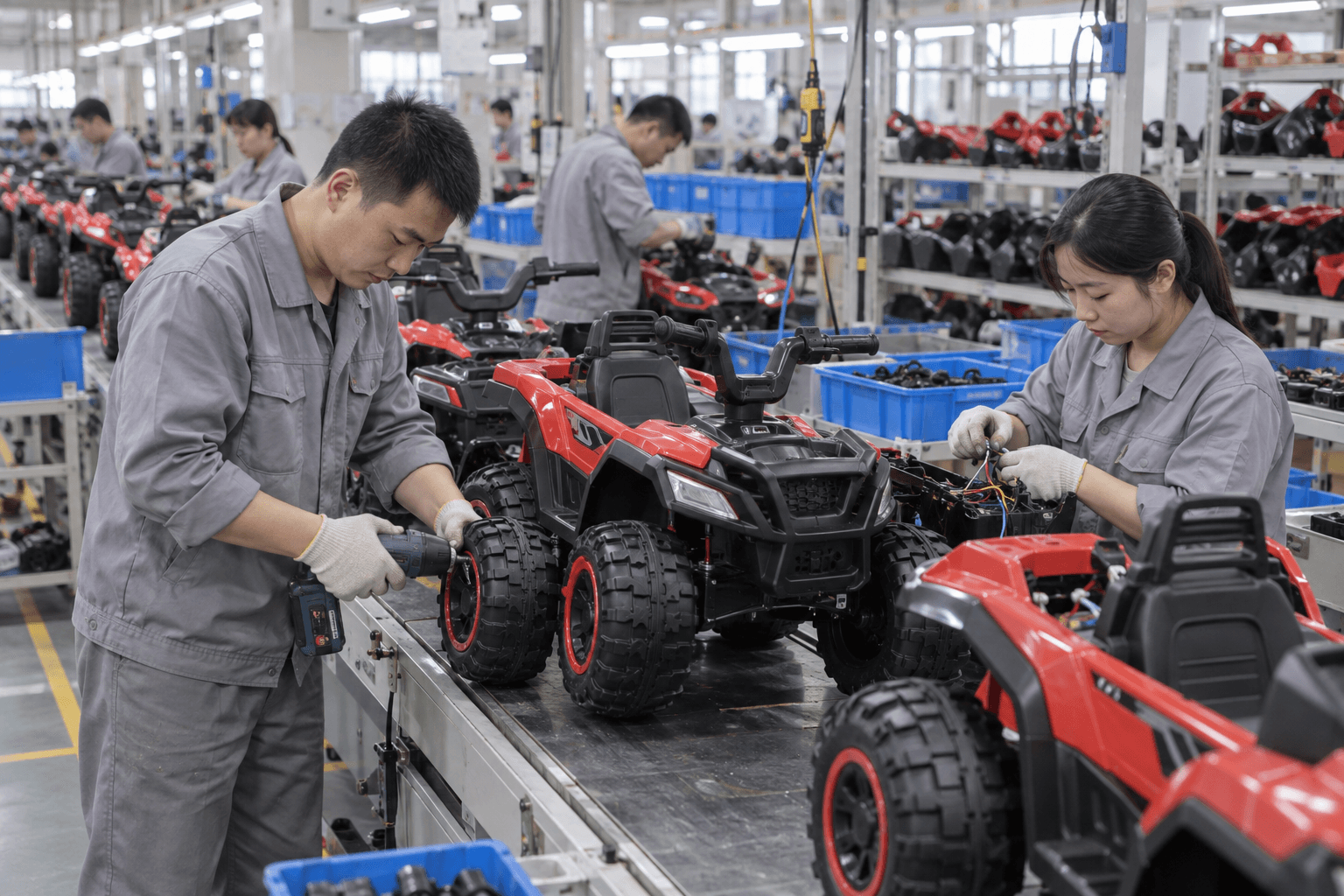
A factory tour or remote production review should show how components enter the line, how work instructions are communicated, where assemblies are checked, and how finished units move into inspection and packing. Clean floors are welcome, but process visibility is more important than presentation.
Look for practical evidence: incoming material identification, component storage, assembly fixtures, controlled tools, in-process checks, electrical testing, appearance standards, nonconforming-product handling, packing instructions, and batch records. Ask who can stop production when a repeated issue appears and how corrective action is recorded.
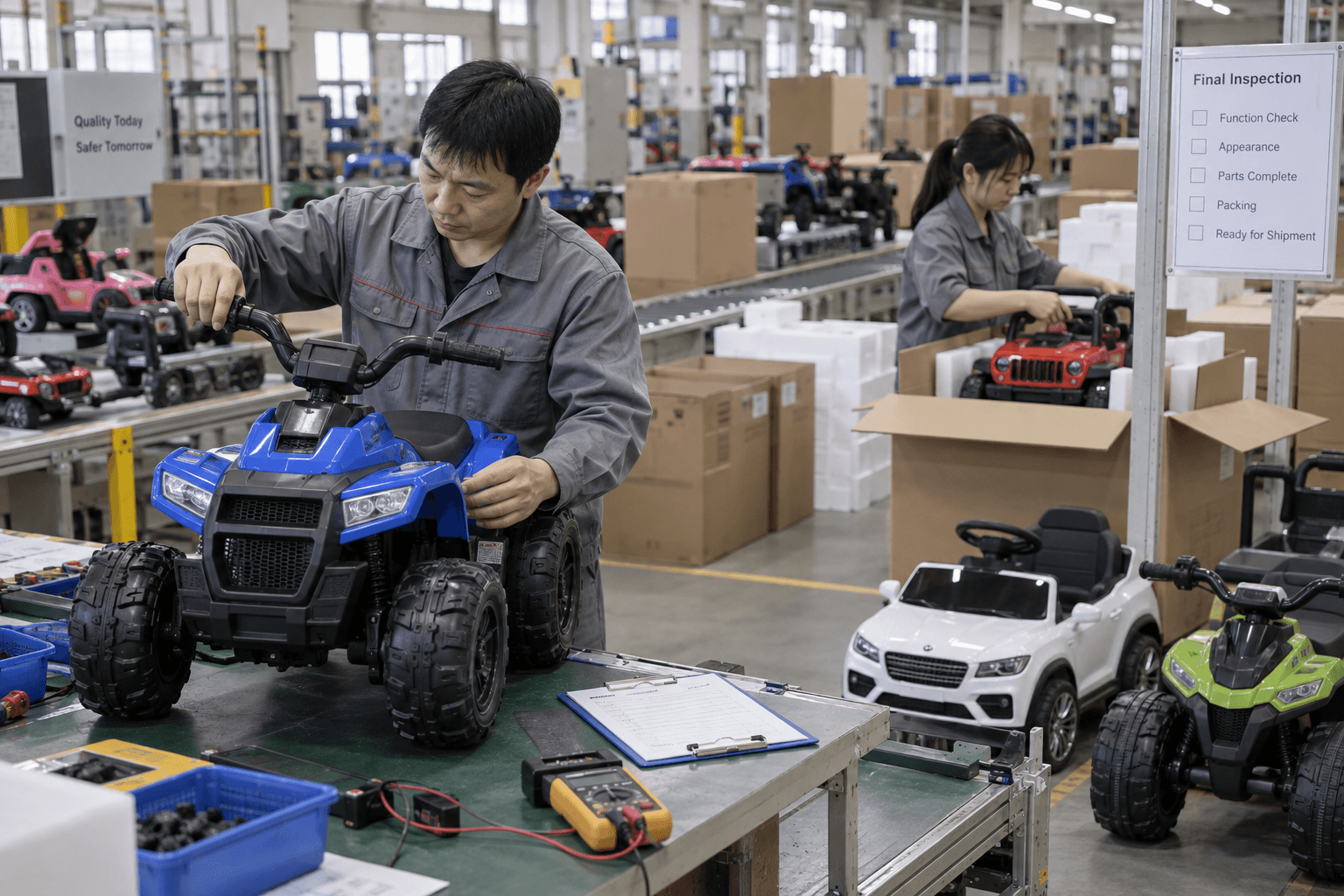
Capacity claims also need context. Ask about the selected model, anticipated order quantity, component lead times, peak-season loading, sampling workload, and packaging availability. A theoretical monthly maximum is less useful than a realistic production plan for your exact order. The CubRover manufacturing workflow outlines the checkpoints from product brief to loading.
4. Turn the approved sample into a production reference
The approved sample should be a controlled reference, not simply a unit that looked acceptable during a video call. Record its model code, revision, appearance, colors, graphics, key components, functions, accessories, labels, manual, charger, carton artwork, and internal protection. If something differs from the quotation, document the decision before production.
Photos are useful for color placement and pack-out, but they cannot capture every functional or technical requirement. Keep a written specification with measurable or identifiable acceptance points. When a change is requested, ask whether it affects tooling, component availability, assembly instructions, testing, labels, packaging, lead time, or cost.
Useful sample approval records
- A signed or digitally approved specification with a revision date.
- Appearance photos showing all sides, graphics, labels, and key details.
- A function checklist covering model-specific controls and accessories.
- Packaging photos showing every included item and protection point.
- A deviation list recording any accepted difference from the original brief.
5. Build an inspection plan around buyer risk
Inspection should reflect the product, order, and known failure modes. A generic checklist may miss the points that matter most to a particular model. Define what will be checked during assembly, what will be checked on finished units, how sampling will be handled, and which results are required before release.
Typical categories include surface condition, fit and finish, fasteners, steering, forward and reverse operation, stopping behavior, battery and charger identification, switches, lights, accessories, labels, manuals, carton condition, shipping marks, and quantity. The applicable criteria and test method must be agreed rather than assumed.
For private-label programs, inspection must also confirm that production artwork and warnings match the approved files. A correct product in the wrong carton can still become a commercial problem. Review the CubRover quality-control approach for a practical checkpoint structure.
6. Verify that compliance documents match the exact product
Compliance is not a logo printed on a quotation. It is a relationship between a defined product, applicable legal requirements, test methods, supporting technical files, and the responsible economic operator. Buyers should confirm that reports identify the relevant model and configuration and that later customization does not invalidate their use.
For the United States, the CPSC explains that ASTM F963 is incorporated as a mandatory toy safety standard through 16 CFR part 1250. Toys designed or intended primarily for children 12 and under generally require third-party testing by a CPSC-accepted laboratory and a Children’s Product Certificate covering applicable requirements. The exact sections depend on the product. Buyers should review the current CPSC toy-safety business guidance.
For the European Union, the legal framework is in transition. The European Commission states that Regulation (EU) 2025/2509 entered into force on January 1, 2026 and will apply from August 1, 2030 after the transition period. Current product planning should therefore be reviewed against the applicable requirements and timing for the intended placing-on-market date. See the Commission’s official toy-safety legislation page.
Ask for report numbers, sample descriptions, model references, photographs where available, issue dates, laboratory identity, and the standards or regulations covered. Then compare those details with the product you intend to buy. If the battery, charger, electronics, material, dimensions, speed, or construction changes, obtain qualified advice about whether new evaluation is required.
7. Confirm packaging and shipment preparation early
Packaging affects landed cost, damage risk, warehouse handling, online fulfillment, retail presentation, and container utilization. It should be part of product development rather than a final artwork task. Confirm assembled versus partially assembled pack-out, carton dimensions, internal protection, accessory placement, manual position, charger protection, barcode location, shipping marks, and any agreed carton test.
Ask the supplier to prepare a packaging sample or packing demonstration before mass production. Check that components cannot rub against painted or visible surfaces, loose hardware is contained, and the customer can identify all parts during assembly. For e-commerce channels, pay particular attention to protection at corners, wheels, handlebars, and body panels.
Before loading, align quantity records, carton counts, pallet requirements where applicable, container plan, loading photos, and release authority. A clear handoff between inspection and logistics helps prevent a shipment from being loaded while open quality or documentation issues remain.
8. Manage customization without losing configuration control
Useful customization gives the buyer commercial differentiation while keeping production stable. Color, graphics, trim, manuals, labels, carton artwork, and selected accessories are often lower-risk starting points than fundamental changes to the electrical or structural platform. Availability still depends on the model, tooling, order quantity, and component supply.
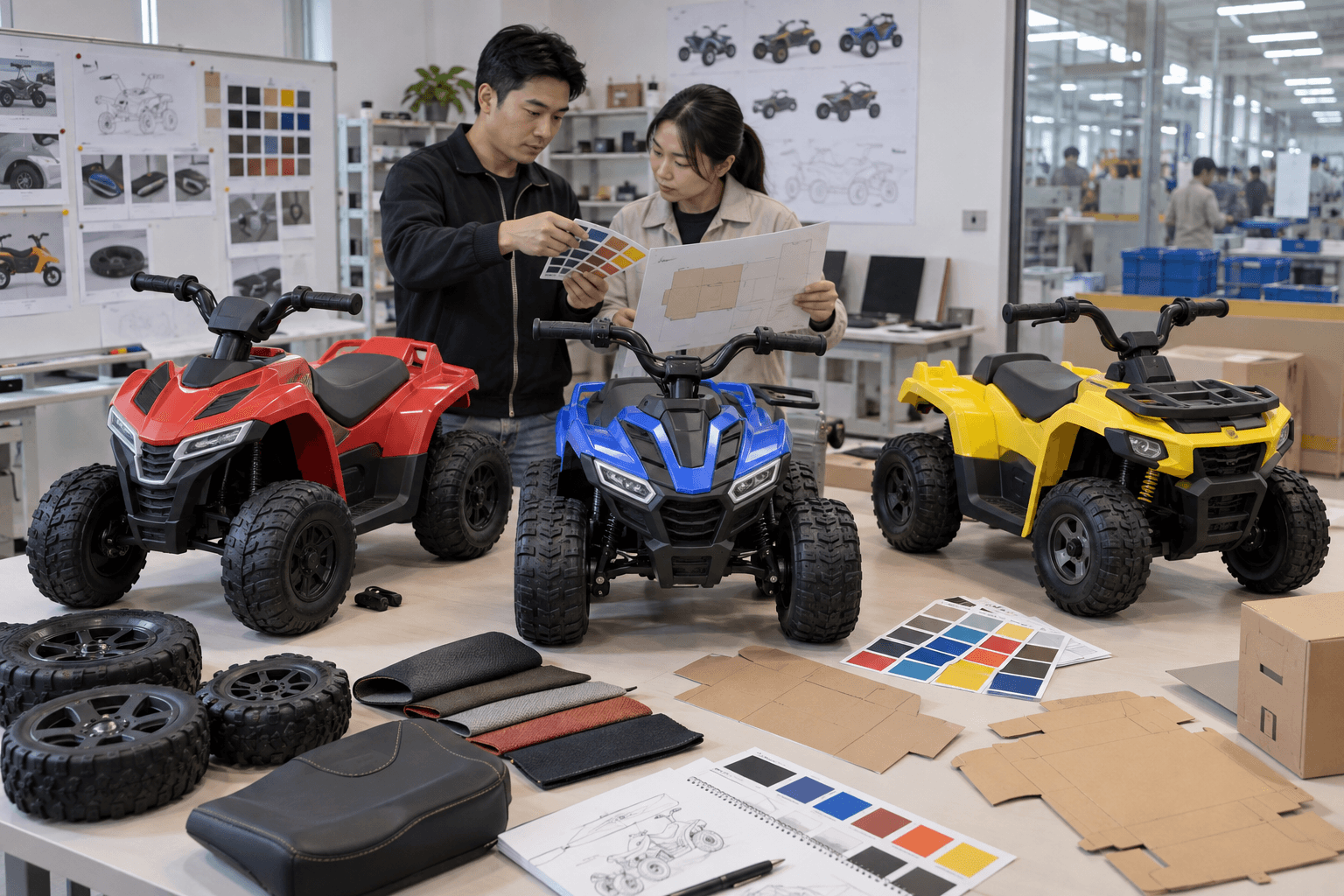
Every accepted option should appear in the approved sample record and purchase specification. Avoid informal changes made only in chat messages. Ask for an updated revision whenever the configuration changes, and make sure the inspection team receives the same revision used by purchasing and production.
Review the CubRover OEM and ODM program to see how product platform, finish, packaging, and market preparation can be organized around a buyer brief.
Warning signs during supplier evaluation
- The supplier quotes before confirming destination market, age range, or required functions.
- Product specifications change between the quotation, sample, and order documents without a revision record.
- Certificates are presented without a clear connection to the exact model and configuration.
- Customization is described as unlimited, with no discussion of tooling, testing, MOQ, or lead-time impact.
- The inspection plan is limited to appearance and quantity while electrical and functional checks remain undefined.
- Packaging is postponed until after production or carton dimensions are not confirmed before shipment planning.
One warning sign does not automatically disqualify a supplier, but it should trigger a specific follow-up. Strong partners explain constraints, identify missing information, and document decisions. Overconfident answers are less valuable than a transparent technical review.
Conclusion: choose the process behind the product
The best sourcing decision is not necessarily the lowest quotation or the model with the longest feature list. It is the supplier and platform combination that can meet the buyer’s market, product, documentation, packaging, and delivery requirements with a controlled path from sample to shipment.
Start with a written brief, compare complete configurations, verify the sample record, define inspection points, review model-specific compliance files, and approve packaging early. This approach gives buyers a stronger basis for quotation comparison and reduces avoidable changes after production begins.
Frequently asked questions
What information should I send before requesting a quotation?
Send the destination market, intended age range, preferred voltage, target quantity, retail channel, required functions, packaging expectations, and target timeline. A clear brief helps the supplier compare suitable platforms and identify which requests require engineering review.
Should I choose a 6V, 12V, or 24V children’s ATV?
Choose the platform from the intended age grading, vehicle size, target performance, terrain assumptions, product positioning, and destination-market requirements. Voltage alone does not define suitability. Review the full vehicle specification, motor arrangement, battery, speed settings, braking behavior, and tested configuration.
What should an approved sample record contain?
The record should identify the exact model, colors, graphics, components, functions, accessories, labels, manual, carton artwork, protection method, and any agreed deviations. Photos are useful, but they should support—not replace—a written specification that purchasing, production, and inspection teams can follow.
Can one certificate cover every customized model?
Usually not. Reports and certificates relate to a defined sample, construction, materials, components, and test scope. Changes to batteries, chargers, motors, electronics, materials, dimensions, or age grading may affect applicability. Confirm the exact report-to-product relationship with a qualified laboratory or compliance specialist.
When should packaging be reviewed?
Review packaging during sample approval, not after batch production. Confirm carton dimensions, internal protection, accessory placement, manuals, warnings, shipping marks, barcode location, drop-test expectations, and loading assumptions before the purchase order is released.
What should be checked before shipment?
The final plan commonly includes quantity, appearance, assembly, electrical functions, forward and reverse operation, steering, stopping behavior, included parts, labels, manuals, carton condition, shipping marks, and loading records. The exact plan should be agreed for the model and order.
Send CubRover your product requirements
Share your destination market, target age, voltage platform, quantity, feature priorities, packaging needs, and desired timeline. We can use that brief to review the most suitable starting platform and quotation scope.
Request a Product Review