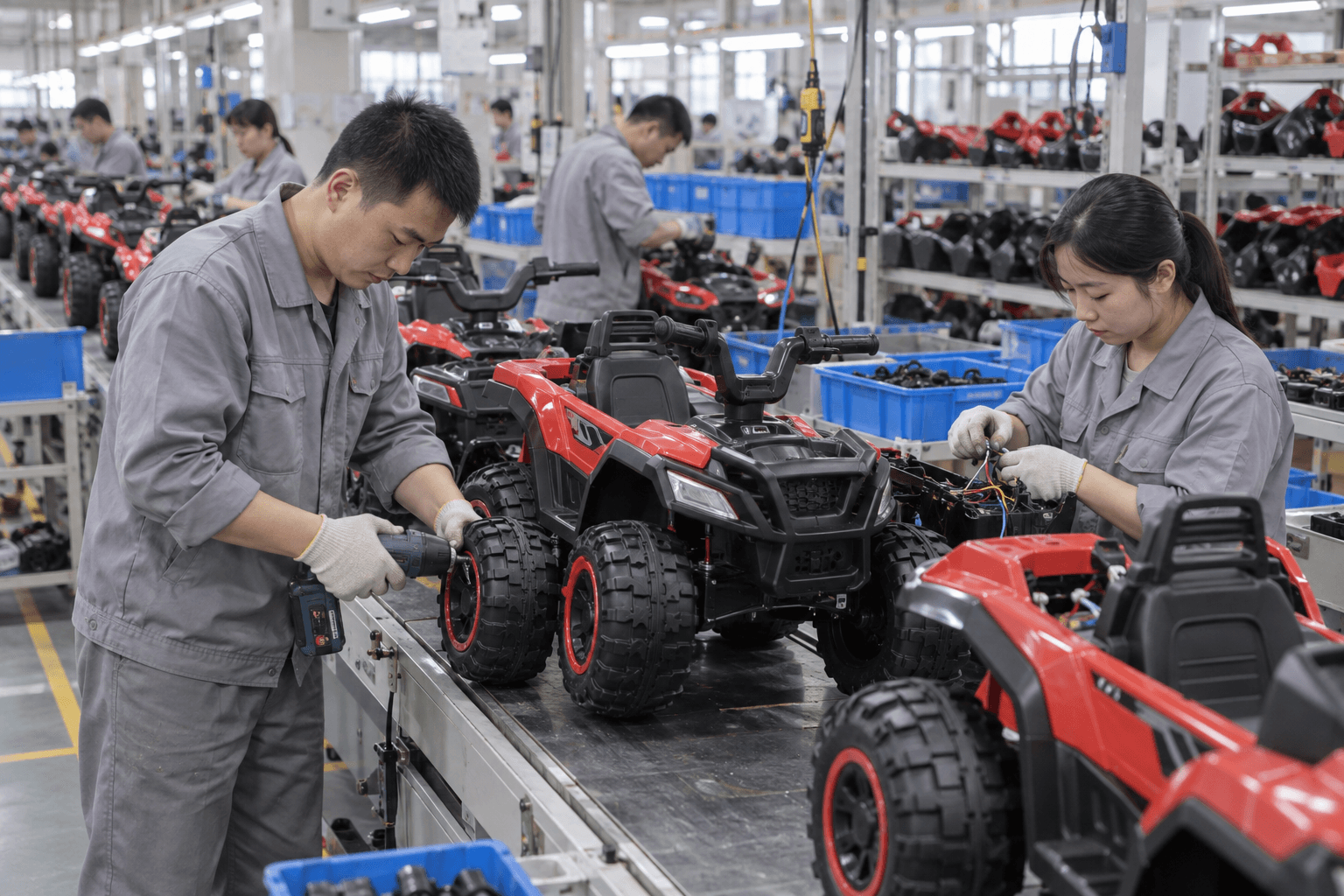
The short answer
A kids ATV factory audit should verify the legal and operating entity, product and process capability, supplier controls, approved-sample system, bill-of-materials control, incoming inspection, assembly instructions, testing, nonconforming-product handling, traceability, packing, and corrective action. Certification can support due diligence, but buyers still need model-specific evidence that the factory can build and inspect the exact product ordered.
A polished showroom and a quality certificate do not prove that a factory can repeat an approved children’s ATV across a production batch. For importers, the useful question is whether the supplier controls the people, materials, equipment, instructions, tests, records, and changes that determine the product actually shipped.
This guide turns the high-intent searches “kids ATV factory audit,” “kids electric ATV quality inspection,” and “ride-on toy quality-control checklist” into a practical buyer workflow. It is not a substitute for a qualified auditor, laboratory, or destination-market compliance review. It helps sourcing teams define what evidence to request and how to connect an audit finding to purchasing and shipment decisions.
1. Define the audit purpose, product, and decision before the visit
A factory audit should answer a purchasing decision, not produce a generic score. State whether the visit supports supplier qualification, a new model launch, corrective-action follow-up, capacity confirmation, or an annual review. Identify the exact product families, destination markets, order quantities, customization, required processes, expected shipment window, and critical risks.
Separate three questions. A system audit asks whether the organization has repeatable controls. A process audit follows how a specific product is made and checked. A product inspection evaluates selected finished units against agreed criteria. One activity can inform another, but a system certificate does not replace a product inspection, and a passing sample does not prove the management system is effective.
Write the audit brief in decision language
- Confirm the manufacturing site, legal entity, subcontracted processes, and product scope.
- Name the models, revisions, critical components, special processes, and customization to be reviewed.
- List required destination-market documents without assuming one report covers every variant.
- Define high-risk areas such as batteries, chargers, wiring, drivetrain, steering, fasteners, labels, and pack-out.
- State who receives findings, how evidence will be graded, and which findings block sample or order approval.
- Set the date for corrective-action evidence and any follow-up visit or production inspection.
Send the brief before the visit. A supplier that understands the scope can prepare responsible personnel and controlled records. Last-minute document collection often produces screenshots and disconnected files that are difficult to verify.
2. Review the document pack before walking the production floor
Document review helps the auditor identify what should exist on the floor. Request the business registration, organization chart, site and process scope, quality manual or process map, relevant certification details, recent internal-audit and management-review evidence, equipment list, calibration program, approved-supplier controls, complaint trends, and examples of corrective action.
For the target kids ATV, request the current specification, bill of materials, drawings, wiring information, approved sample record, risk or technical review, test plan, work instructions, inspection standards, packing specification, labels, manual, and change history. Sensitive commercial information can be handled under an appropriate confidentiality agreement, but the buyer still needs sufficient evidence to assess control.
| Evidence | Buyer question | Warning sign |
|---|---|---|
| Organization and site scope | Who owns purchasing, production, quality, engineering, and release? | Responsibilities exist only in informal chat |
| Controlled product file | Can staff identify the current approved revision? | Conflicting spreadsheets or undated artwork |
| Supplier and incoming controls | How are critical parts approved and checked? | Purchasing substitutes by price without review |
| Test and calibration records | Are methods and equipment fit for the decision? | Pass marks without method, limits, or equipment ID |
| Complaint and CAPA records | Does the factory learn from repeated issues? | Every complaint is classified as user error |
| Training and work instructions | Can operators perform the current process consistently? | Instructions are generic or unavailable at the station |
Verify dates, revision numbers, model identifiers, signatures or approvals, and links among records. A thick binder is not evidence if its documents describe another site or product. Select a few records and trace them from customer requirement to purchasing, assembly, inspection, and release.
3. Follow one product through the real factory flow
Walk the actual route used by the order: receiving, quarantine, incoming inspection, storage, molding or fabrication where applicable, subassembly, electrical assembly, final assembly, end-of-line testing, repair, packing, finished-goods storage, and loading. Record which steps occur at the audited site and which are subcontracted.
Capacity should be supported by a process calculation, not a statement about monthly output. Review available shifts, equipment, line balance, bottlenecks, test time, changeovers, trained operators, material lead times, rework, and other confirmed orders. Peak output achieved for a simple model may not apply to a customized ATV requiring different components, artwork, tests, or packing.
Observe conditions that records may not reveal
- Are incoming materials identified and separated by inspection status?
- Are batteries, chargers, motors, controllers, wheels, and printed items protected and traceable?
- Do operators have the correct revision at the workstation?
- Are tools, fixtures, gauges, and test equipment maintained and suitable?
- Are nonconforming parts physically controlled so they cannot return to production by accident?
- Does packing use the approved internal protection, accessories, manual, and shipping marks?
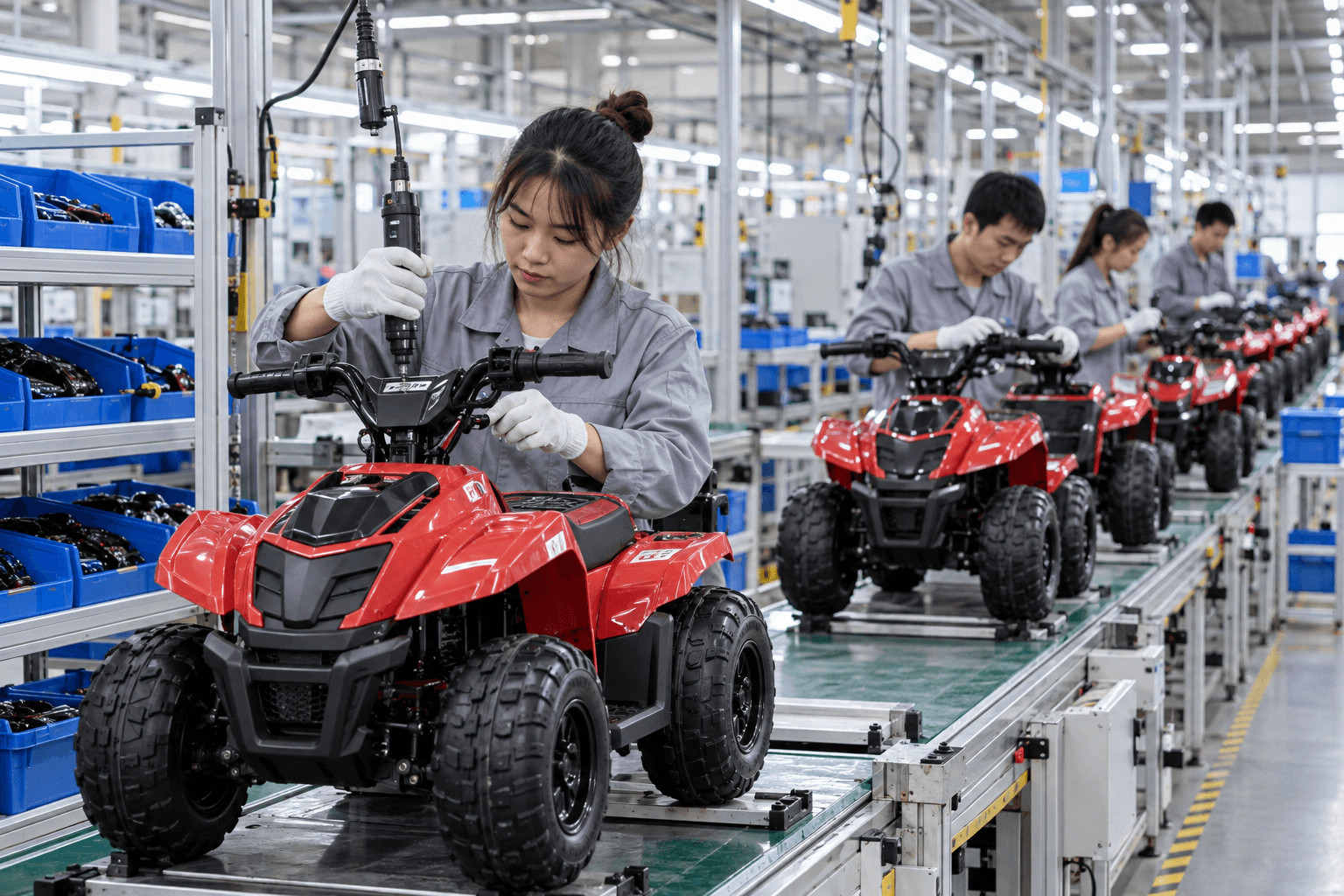
The CubRover manufacturing workflow shows the product brief, sample, production, inspection, pack-out, and loading gates that buyers can use to structure this review.
4. Test whether the quality system works beyond the certificate
A quality-management certificate can provide context, but buyers should verify its issuer, accredited scope, site address, product or activity scope, edition, issue and expiry status, and any transition information. A certificate does not mean every unit is defect-free, that a particular product complies with destination-market rules, or that the audited site controls every process.
ISO describes ISO 9001:2026 as a quality-management-system standard focused on consistently meeting customer and applicable requirements and improving the system. ISO also notes that certification is voluntary. Buyers should verify the exact certificate rather than writing “ISO factory” as a product claim.
Choose one recent nonconformity and follow it. Was the affected material isolated? Was the scope checked across other units, orders, or models? Did the factory identify a cause rather than restating the defect? Did the action change the process, training, supplier control, fixture, test, or specification? Was effectiveness verified after implementation?
Then choose one product change. Compare the request, technical review, sample, bill of materials, test evidence, artwork, instructions, approval, purchasing record, and production revision. Silent substitutions are a major risk in battery-operated ride-on programs because an apparently similar charger, controller, motor, connector, or plastic can change function and the relevance of existing evidence.
5. Audit supplier approval, incoming inspection, and traceability
The final assembly factory depends on its component supply chain. Ask how suppliers are selected, approved, monitored, and re-evaluated. Critical items should have defined specifications and incoming controls appropriate to their risk. A purchase description such as “12V motor” or “black wheel” is rarely enough to prevent substitution.
Review actual incoming records for batteries, chargers, motors and gearboxes, controllers, switches, wiring, connectors, wheels, axles, fasteners, plastics, coatings, labels, cartons, and manuals. Confirm sampling, checks, acceptance limits, lot identity, disposition, and inspector. Where material or component testing is outsourced, connect the report to the received lot and controlled specification.
| Component | Identity and inspection examples | Why traceability matters |
|---|---|---|
| Battery | Model, chemistry, voltage, capacity marking, connector, dimensions, lot, condition | Charging, runtime, fit, shipping, and service decisions |
| Charger | Model, input/output, plug, polarity, connector, labels, functional sample | Destination fit and electrical-system compatibility |
| Motor/gearbox | Part number, rating, ratio, connector, rotation, noise sample | Drive behavior, current demand, replacement parts |
| Controller/wiring | Revision, functions, protection, connector map, workmanship | Modes, soft start, stopping logic, troubleshooting |
| Wheel/axle | Construction, dimensions, tread, runout, hub fit, axle interface | Tracking, noise, grip, durability, service |
| Printed materials | Artwork revision, language, barcode, model, warnings, legibility | Compliance, retail identity, traceability |
Traceability depth should match risk and business need. The buyer should be able to connect a finished batch to key component lots and production dates strongly enough to investigate complaints and contain an issue. An unreadable handwritten code that no one can interpret is not functional traceability.
6. Connect the approved sample to production controls
The approved or golden sample should be a controlled reference, not a dusty display unit. It needs a model and revision, approval date, condition record, photographs, component configuration, functions, labels, manual, accessories, packaging, and accepted deviations. Define who can access it and how replacement or deterioration is handled.
At the line, the same requirements should appear in practical form. Operators need visual and written instructions for the task they perform. Quality checkpoints should occur early enough to prevent a hidden problem from reaching finished goods. For example, wiring routing and connector engagement are easier to verify before body panels close the assembly.
Useful in-process checkpoints may include
- Model, color, artwork, and component identity at material issue.
- Battery restraint, wiring route, polarity, connector engagement, protection, and clearance.
- Motor and gearbox fit, axle and wheel assembly, steering movement, suspension hardware, and fasteners.
- Forward, reverse, speed modes, soft start, lights, sound, remote functions, and stopping response where applicable.
- Surface condition, labels, manual, charger, hardware, accessories, and model identification.
- Pack-out layers, product restraint, carton closure, barcode, shipping marks, gross weight, and final quantity.
7. Separate engineering validation, line testing, and shipment inspection
Engineering validation determines whether a design or change meets defined requirements. Routine end-of-line testing checks repeatable functions on production units. Pre-shipment inspection samples finished goods for identity, quantity, workmanship, function, labels, accessories, packaging, and agreed tests. Each needs its own method and acceptance decision.
Ask the factory to demonstrate a test. The record should identify the product, configuration, load or fixture, battery state, surface or equipment, duration, measurement, limits, result, operator, date, and equipment status. A green sticker is meaningful only if the process behind it is controlled.
If an inspection uses an acceptance-sampling approach, agree the lot definition, inspection level, sampling method, defect classes, and acceptance limits before production finishes. Do not copy a generic AQL value without considering safety, regulatory, functional, visual, packaging, and contractual risks. Some findings require immediate containment regardless of the statistical result.
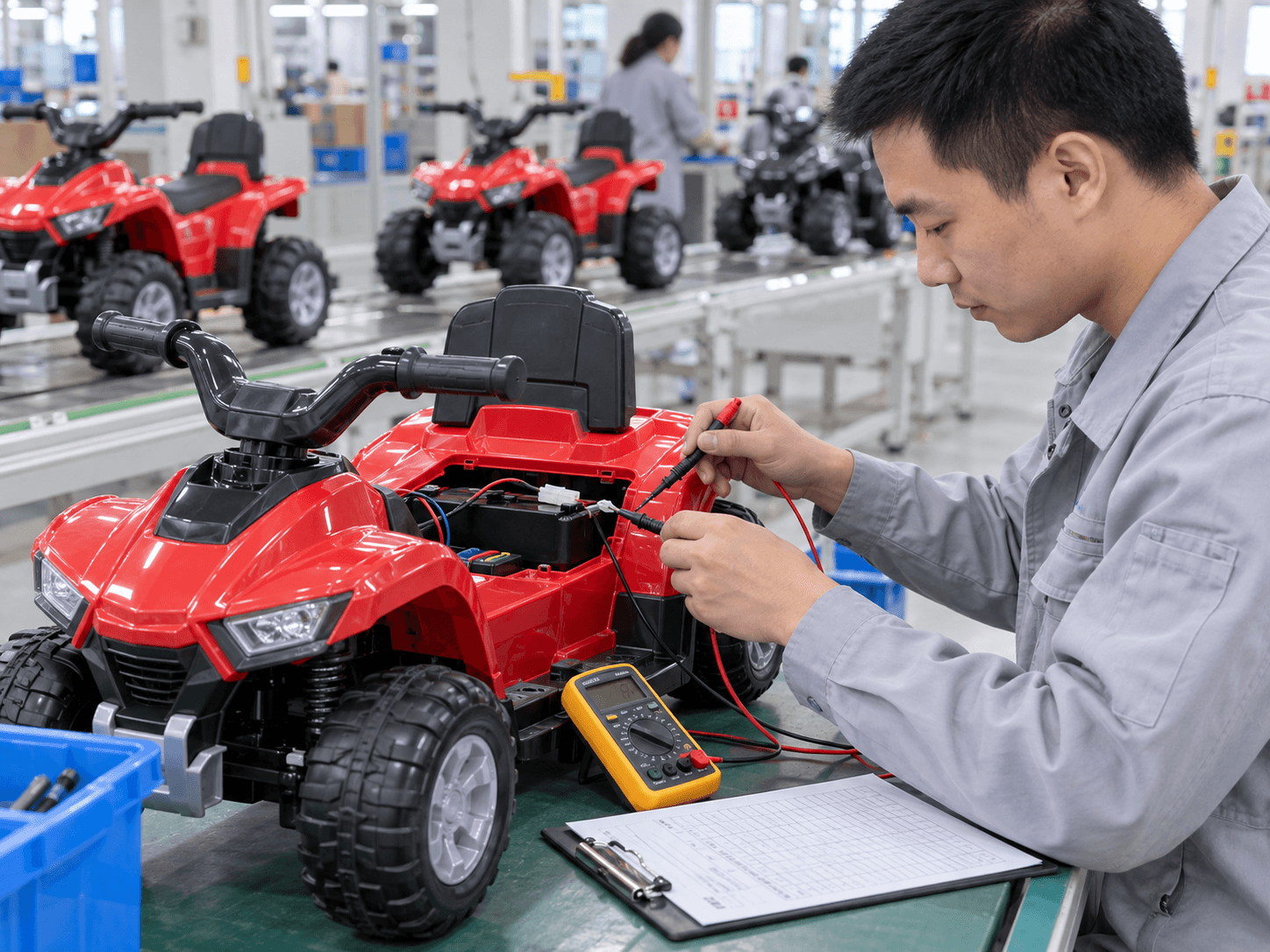
Use the CubRover quality-control page for the factory checkpoint overview and the pre-shipment inspection guide for finished-goods sampling and pack-out review.
8. Turn audit findings into controlled action and sourcing decisions
Classify findings by their effect on product safety, compliance, specification, function, reliability, traceability, packaging, and delivery. Support each finding with objective evidence: document title and revision, record sample, observation, model, photograph reference, or interview confirmation. Avoid broad statements such as “quality system weak” that give the factory no actionable path.
A corrective-action response should contain immediate containment, affected scope, cause analysis, corrective action, owner, due date, evidence, and effectiveness check. Replacing one defective part addresses the observed unit; it does not automatically prevent recurrence. The buyer should decide whether evidence can be reviewed remotely or whether a follow-up audit, sample, pilot run, or inspection is required.
| Result | Buyer action | Release condition |
|---|---|---|
| Acceptable control | Proceed to controlled sample or order gate | Normal approvals and inspections remain |
| Minor gaps | Approve documented correction plan | Evidence closed by agreed milestone |
| Major system or process gap | Pause affected program activity | Verified CAPA and focused follow-up |
| Critical integrity, safety, or traceability concern | Do not release affected product | Escalated investigation and qualified review |
Conclusion
A professional kids ATV factory audit does not search for a perfect score. It tests whether requirements survive the journey from buyer brief to purchased components, assembly, testing, packing, and release. Define the decision, trace real records, observe real production, challenge change control, and close findings with evidence. That is how an audit reduces sourcing risk instead of becoming a certificate-collection exercise.
Frequently asked questions
What should a kids ATV factory audit include?
It should cover the operating entity, site scope, product capability, supplier controls, approved samples, specifications, incoming inspection, production controls, testing, nonconforming material, traceability, packaging, complaints, and corrective action.
Is an ISO 9001 certificate enough to approve a kids ATV factory?
No. It can support due diligence, but buyers should verify the certificate and still assess model-specific capability, process control, product evidence, inspection, and compliance responsibilities.
What is the difference between a factory audit and pre-shipment inspection?
A factory audit evaluates systems and processes, while a pre-shipment inspection evaluates a defined sample of finished goods against agreed requirements. Many programs use both at different decision points.
How should a golden sample be controlled?
Identify its model, revision, date, configuration, functions, labels, manual, accessories, packaging, photos, approvals, and accepted deviations. Define storage, access, condition checks, and replacement rules.
Should an importer use AQL for kids ATV inspection?
Acceptance sampling can support inspection planning, but the buyer must define the lot, defect classes, levels, methods, and special treatment of safety or compliance findings. A generic AQL number is not a complete inspection plan.
How are factory-audit findings closed?
Use containment, scope review, cause analysis, corrective action, ownership, timing, evidence, and an effectiveness check. Significant findings may require a follow-up audit, sample, pilot run, or reinspection.
Turn factory claims into verifiable evidence
Share your product family, market, order stage, critical risks, audit scope, and timing. CubRover will help structure the review around the product that must actually ship.
Contact Us