The short answer
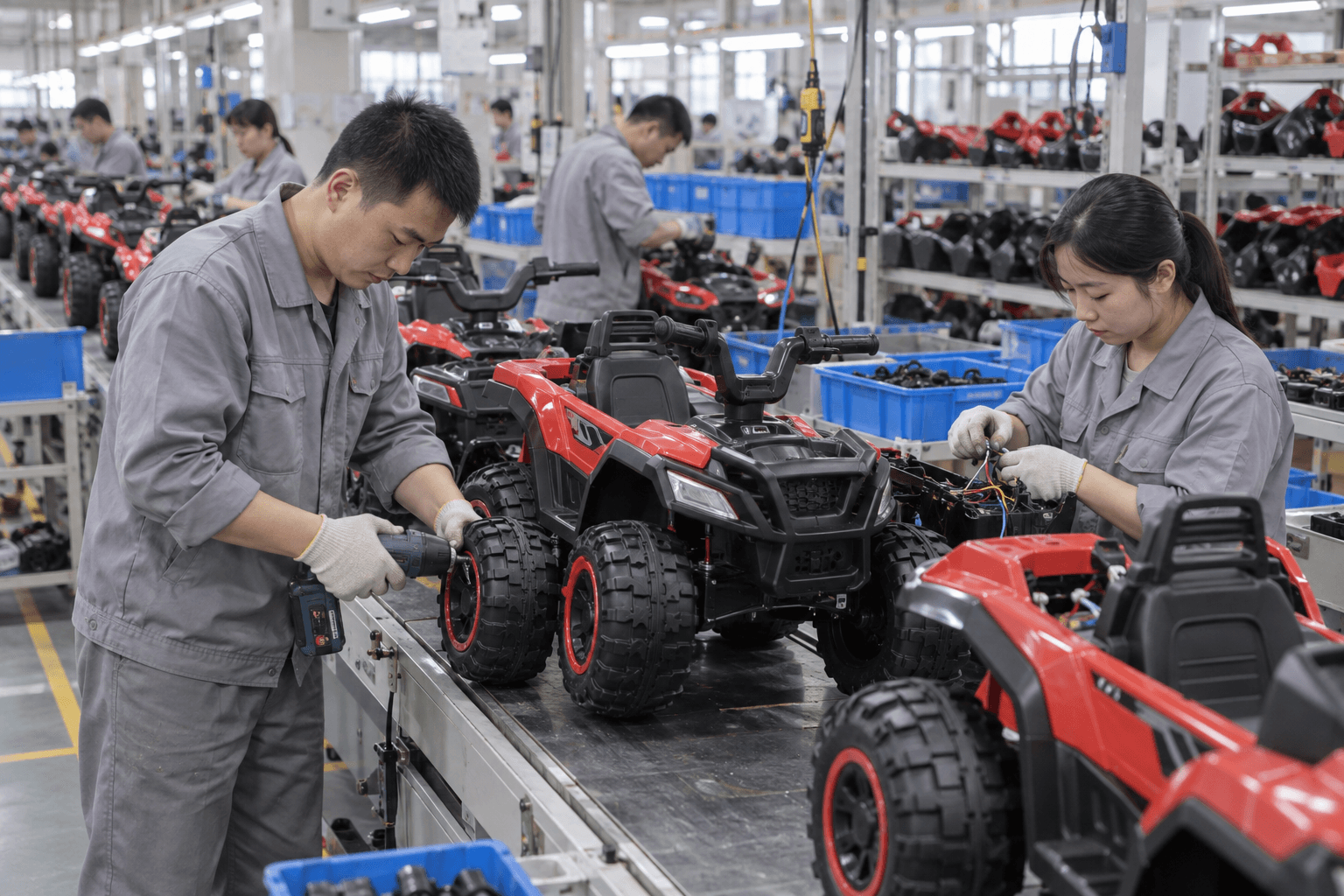
Kids ATV MOQ, wholesale price, and lead time depend on the exact platform, component configuration, customization, packaging, testing, material availability, order mix, and production calendar. Buyers should request an itemized quotation tied to a controlled specification and separate sample, tooling, testing, packaging, inspection, freight, and recurring unit costs before comparing suppliers.
“What is your best price?” and “How quickly can you ship?” are reasonable opening questions, but they do not create a reliable sourcing comparison. Two quotations with the same product photograph may describe different batteries, motors, controllers, wheels, chargers, functions, materials, cartons, inspections, and documentation. The lower number may simply exclude something the buyer assumed was included.
This guide explains how kids ATV wholesale price, minimum order quantity, sample cost, and production lead time are built. It is designed for importers, distributors, retailers, and private-label buyers that want a defensible landed-cost comparison. It does not publish invented price ranges or universal factory promises; exact commercial terms must be quoted for the confirmed model, order, destination, and date.
1. Why kids ATV wholesale quotations differ
The product platform is the first cost driver. A compact 6V mini quad, a core 12V electric ATV, a larger 24V adventure quad, and a pedal-powered model use different bodies, drivetrains, batteries, electronics, materials, cartons, assembly time, and container space. Voltage is only a label for part of the system.
Within one platform, the component list can change substantially. A quotation may use one or two motors, a different battery capacity, plastic or EVA-style wheels, basic or upgraded controls, alternative lights and sound, a different charger, additional accessories, or private-label packaging. Unless the supplier identifies the quoted configuration, the price cannot be audited.
Ask every supplier to quote the same commercial baseline
- Exact model and revision, product size, net weight, voltage, battery, motor arrangement, controller, charger, and wheel type.
- Standard functions, optional functions, accessories, hardware, labels, manual, and spare-parts expectations.
- Body color, graphics, logo, barcode, carton artwork, internal protection, and pack-out.
- Order quantity by model and color, mixed-order assumptions, Incoterm, loading port, and currency.
- Sample, tooling, testing, inspection, documentation, and other non-recurring charges.
- Quotation validity, payment terms, component lead time, production time, and shipment readiness assumptions.
A good quotation makes exclusions visible. If freight, duties, destination charges, third-party testing, external inspection, tooling, sample delivery, or artwork work is excluded, that should be stated. Transparency is more useful than a low headline number that changes after sample approval.
2. What determines the minimum order quantity?
MOQ is not only a factory policy. It often reflects how materials, components, printing, color batches, line changeovers, cartons, and logistics are purchased or scheduled. An existing standard model in a standard color may support a different minimum from a custom pigment, printed carton, new decal set, or exclusive component.
A supplier may quote several minimums: a model MOQ, a color MOQ, an artwork MOQ, a packaging MOQ, or a total order MOQ. Buyers should ask which limit creates the constraint. If a carton printer requires a larger batch than final assembly, the factory may offer a plain carton with labels for a pilot order and printed cartons at a later volume.
| MOQ driver | Why it matters | Buyer option to discuss |
|---|---|---|
| Standard model availability | Existing components and instructions reduce setup | Begin with a proven platform |
| Custom body color | Pigment and molding runs may require batch volume | Use standard color for pilot order |
| Decals and logo | Printing setup and minimum sheets | Combine artwork efficiently |
| Printed carton | Board and print supplier minimums | Use neutral carton plus approved label |
| Component option | Supplier pack quantity or special purchasing | Select validated standard component |
| Mixed models or colors | More changeovers and material coordination | Limit first order variants |
Low MOQ can be valuable for market testing, but it may increase unit cost, artwork cost per unit, component risk, and production complexity. The right minimum is the smallest order that still supports a stable product, acceptable landed cost, clear quality plan, and realistic replenishment route.
3. Separate unit price from total program cost
A buyer should calculate the cost of launching and landing the program, not only the ex-factory unit price. Non-recurring costs can include samples, sample freight, tooling, artwork preparation, packaging development, laboratory work, document review, external inspection, and retail setup. Recurring costs include the product, packaging, spare parts, freight, duties, warehousing, and expected support or return costs.
Packaging volume can outweigh a small unit-price saving. A larger carton may reduce the number of units per container, increase warehouse space, or create parcel surcharges. A cheaper internal pack-out may produce more scuffs, broken parts, missing hardware, and customer-service claims. These costs appear after shipment, but they belong in the sourcing decision.
| Cost group | Examples | Comparison question |
|---|---|---|
| Product | Vehicle, charger, accessories, retail pack | Is the configuration identical? |
| Development | Samples, tooling, artwork, prototypes | Is this one-time or recurring? |
| Compliance and quality | Testing, document review, inspection | Who pays and what is included? |
| Logistics | Export carton, loading, freight, insurance | How many confirmed units fit? |
| Import and channel | Duty, tax, warehouse, marketplace fees | Which destination assumptions apply? |
| After-sales risk | Parts, replacements, returns, support | What evidence supports the risk estimate? |
4. Understand sample cost and what the sample proves
A sample price may be higher than the production unit price because it includes individual preparation, configuration work, packaging, handling, and limited purchasing. Express freight for a bulky ride-on product can also be material. Buyers should ask whether the sample charge, customization work, or freight is refundable or creditable under a later order, but should not assume it is.
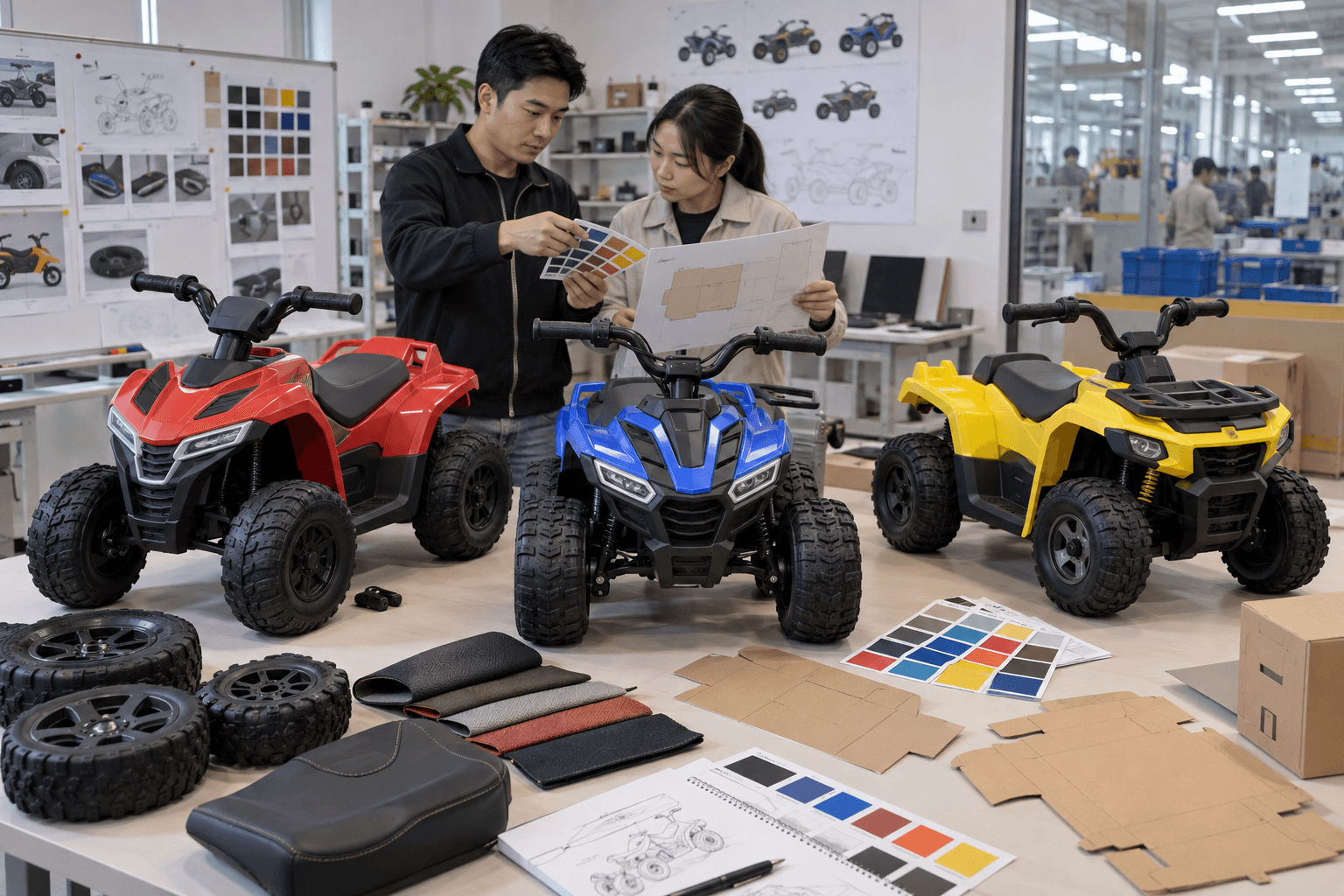
The more important question is whether the sample represents production. An early appearance sample may use temporary decals, substitute colors, prototype electronics, or non-final packaging. A production-representative sample should use the intended critical components, functions, labels, manual, accessories, hardware, and pack-out wherever possible.
Sample stages may include
- Platform sample to assess size, design, controls, and base performance.
- Customized appearance sample for color, graphics, logo, and feature placement.
- Engineering or function sample for a new component combination.
- Compliance sample prepared for an agreed laboratory assessment.
- Pre-production sample using final artwork, components, instructions, and pack-out.
- Shipment sample retained or selected from production for reference and after-sales analysis.
Define what each sample is intended to approve. A buyer should not approve final production packaging based on an unpacked showroom unit, or approve compliance configuration from a sample with substitute components. Record each sample revision and its limitations.
5. Build a realistic sample and production lead time
Lead time should be a sequence of dated gates rather than one optimistic number. A private-label order can include product selection, quotation, sample preparation, buyer evaluation, corrections, artwork translation, compliance review, material purchasing, production scheduling, assembly, inspection, rework, packing, and loading. Buyer approvals can be on the critical path.
Component availability is often decisive. Batteries, motors, controllers, chargers, molded colors, printed cartons, and custom decals may follow different supplier schedules. Peak-season capacity or holiday closures can affect purchasing and production. Ask the factory when the clock starts: deposit, final specification, artwork approval, compliance release, or material confirmation.
| Gate | Owner input | Completion evidence |
|---|---|---|
| Brief and quotation | Complete requirements and quantity | Comparable signed quotation |
| Sample | Selected platform and options | Approved sample revision |
| Artwork | Logo, languages, barcode, legal text | Released production files |
| Compliance review | Exact model and destination market | Required evidence and open issues resolved |
| Materials and production | Deposit and frozen specification | Finished batch and production records |
| Inspection and loading | Agreed criteria and shipping plan | Release report and loading record |
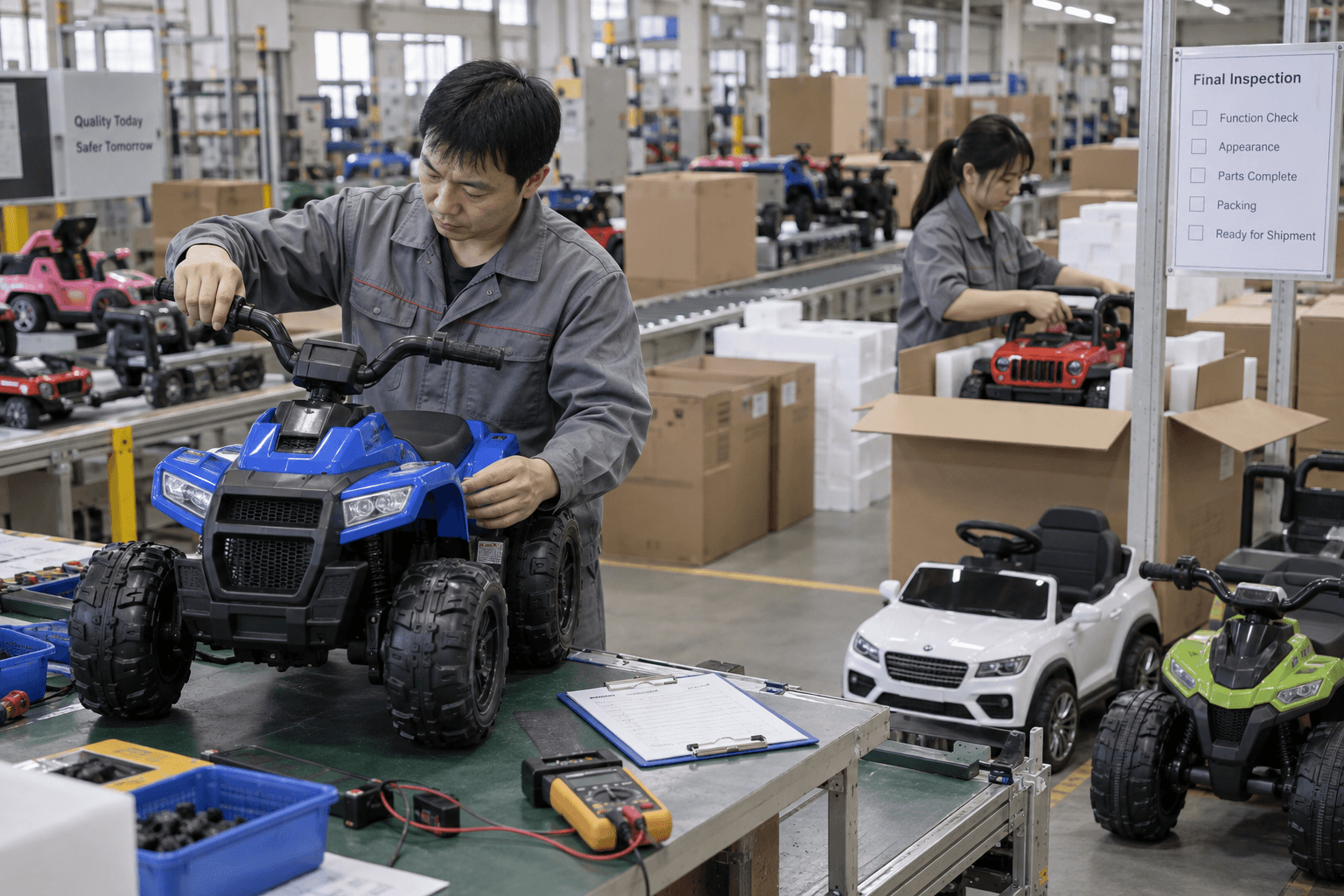
Allow contingency for corrective action. If inspection identifies a repeated defect, the schedule needs time for sorting, rework, replacement material, and reinspection. A promise that leaves no room for quality decisions encourages shipment pressure at the worst possible moment.
6. Verify carton data and container quantity
Container quantity should be calculated from confirmed production carton dimensions and a realistic loading pattern. Catalog carton data may describe another configuration, and theoretical cube calculations ignore door clearance, orientation, carton strength, bracing, voids, and practical handling.
Request net weight, gross weight, outer dimensions, units per carton, carton construction, and a loading illustration or record from a comparable order. Confirm whether wheels, handlebar, seat, guards, battery connection, or accessories are removed. These decisions affect both cube efficiency and installation preparation.
Use the packaging and pre-shipment inspection checklist to review pack-out, damage prevention, validation, carton inspection, and loading records.
Do not choose a product solely because it fits more units per container. A compact pack-out that creates difficult assembly, excessive surface contact, or weak protection can increase damage and support costs. Compare usable landed units, not only loaded cartons.
7. Link payment milestones to objective approvals
Payment terms are commercial risk controls, not just percentages. Buyers and suppliers should agree what must be completed before each milestone: confirmed specification, sample approval, artwork release, material purchase, production completion, inspection acceptance, and shipment documents.
The exact arrangement depends on the relationship, order, tooling, materials, and supplier policy. Whatever structure is agreed, it should identify currency, beneficiary, fees, timing, late approvals, order changes, cancellation, inspection, rework, and the documents required for the next step. Use appropriate financial and legal advice for significant transactions.
Avoid sending funds based solely on a product image or informal chat. Verify the contracting entity, bank account consistency, quotation or pro forma invoice, product specification, and responsible contacts. Keep commercial records connected to the same model, order, and revision used by quality and logistics teams.
Compliance work should also be budgeted against current official requirements. The U.S. CPSC Children’s Product Certificate guidance explains the importer or manufacturer certification framework for covered children’s products.
8. A quotation checklist for serious B2B comparison
- Confirm the supplier and contracting entity.
- Identify the exact model, revision, configuration, and approved options.
- State quantity by model, color, and packaging version.
- Separate standard product price from customization and non-recurring charges.
- Record Incoterm, port, currency, payment, validity, and exclusions.
- Confirm carton dimensions, gross weight, loading estimate, and shipment method.
- Define sample stages, artwork approvals, compliance review, and inspection.
- Use a milestone schedule with owners, evidence, and contingency.
A professional buyer does not need the longest quotation. The buyer needs one that allows a second person to understand exactly what is being purchased and how the order will be approved. If critical assumptions remain in chat messages, consolidate them before paying a deposit.
For supplier due diligence, continue with How to Choose a Children’s Electric ATV Manufacturer. For platform selection, compare 6V, 12V, and 24V kids ATVs.
Conclusion
MOQ, wholesale price, sample cost, and lead time are outputs of a defined program. Establish the exact vehicle, customization, quality plan, packaging, commercial terms, and schedule before comparing numbers. The most useful quotation is not automatically the cheapest or fastest; it is the one that remains accurate after sample approval and shipment inspection.
Frequently asked questions
What is the MOQ for a wholesale kids ATV order?
MOQ depends on the model, color, component options, custom graphics, printed carton, supplier purchasing minimums, and production plan. Ask for model, color, packaging, and total-order minimums separately.
Why is the sample price higher than the wholesale unit price?
A sample may require individual preparation, customization, handling, and express freight without production-scale purchasing. Ask what the sample represents and whether any charge is creditable against a later order.
What affects kids electric ATV wholesale price most?
The base platform, battery, motors, controller, charger, wheels, functions, materials, customization, packaging, quantity, inspection, testing, and commercial terms all affect the quotation.
How long does kids ATV production take?
There is no universal lead time. It depends on sample and artwork approval, compliance review, component availability, order size, customization, factory schedule, inspection, and corrective action. Request a milestone plan tied to your order date.
How many kids ATVs fit in a 40HQ container?
The answer depends on the confirmed outer carton dimensions, orientation, loading pattern, practical clearance, and product mix. Use production pack-out data rather than a generic catalog estimate.
What should I send to get an accurate quotation?
Send the market, exact model or voltage range, quantity, required functions, color and brand scope, packaging channel, documentation expectations, Incoterm, sample timing, and target shipment date.
Request a quotation buyers can actually compare
Share your destination market, target platform, quantity, configuration, branding, packaging, Incoterm, and schedule. CubRover will organize the quote around clear assumptions.
Get a Quote