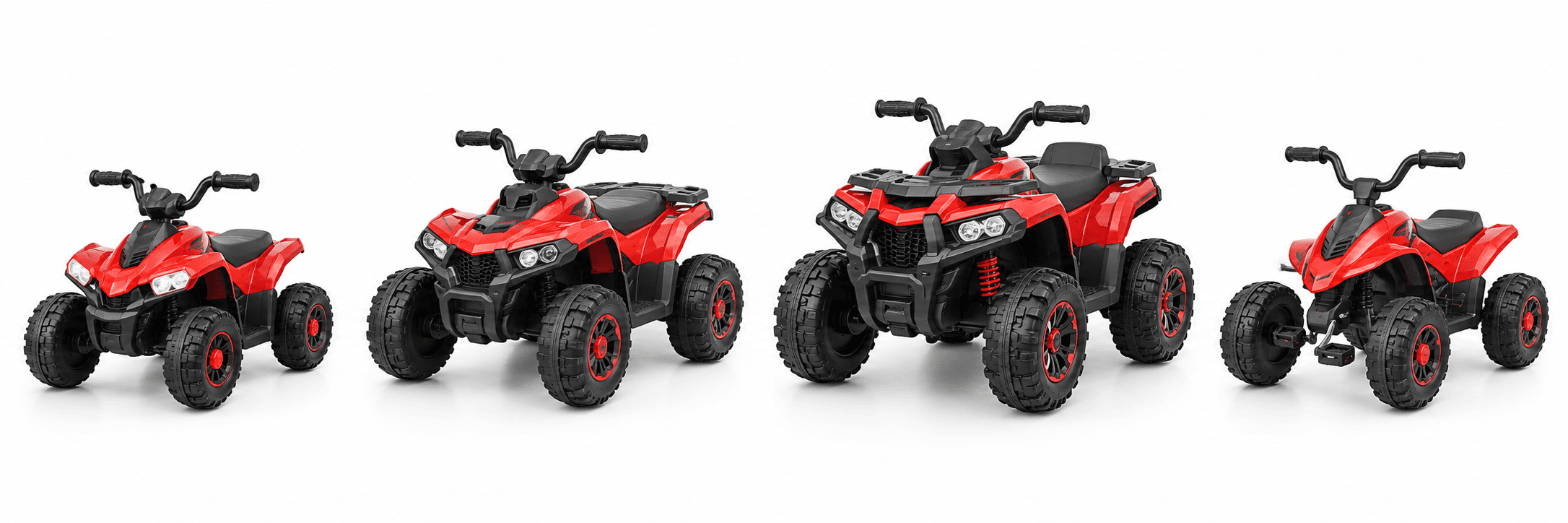
The short answer
Choose a kids ATV drive configuration by application, not by the largest motor count. Plastic wheels can suit controlled hard surfaces and value-focused programs; EVA-style tread bands may change noise and grip characteristics but are not equivalent to pneumatic tires. Single, dual, and four-motor layouts must be assessed together with motor rating, gearing, wheel diameter, battery, controller, vehicle mass, steering, stopping behavior, and test conditions. Buyers should approve a production-representative sample and define repeatable factory tests before ordering.
Motor count and wheel type are among the most visible specifications in a children’s electric ATV quotation. They are also among the easiest to misunderstand. A listing may highlight “four motors,” “4WD,” “EVA wheels,” or “high speed” without explaining the motor rating, gearbox ratio, tire construction, controller logic, battery under load, vehicle mass, intended surface, or conditions behind a performance statement.
For importers, distributors, and private-label buyers, the commercial question is not which specification sounds strongest. It is which complete configuration creates predictable operation for the intended age range, market, terrain, supervision model, price position, carton, and after-sales plan. This guide provides a structured way to compare drive systems and turn marketing terms into an inspectable product specification.
1. Define the product application before selecting components
Begin with the user and use environment. A compact quad intended for younger riders on level, dry, private property has different priorities from a larger model expected to cross short grass or slightly uneven ground. Neither should be described as suitable for public roads, steep slopes, deep water, loose traffic areas, or unsupervised use. The responsible buyer must align the intended use, warnings, instructions, and applicable requirements for each destination market.
Document the expected rider range, maximum permitted load, typical surface, acceptable speed modes, adult-control expectations, session pattern, storage conditions, charging environment, assembly preparation, and retail price position. Avoid choosing the drivetrain before this brief exists. Otherwise, a component upgrade can add cost and weight without solving the actual customer requirement.
A useful application brief answers these questions
- Who is the intended user, and what age, size, ability, and supervision assumptions will the product communication make?
- Will the vehicle mainly operate on smooth pavement, indoor flooring, compacted paths, short grass, or another defined private surface?
- What gradients, obstacles, moisture, temperature, and storage conditions are outside the intended use?
- Which controls are required: pedal, push-button start, forward and reverse, high and low speed, soft start, remote stop, or another market-specific function?
- What battery, charger, run-session, charging, maintenance, assembly, and spare-part expectations must the program support?
- Which claims must be demonstrated on the approved configuration rather than copied from a generic catalog?
If the platform is not yet selected, start with the 6V vs 12V vs 24V kids ATV buyer guide. Voltage class can narrow the range, but the final decision still depends on the complete system.
2. Plastic wheels vs EVA-style wheels: what buyers should compare
“Plastic wheel” normally describes a molded rigid wheel, while “EVA wheel” in the ride-on market often means a molded wheel or hub with an EVA foam tread layer or ring. Construction varies by supplier and model. Buyers should request a section photograph, material description, dimensions, weight, attachment method, hardness or density information where meaningful, and an actual sample rather than relying on one label.
Rigid molded wheels are common because they are durable, consistent, relatively light, and simple to maintain. Their noise, vibration, and traction depend on tread pattern, material, wheel diameter, surface, load, and chassis. EVA-style tread can reduce harsh contact noise and change grip on some surfaces, but foam can cut, compress, wear, separate, or collect visible damage depending on formulation and use. It should not be presented as an air-filled tire.
| Decision point | Rigid molded plastic wheel | EVA-style tread wheel |
|---|---|---|
| Construction | One-piece or assembled molded structure | Molded structure with foam tread element; verify design |
| Typical program role | Value, low maintenance, consistent production | Noise and ride-feel differentiation on defined surfaces |
| Surface behavior | Depends strongly on tread and hard-surface conditions | May change grip and damping; must be sample-tested |
| Durability concern | Wear, cracking, deformation, hub or axle fit | Wear plus cuts, compression, bonding, and tread damage |
| Maintenance | No inflation; inspect wear and attachment | No inflation; inspect foam and attachment condition |
| Verification | Material, dimensions, runout, tread, axle fit, load test | All plastic-wheel checks plus foam construction and adhesion |
Do not select EVA-style wheels only because they support a higher retail claim. Test the exact production-representative vehicle on each intended surface with the defined load and battery state. Observe starting, turning, stopping, vibration, noise, wheel slip, current draw, motor or gearbox temperature, tread condition, and steering effort. A change in grip can also change drivetrain load.
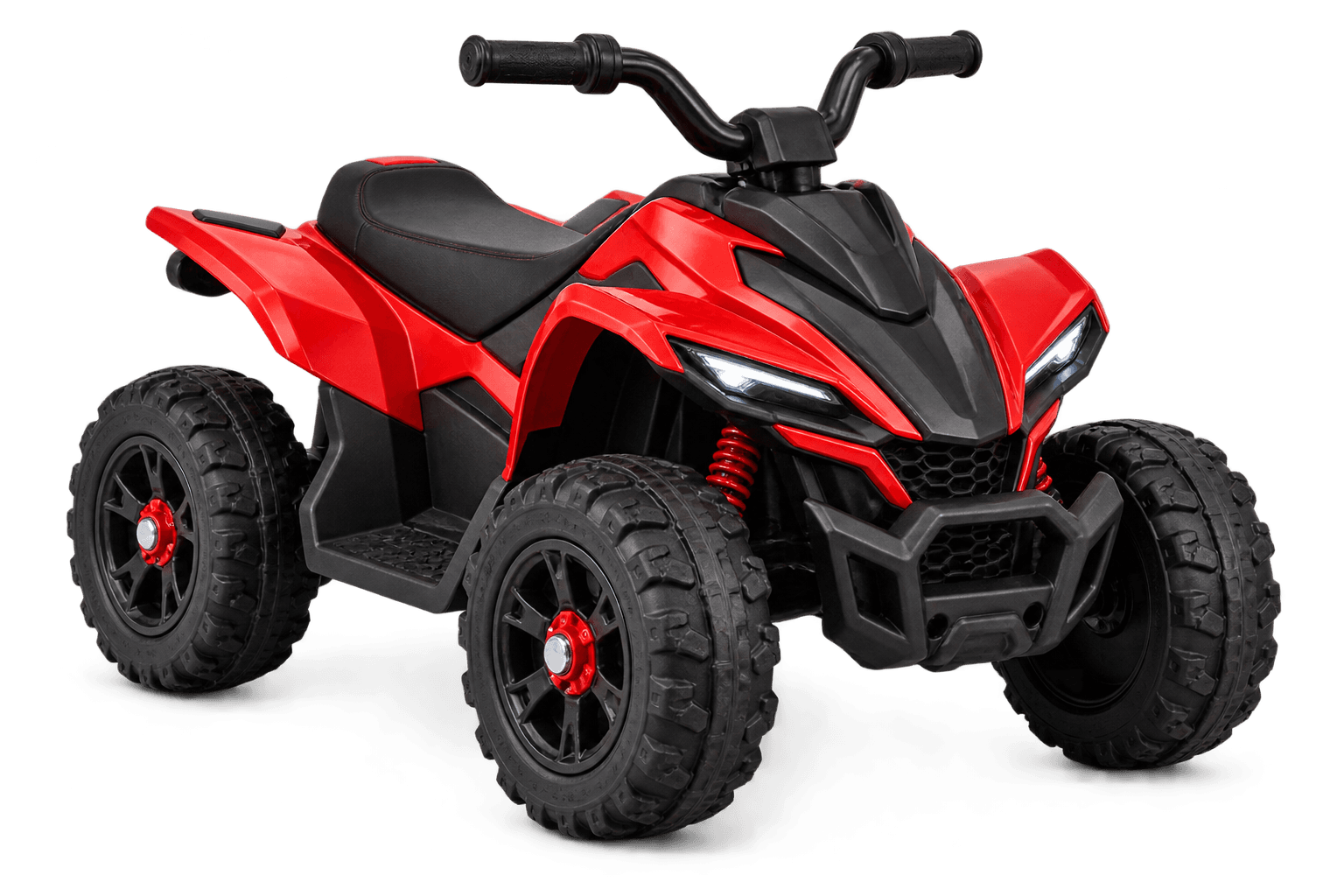
3. Single motor vs dual motor vs four-motor kids ATVs
Motor count indicates how many drive motors are installed, but it does not state total usable output or vehicle performance. Two small motors are not automatically stronger than one appropriately selected motor. Four motors do not automatically create better control. Motor rated voltage, rated and peak characteristics, gearbox, efficiency, controller current limits, wiring, battery voltage under load, wheel diameter, axle arrangement, vehicle weight, and software behavior all influence the result.
A single-motor layout can reduce parts, wiring, synchronization issues, weight, and replacement complexity. Dual-motor layouts can distribute drive across two wheels and are widely used for product positioning or improved operation under defined loads and surfaces. Four-motor layouts may drive four wheels, but they add electrical and mechanical interfaces and may increase current demand, inspection points, and after-sales parts. The best architecture is the simplest one that meets documented requirements with acceptable margins.
| Layout | Potential program benefit | Questions to verify |
|---|---|---|
| Single motor | Lower complexity and service-parts count | Driven axle, gearbox capacity, starting behavior, load margin |
| Dual motor | Drive distributed to two wheels; common step-up feature | Matched motors, wiring, controller limits, straight tracking, wheel slip |
| Four motors | Four driven wheel positions on some platforms | Actual independent drive, current demand, synchronization, thermal behavior, service access |
Ask for motor labels and supplier specifications, gearbox ratio, controller identification, fuse or protection details, wire and connector specifications, battery model, and wiring diagram. Confirm whether motors are identical and how the system behaves if one wheel loses traction, one connector is loose, or battery voltage falls during a session. These questions are more meaningful than multiplying a printed watt number.
4. What “4WD” should mean on a children’s electric ATV
In this category, “4WD” may be used for a vehicle with a motor at each wheel or another system that drives all four wheel positions. It should not be inferred from styling, four visible wheels, or a selectable dashboard label. The quotation, specification, sample, product label, manual, and retail claim should use consistent language.
Verify the physical drive path and control strategy. Determine whether all four motors operate in every forward mode, whether reverse uses the same arrangement, how high and low modes are controlled, and whether a “2WD/4WD” selection actually changes driven wheels or only speed. Record motor part numbers and connector positions so incoming inspection and after-sales teams can identify them.
Evidence to request for a 4WD claim
- A controlled bill of materials and wiring diagram showing four drive motors or the defined four-wheel drive path.
- Photographs or a video of the underside and wheel-drive interfaces on the approved sample.
- A functional test method that observes every driven wheel under a safe, repeatable condition.
- Loaded starting, low-speed, turning, stopping, and defined-surface results with battery state and test load recorded.
- Thermal and repeated-operation observations appropriate to the product design and intended use.
- Production inspection points that confirm the claimed configuration before packing.
More driven wheels can increase traction on a defined surface, but traction is not the same as safe terrain capability. Children’s ride-on products can still lose stability, stop unevenly, become stuck, or be misused on slopes and near hazards. Claims and imagery should remain within the evaluated intended use.
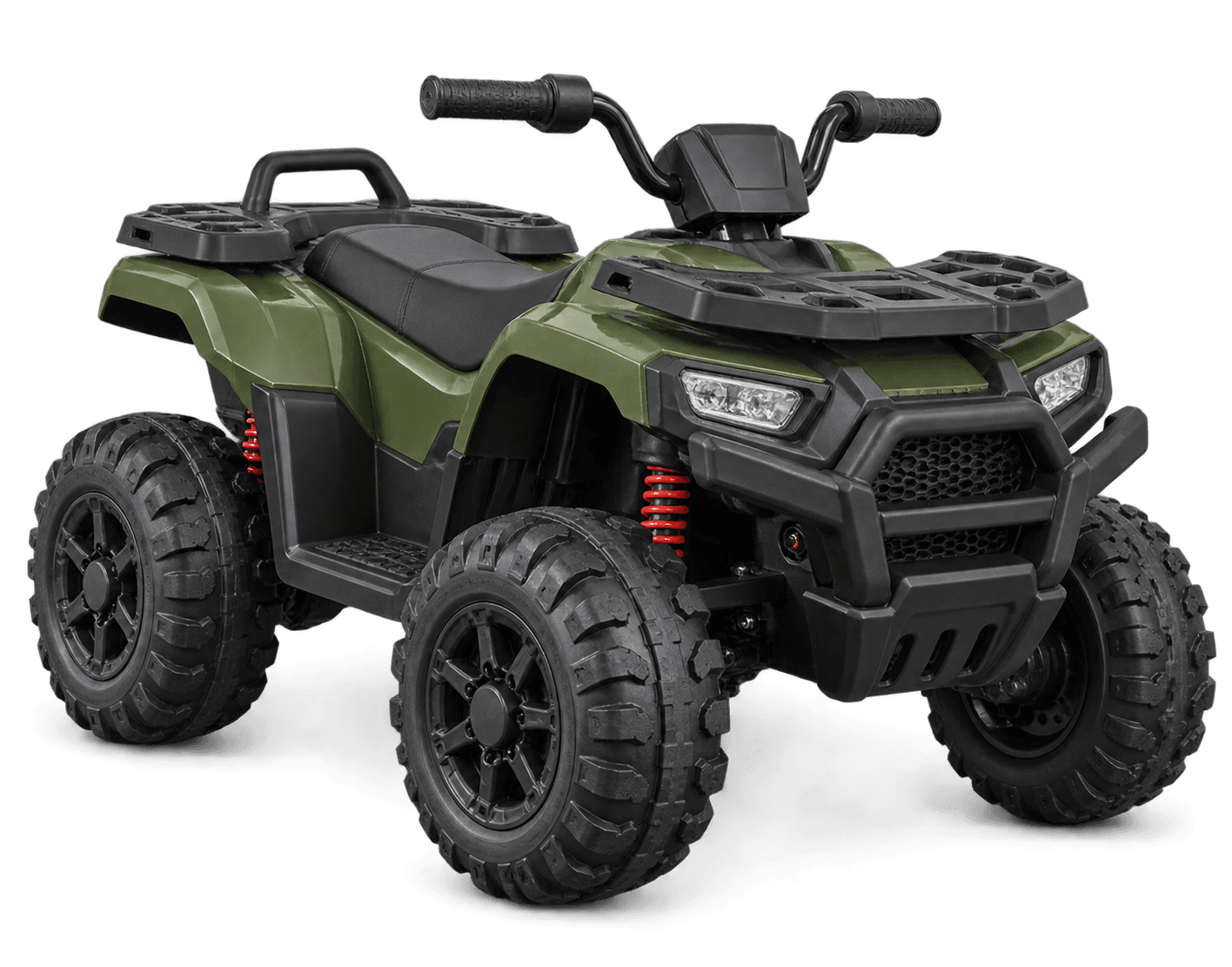
5. Motor rating is only one part of the performance system
Vehicle behavior is an interaction among the battery, controller, motors, gearing, wheels, mechanical resistance, vehicle mass, rider load, surface, gradient, and battery state. Changing any one element can affect starting current, speed, torque at the wheel, run duration, stopping distance, noise, temperature, and component life.
A larger wheel travels farther per revolution, which can change theoretical vehicle speed and wheel torque for the same motor and gearbox output. A different gearbox ratio can exchange speed for torque. Controller current limits and soft-start programming influence launch feel and electrical stress. Battery internal resistance and state of charge affect voltage under load. Marketing only the nominal voltage and total motor watts hides these relationships.
Request test conditions with every performance statement
- Exact production configuration, battery model and condition, charger, controller, motors, gearing, wheels, and firmware or selectable mode.
- Test rider or applied load, vehicle mass, surface material, gradient, temperature, route length, and measurement method.
- Starting state of charge, rest period, number of repetitions, and whether lights, sound, or other electrical functions were active.
- Measured outcome, normal variation, observed limits, and any protective shutdown, excessive heat, noise, odor, or component change.
- A clear distinction among design target, internal factory result, third-party result, and consumer-facing claim.
Range and speed figures are especially condition-dependent. Instead of requesting one impressive number, define the condition relevant to the buyer’s product application and ask for repeatable results. The published wording should not be more certain than the underlying test evidence.
6. Evaluate soft start, speed modes, suspension, steering, and stopping together
Soft start generally describes a controller strategy that increases output progressively instead of applying an abrupt step. Its effectiveness depends on programming, drivetrain play, load, battery condition, pedal or switch behavior, and mode selection. Buyers should judge the launch on the representative vehicle rather than approving the phrase alone.
High and low speed modes should have defined operation and clear user instructions. Confirm the actual control, default state at power-up, adult access, reverse behavior, transition between modes, and whether the setting changes controller output or another part of the drive system. Remote-control or remote-stop functions, where offered, also require defined range, pairing, priority, battery, interference, and failure behavior.
Suspension can change ride feel and wheel contact, but a visible spring is not proof of an effective suspension system. Inspect usable travel, spring and damper behavior where applicable, clearances, fasteners, pinch or entrapment considerations, steering interaction, and durability. Steering geometry, turning radius, wheel runout, axle alignment, tire grip, drivetrain drag, and stopping logic all contribute to controllability.
| Feature | Sample review | Production check |
|---|---|---|
| Soft start | Launch consistency under defined loads and states of charge | Correct controller and repeatable start behavior |
| High/low mode | Mode logic, access, speed difference, reverse behavior | Switch, wiring, labels, and functional result |
| Suspension | Travel, clearance, stability, fasteners, durability | Correct components, assembly, and secure hardware |
| Steering | Alignment, effort, turning, interference, return behavior | Fasteners, play, left/right function, wheel fit |
| Stopping | Pedal-release or control behavior under defined conditions | Repeatable functional check and instructions |
7. Convert the chosen configuration into factory tests
A sample demonstration is useful only if the factory can repeat the approved configuration. Translate the decision into a controlled bill of materials, component specifications, assembly instructions, critical-to-quality points, end-of-line tests, sampling plans, records, and change control. The inspection team must know which deviations require isolation or buyer approval.
Incoming checks can verify motor, gearbox, battery, controller, charger, wheel, axle, suspension, connector, and label identity. In-process checks can cover routing, connector engagement, polarity, fastener method, wheel attachment, steering, clearance, and drivetrain movement. End-of-line checks can confirm forward and reverse, modes, lights and sound, remote functions where applicable, wheel drive, abnormal noise, basic stopping response, charger fit, and visual condition.
Engineering validation should be distinguished from routine production testing. Longer loaded operation, repeated start-stop cycles, surface evaluation, thermal observations, structural tests, packaging validation, and applicable third-party assessment may require dedicated samples, equipment, procedures, and acceptance criteria. A short line function check cannot replace them.
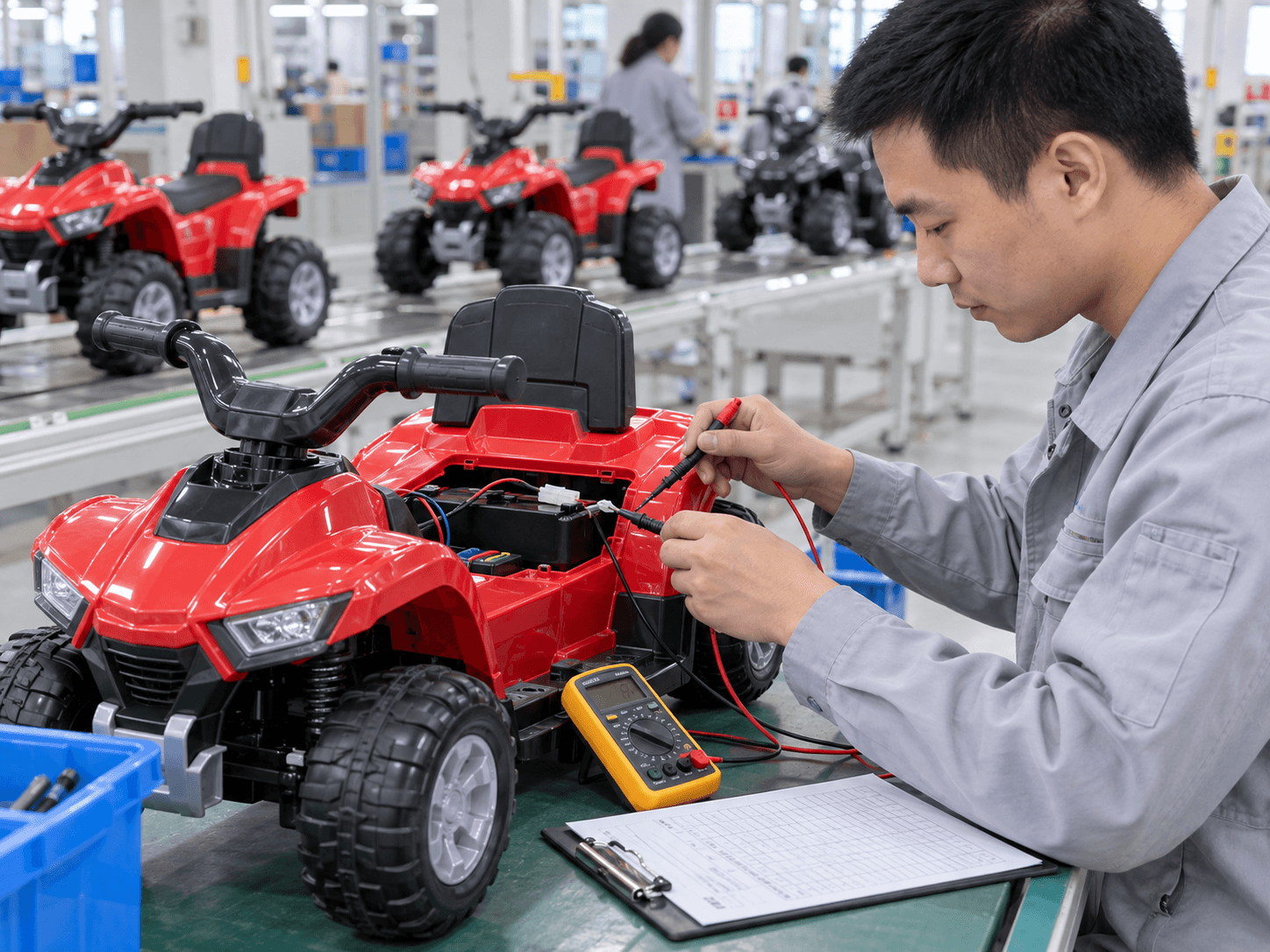
Review the broader CubRover quality-control workflow and the children’s ATV compliance checklist when building the model-specific verification plan.
For authoritative market guidance, see the U.S. CPSC toy-safety business page and the European Commission toy-safety portal. A qualified specialist should confirm which requirements apply to the exact configuration.
8. Freeze the specification and inspect what will actually ship
Before production purchasing begins, freeze the wheel construction, dimensions and tread; motor and gearbox part numbers; driven-wheel arrangement; battery; controller; charger; wiring and protection; modes and software behavior; suspension and steering components; labels; manual; and consumer-facing claims. Link this specification to an approved sample and dated photographs.
A pre-shipment inspection should confirm quantity, model identity, workmanship, configuration, functions, labels, accessories, packaging, and a defined sample of performance-related checks. It should not invent acceptance criteria on the inspection day. If a critical component differs from the approved record, identify the change and review its functional, compliance, documentation, and commercial impact before release.
The packaging and pre-shipment inspection guide explains how to connect the approved product to carton checks, sampling, defect handling, and loading evidence.
Conclusion
Plastic or EVA-style wheels, one, two, or four motors, 4WD, suspension, and speed modes are not isolated quality grades. Each choice changes a product system. Define the application first, compare controlled configurations, test under recorded conditions, approve a representative sample, freeze the specification, and inspect production against it. That process gives buyers a more reliable product story—and gives factories a product they can consistently build.
Frequently asked questions
Are EVA wheels better than plastic wheels for a kids ATV?
Not universally. EVA-style tread may change noise, vibration, and grip on certain surfaces, while rigid molded wheels can offer simple maintenance and consistent durability. Compare the exact construction on the intended surface under the intended load.
Is a four-motor kids ATV always more powerful than a dual-motor model?
No. Usable performance depends on motor and gearbox specifications, controller limits, battery behavior, wheel diameter, vehicle weight, mechanical losses, surface, and load. Motor count alone is not a complete comparison.
What should a 4WD kids ATV specification include?
It should identify the physical drive layout, motor and gearbox part numbers, controller and wiring, operating modes, driven-wheel behavior, test method, and production checks supporting the four-wheel-drive claim.
What does soft start mean on a children’s electric ATV?
Soft start normally means the controller applies output progressively to reduce an abrupt launch. The buyer should verify the actual behavior across loads, speed modes, and battery states on a representative sample.
Does suspension make a kids ATV suitable for rough terrain?
Not by itself. Suspension design, travel, chassis, wheels, steering, speed, stability, intended use, warnings, and test evidence all matter. A visible spring should not be treated as proof of off-road capability.
How should a factory test kids ATV motors and wheels?
Use incoming identity checks, controlled assembly checks, end-of-line functional tests, and separate engineering validation where required. Record the model, configuration, conditions, acceptance criteria, result, and corrective action.
Choose a drivetrain that fits your market
Tell CubRover the rider range, intended surface, load, wheel preference, drive layout, controls, target quantity, destination market, and retail position. We will help structure a sample and quotation request.
Ask for Product Catalog