
The short answer
For OEM kids ATV color matching, define each substrate and process—molded plastic, painted metal, foam, seat, wheel, decal, label, carton, and screen display—then provide controlled color references, viewing light, gloss and texture expectations, artwork files, logo rules, print method, adhesive and durability needs, acceptable variation, signed sample, boundary samples, production inspection, and change control. Do not expect identical appearance across different materials from one digital code.
Brand teams often send a Pantone reference and expect every molded, painted, printed, and digital surface to match exactly. Physical materials reflect light differently, and pigment, texture, gloss, thickness, and process variation change perception.
This guide helps buyers approve a coherent product rather than chase an impossible cross-material match.
1. Map every colored and branded surface
Create a part-by-part table covering substrate, process, supplier, color reference, texture, gloss, print or decal, logo, legal markings, and whether the part is consumer-visible after assembly.
For OEM kids ATV color matching and graphics, this decision should be translated into measurable requirements rather than left as a sales description. State the responsible person, approved reference, acceptable variation, verification method, and record required for release. If the evidence cannot be connected to the quoted model and revision, treat the point as open rather than confirmed.
Questions buyers should resolve
- Include hidden service-identification colors.
- Separate molded and painted parts.
- List fasteners and wheel details.
- Map carton and manual artwork.
- Assign an owner to each asset.
At the quotation stage, ask the supplier to mark each point as standard, optional, unavailable, or pending confirmation. Attach the answer to a model code and dated revision. This prevents a useful discussion from becoming an undocumented promise and exposes differences early enough to affect supplier selection, sample cost, tooling, and schedule.
2. Use physical and digital references correctly
Provide master brand files and a recognized color reference, then approve physical samples on the intended material. Define lighting, viewing distance, angle, background, and instrument use where appropriate.
For OEM kids ATV color matching and graphics, this decision should be translated into measurable requirements rather than left as a sales description. State the responsible person, approved reference, acceptable variation, verification method, and record required for release. If the evidence cannot be connected to the quoted model and revision, treat the point as open rather than confirmed.
Questions buyers should resolve
- Use current physical color standards.
- Record reference edition and condition.
- Evaluate under agreed light sources.
- Avoid monitor-only approval.
- Photograph only as supporting evidence.
During sample review, observe both the expected outcome and the way it is achieved. Photograph identifiers and interfaces, record conditions, repeat variable observations, and note any technician adjustment made before the result. An approval should distinguish an accepted production feature from a one-off sample correction that still needs process control.
3. Control logos, decals, and printed details
Specify vector artwork, dimensions, placement references, orientation, bleed, color separations, print process, laminate, adhesive, substrate preparation, edge treatment, legal clear space, and prohibited distortion.
For OEM kids ATV color matching and graphics, this decision should be translated into measurable requirements rather than left as a sales description. State the responsible person, approved reference, acceptable variation, verification method, and record required for release. If the evidence cannot be connected to the quoted model and revision, treat the point as open rather than confirmed.
Questions buyers should resolve
- Use versioned source files.
- Check mirrored left-right graphics.
- Approve dielines and placement jigs.
- Review bubbles, lift, and wrinkles.
- Confirm intellectual-property permission.
Before purchase-order release, convert the decision into controlled documents: specification, bill of materials or approved part reference, drawing or artwork, work instruction, inspection point, and change-notification rule as applicable. The commercial document should state which revision governs when a chat message, catalog sheet, and sample appear to conflict.
4. Review aging, abrasion, cleaning, and environment
Color and graphics can change through UV exposure, heat, cold, cleaning, abrasion, plastic migration, surface texture, and storage. Define relevant validation without promising universal fade or scratch resistance.
For OEM kids ATV color matching and graphics, this decision should be translated into measurable requirements rather than left as a sales description. State the responsible person, approved reference, acceptable variation, verification method, and record required for release. If the evidence cannot be connected to the quoted model and revision, treat the point as open rather than confirmed.
Questions buyers should resolve
- Test representative materials.
- Record exposure method and duration.
- Compare against controlled references.
- Inspect adhesive edges and print.
- Review packaging contact marks.
During production, check the earliest point at which a mismatch can be detected economically. Incoming verification may be better for a component identity; an in-process fixture may be better for assembly; an end-of-line test may be better for complete function. Record failed units and their disposition instead of quietly reworking them without trend data.
5. Establish color and appearance boundaries
Use signed master and boundary samples, measured values where suitable, consistent inspection lighting, viewing distance, defect zones, lot traceability, first-piece approval, and escalation for pigment or supplier changes.
For OEM kids ATV color matching and graphics, this decision should be translated into measurable requirements rather than left as a sales description. State the responsible person, approved reference, acceptable variation, verification method, and record required for release. If the evidence cannot be connected to the quoted model and revision, treat the point as open rather than confirmed.
Questions buyers should resolve
- Approve first production parts.
- Keep resin and pigment lot data.
- Check assembled color harmony.
- Separate critical and minor zones.
- Retain samples under proper storage.
Before shipment, compare the finished lot with the approved decision and customer-facing promise. Review whether packaging, manual, labels, accessories, product photographs, online claims, and service parts still describe the same configuration. A technically acceptable product can still create claims when the delivered information sets a different expectation.
6. Build a sample and evidence plan for OEM kids ATV color matching and graphics
Commercial comparisons become reliable only when every supplier is answering the same written requirement. A buyer should distinguish confirmed facts, supplier assumptions, optional features, exclusions, and items that still require sample or document review. Informal chat can support the discussion, but the approved specification and commercial record should contain the decision.
For sourcing decisions, the sample is a purchasing control as well as a product. Record its model, revision, components, functions, appearance, labels, instructions, accessories, and pack-out. When a sample uses temporary or substitute parts, list them explicitly and prevent the buyer from approving production against an unrepresentative unit.
The appearance file should connect brand standards, substrates, processes, physical color references, artwork files, dielines, placement measurements, sample approvals, durability results, boundary samples, inspection conditions, pigment and supplier lots, and change records.
Evidence quality also depends on provenance. Mark who created each record, when it was created, which equipment or reference was used, and whether the reviewer was independent from the activity. Keep original files where practical. A cropped photograph, spreadsheet value, or translated summary can support a decision, but it should not obscure the underlying report, sample identity, method, or limitation.
Evidence to retain in the buyer file
- Identify the exact model, revision, option set, and destination market.
- Record the test, review, or approval method before accepting a claim.
- Keep photographs, measurements, results, deviations, and responsible approvals.
- Separate an engineering sample from a production-representative sample.
- Resolve open items before purchase order, artwork, or shipment release.
- Repeat affected checks whenever a critical component or instruction changes.
7. Translate the approved decision into production control
Supplier capability must be connected to the order. Confirm which processes happen at the quoted site, which are subcontracted, how critical components are purchased, how changes are approved, and how production is checked against the sample. Capacity, lead time, and price are meaningful only for the frozen configuration and order conditions.
For OEM kids ATV color matching and graphics, the controlled product file should identify the customer requirement, approved model, components or materials affected, operating conditions, labels and instructions, sample evidence, production checks, packaging, and authorized deviations. Purchasing and quality teams should work from the same revision.
Change control is especially important after sample approval. A supplier may consider two components commercially equivalent even when their ratings, connectors, materials, software behavior, appearance, service compatibility, or evidence differ. Require a written change request that explains the old and proposed item, reason, functional effect, document effect, cost, schedule, and approval.
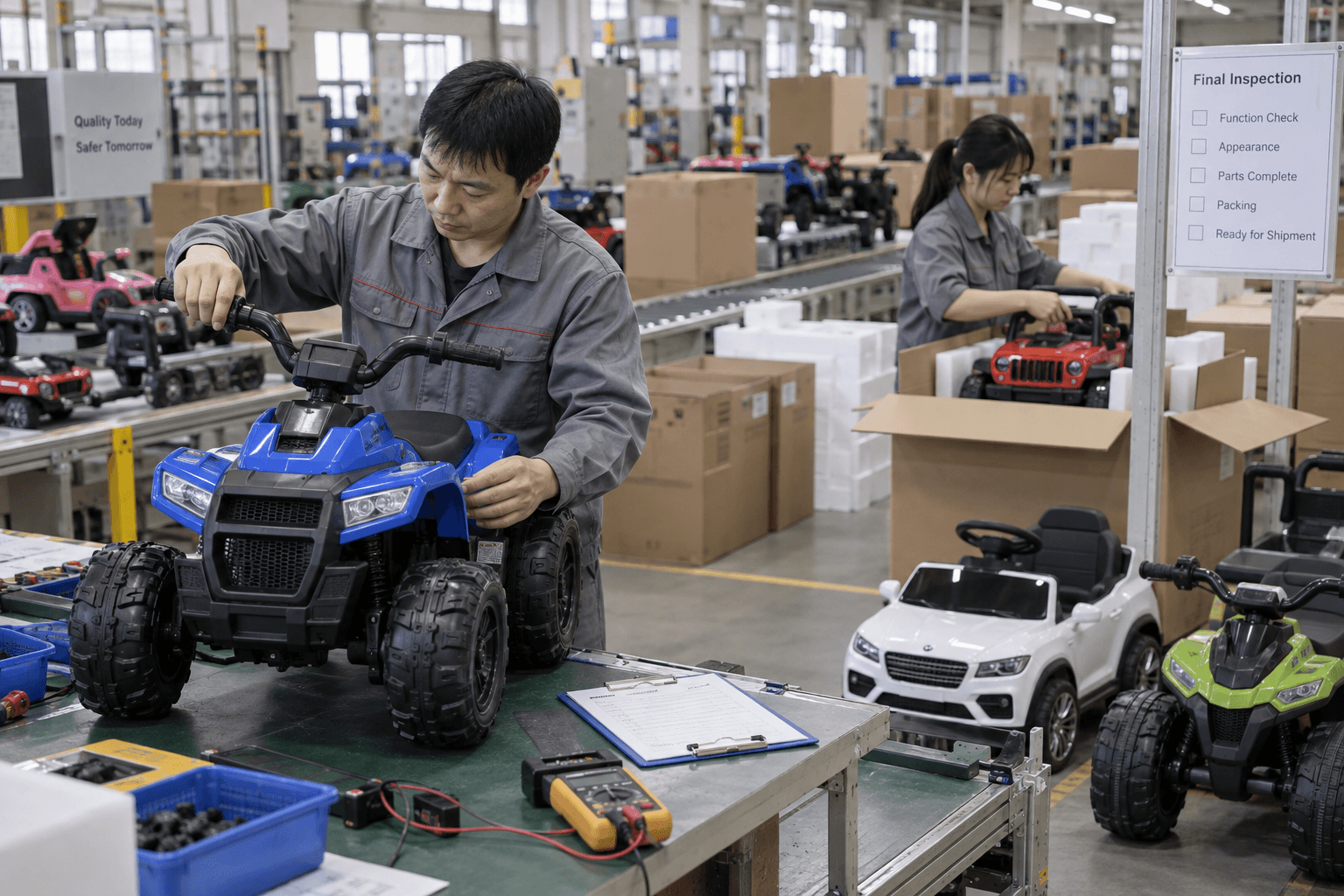
Control plans should be practical enough to survive a busy production day. Define the sampling frequency, responsible role, measuring or test equipment, record format, reaction plan, and authority to stop or release work. Audit a small selection of completed records against physical units; a completed checkbox is useful only when the method and acceptance boundary were understood.
Factory controls to agree before production
- Approved bill of materials and current component specifications.
- Incoming identity and condition checks for critical parts.
- Work instructions available at the relevant production station.
- In-process checks before assemblies become difficult to inspect.
- End-of-line functions recorded against defined acceptance criteria.
- Nonconforming units isolated, corrected, rechecked, and traceable.
| Gate | Required evidence | Release question |
|---|---|---|
| Specification | Current model, configuration, requirements, and exclusions | Does everyone understand the same product? |
| Sample | Representative unit, test records, photographs, and deviations | Is this the production reference? |
| Materials | Approved suppliers, part identity, incoming results, and status | Do received parts match the frozen file? |
| Production | Instructions, checkpoints, test results, and nonconformity control | Can the factory repeat the approved decision? |
| Shipment | Inspection, pack-out, documents, quantity, and release record | Is the finished lot acceptable to ship? |
8. Inspect the finished order and preserve decision-ready records
Shipment release should use criteria agreed before production finishes. Inspect identity, quantity, workmanship, functions, labels, documents, accessories, packing, carton condition, and any topic-specific checks. A professional release decision records the sample selected, method, result, defects, corrective action, and authorization to ship.
The inspection plan for OEM kids ATV color matching and graphics should identify the lot, sampling approach, defect classes, methods, tools, acceptance limits, and escalation rules. Safety- or compliance-related discrepancies require appropriate containment and expert review; they should not be diluted into a general visual defect percentage.
Retain an organized release pack: purchase specification, approved sample record, change approvals, inspection report, photographs, test summaries, packing evidence, shipment identifiers, and open-item disposition. Records should be searchable by model and batch so that a later complaint can be connected to the product that was actually supplied.
A useful inspection report separates facts from recommendations. It shows what was available, what was sampled, what method was used, what was observed, and which requirement determined conformity. When a check could not be completed, record the limitation openly. The buyer can then make a conscious release, hold, rework, or reinspection decision instead of treating missing evidence as a passing result.
9. Use a staged buyer action plan
A staged plan prevents commercial urgency from bypassing technical decisions. Assign an owner and due date to every open assumption, and do not let a quotation, sample, laboratory file, artwork proof, or inspection report stand alone. Each gate should point to the same model and revision.
- Define the customer, market, channel, product, and decision that the article addresses.
- Convert marketing language into a controlled specification with measurable acceptance criteria.
- Review a representative sample and record assumptions, limitations, and approved deviations.
- Confirm market, test, documentation, packaging, and commercial responsibilities.
- Freeze the product and artwork revision before purchasing production materials.
- Inspect the finished order, close significant findings, and retain release evidence.
- Feed shipment and customer results into the next product and process revision.
When an issue appears, contain the affected scope first. Then distinguish the observed defect from its cause, review whether other models or batches are affected, implement corrective action, and verify that the action worked. Replacing one failed unit may satisfy an immediate customer need, but it does not prove recurrence has been prevented.
After launch, compare the assumptions in the sourcing file with arrival inspection, assembly time, customer questions, returns, warranty parts, damage, and sell-through feedback. Normalize data by units and time in market where possible. This closes the loop between product application and factory control and provides evidence for the next quotation rather than relying on memory or isolated anecdotes.
Continue the buyer workflow with OEM and private-label guide and packaging and artwork guide and materials and workmanship guide.
Conclusion
Reliable OEM appearance comes from substrate-specific approval and repeatable inspection. Map every surface, use physical samples, control artwork and durability, define variation, and approve production under consistent conditions.
Frequently asked questions
Can Pantone colors match molded plastic exactly?
A Pantone reference guides the target, but resin, pigment, texture, gloss, thickness, light, and process affect the physical result.
Why do the body and decal look different?
They use different materials, inks or pigments, surfaces, and optical properties; approve the assembled visual relationship.
What artwork files should a buyer provide?
Usually editable vector files, fonts or outlined text, color references, dimensions, placement rules, and licensed brand assets.
Can factory photos approve color?
Photos help document a sample but cameras, lighting, compression, and displays make them unreliable as the sole standard.
What is a boundary sample?
It is a physical reference representing an agreed acceptable or reject edge for a defined appearance characteristic.
When is a new color sample required?
Review after pigment, resin, substrate, supplier, tooling, texture, gloss, paint, ink, adhesive, or process changes.
Translate brand standards into factory controls
Share your brand assets and product platform for a physical sample and production-appearance plan.
Get a Quote