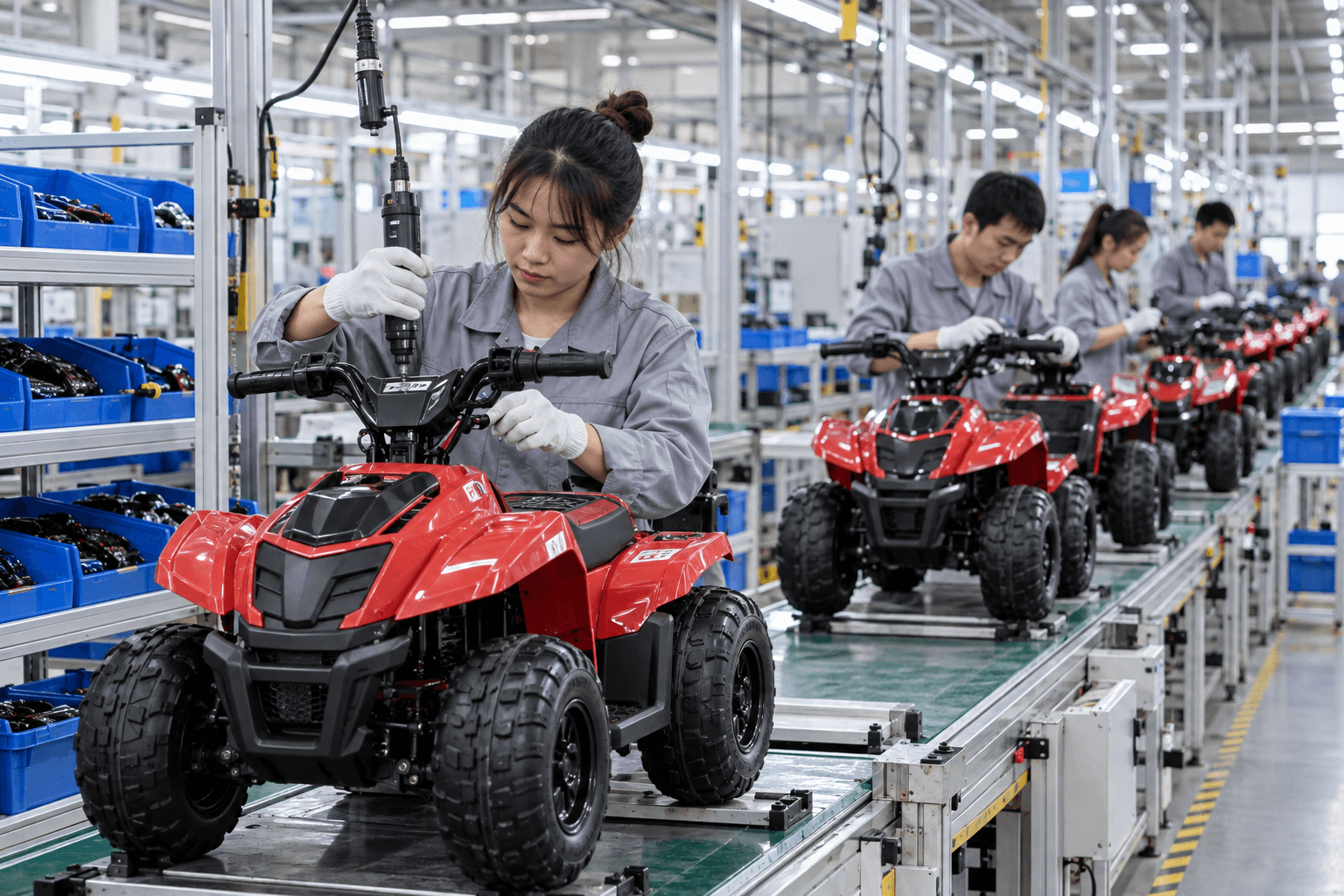
The short answer
Use a kids ATV pilot run to verify that final materials, suppliers, tooling, work instructions, trained operators, fixtures, inspections, line tests, pack-out, traceability, and documents can repeatedly deliver the approved product. Define sample quantity and objectives, record yield and defects, close causes, reverify affected work, and make an explicit scale-up decision.
An engineering sample can be assembled by a technician who knows every adjustment. Production relies on operators, purchased components, fixtures, work instructions, inspection, and packing that must work repeatedly at the planned rate.
This guide explains the pilot gate between sample approval and full production. Pilot quantity and acceptance depend on the design, process, risk, and order rather than a universal unit count.
1. Choose pilot questions that can change the launch decision
Define the questions before choosing a quantity: can purchased parts fit consistently, can operators follow the instructions, can fixtures control assembly, can the test detect faults, and can the carton protect the finished product? Include configuration, schedule, evidence, and acceptance criteria.
Avoid treating the pilot as a ceremonial first batch. Its purpose is to expose process variation while the affected scope is manageable. Identify who can stop the run, approve deviations, authorize rework, and release scale-up. If final materials are not available, state what the run can and cannot validate instead of calling substitute-based output a complete production qualification.
What to confirm before approval
- State specific product and process objectives.
- Define acceptance and stop authority.
- List nonrepresentative parts before starting.
2. Freeze materials, tooling, instructions, and people
Check bill of materials, supplier parts, drawings, torque or assembly methods, wiring diagrams, fixtures, gauges, test equipment, software or controller behavior, labels, manual, carton, and service references. Operators should use the intended instructions rather than verbal coaching alone.
Review incoming status and revision at each station. Pilot difficulties are often caused by mixed components or an instruction that describes an earlier sample. Keep engineering support available, but record each intervention and whether it becomes a process change. An unrecorded expert adjustment can make a pilot look successful while leaving the normal line unable to reproduce it later.
What to confirm before approval
- Verify final part and document revisions.
- Train operators and check fixture readiness.
- Log every engineering intervention.
3. Observe assembly flow and critical interfaces
Track station time, waiting, handling, access, fasteners, wheel and steering interfaces, battery restraint, connectors, cable routing, body fit, decals, charger selection, and pack-out. Identify steps that become hard to inspect after another component is installed.
Measure the actual sequence rather than dividing labor from a theoretical diagram. Check whether parts can be confused, installed backward, omitted, pinched, or damaged. Use poka-yoke or other practical error prevention where appropriate, but verify it works. A station that produces acceptable units only when the supervisor stands beside it needs further work before the planned volume begins.
What to confirm before approval
- Observe the full sequence and hidden interfaces.
- Record opportunities for mix-ups and damage.
- Verify error prevention with controlled checks.
4. Record first-pass yield and defect causes
Count units entering, passing without repair, reworked, rejected, held, and retested. Define the denominator and defect categories clearly. A final quantity of acceptable units does not describe how much troubleshooting or rework was needed to obtain them.
Connect failures to part lot, station, operator instruction, fixture, test method, and product revision. Investigate repeat defects rather than treating every reworked unit as a separate anecdote. Record what changed and verify the correction on affected subsequent output. Keep safety or compliance-related issues on an appropriate escalation path rather than averaging them into a general cosmetic defect rate.
What to confirm before approval
- Separate first-pass output from repaired output.
- Trace defects to process and component evidence.
- Verify correction before closing recurring issues.
5. Validate testing, documents, and sealed-carton delivery
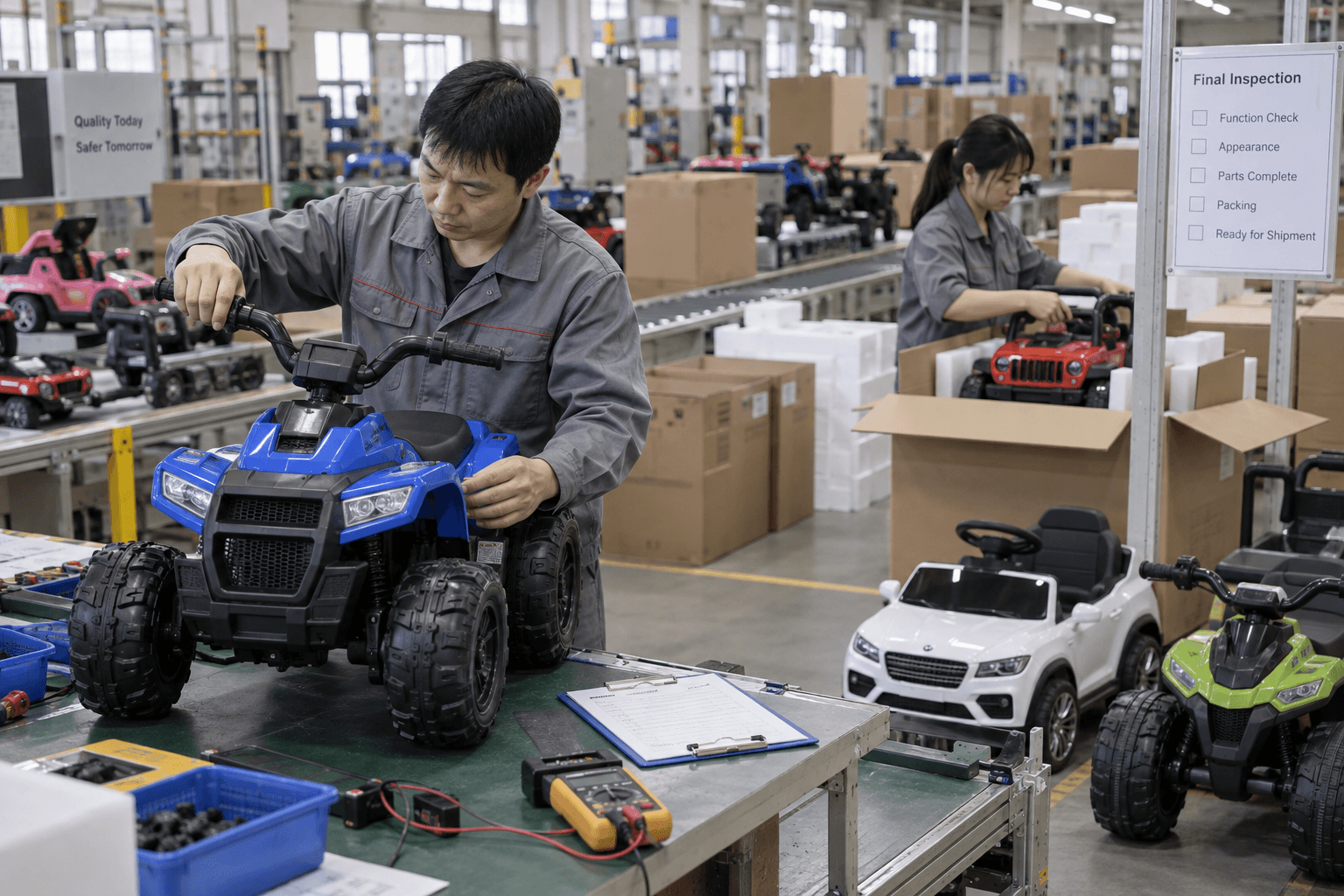
Run the intended end-of-line checks, confirm defect detection where safe and qualified, inspect labels and manuals, verify the regional charger, reconcile hardware and accessories, and rehearse packing. Use the final carton and protection materials if packaging is part of the qualification.
Open selected sealed cartons as a receiving or customer-assembly rehearsal. Check completeness, clarity, cosmetic condition, installation preparation, function, and repacking needs. If distribution testing is required, select production-representative pilot packs and preserve identity. A well-assembled vehicle can still fail launch readiness because the manual, hardware bag, charger, or protective insert does not match.
What to confirm before approval
- Check the test method and failure response.
- Rehearse the complete sealed-carton journey.
- Use final packaging for relevant validation.
6. Make an explicit scale-up decision
Review open defects, corrective actions, repeatability, capacity, component readiness, test coverage, packaging, documentation, traceability, and shipment gates. Classify the outcome as released, conditional with defined scope, or held. State the product and process revision authorized for production.
A conditional launch should identify the unresolved item, risk, containment, owner, quantity limit, verification, and final closure date. Do not allow a vague conditional approval to continue indefinitely. After scale-up begins, check early production against the pilot baseline and watch for staff changes, increased rate, different component lots, or overtime conditions that may reveal new variation.
What to confirm before approval
- Name the released product and process revision.
- Limit and track any conditional approval.
- Verify early scale-up output.
7. Worked example: apply the decision to a real order
The following scenario is illustrative. It explains a decision method rather than reporting a CubRover customer project, measured test result, certification, or completed shipment.
A brand approves a sample with a new wheel and dashboard option. During the pilot, operators repeatedly need help routing the wiring before the body is fitted. The expert-built sample had not revealed this assembly difficulty.
The team records the intervention, revises the routing fixture and work instruction, and checks that the cable remains protected after repeated operation. It then evaluates subsequent units without the same manual adjustment. Packing review also identifies a confusing hardware bag, which is corrected before the full order.
The pilot decision uses first-pass results, verified corrections, final documents, and a controlled release rather than the fact that several finished vehicles look good. Early full production is checked against the corrected baseline. The scenario illustrates a method; it does not report a particular CubRover run or promise a standard pilot size.
| Area | Evidence | Scale-up question |
|---|---|---|
| Materials | Final approved parts and lots | Is the input representative? |
| Assembly | Instructions, interventions, defects | Can normal operators repeat it? |
| Testing | Method, results, failure disposition | Can faults be detected and controlled? |
| Delivery | Pack-out, manual, receiving rehearsal | Is the delivered product ready? |
Questions to include in the buyer decision brief
Convert the review into questions that the supplier can answer against one named model and order. The following prompts come from the topic-specific approval checks above. They are intentionally practical: each answer should identify the responsible party, supporting record, open condition, and date by which the buyer can make the next decision.
- Choose pilot questions that can change the launch decision: State specific product and process objectives. Define acceptance and stop authority. List nonrepresentative parts before starting.
- Freeze materials, tooling, instructions, and people: Verify final part and document revisions. Train operators and check fixture readiness. Log every engineering intervention.
- Observe assembly flow and critical interfaces: Observe the full sequence and hidden interfaces. Record opportunities for mix-ups and damage. Verify error prevention with controlled checks.
- Record first-pass yield and defect causes: Separate first-pass output from repaired output. Trace defects to process and component evidence. Verify correction before closing recurring issues.
- Validate testing, documents, and sealed-carton delivery: Check the test method and failure response. Rehearse the complete sealed-carton journey. Use final packaging for relevant validation.
- Make an explicit scale-up decision: Name the released product and process revision. Limit and track any conditional approval. Verify early scale-up output.
8. Turn the review into a controlled implementation plan
A useful buyer decision has three outputs: an approved requirement, evidence supporting that requirement, and a named person who can release the next activity. Keep these connected by model, configuration, market, document revision, and effective production date. If a supplier gives a conditional answer, preserve the condition in the purchasing record rather than shortening it into an unconditional product claim.
Keep a pilot dossier separate from sample approval. It should connect the run objective, final input status, process records, first-pass results, interventions, corrective actions, packing rehearsal, and signed scale-up disposition. Carry the approved revisions into the inspection brief and purchase-order file.
- Approve pilot objectives and representative inputs.
- Record output and interventions at every gate.
- Close recurring defects with verified actions.
- Rehearse testing and sealed-carton delivery.
- Release the defined revision and verify scale-up.
Agree evidence and acceptance before work starts
Write the review method before the sample, factory testing, document check, shipment inspection, or service exercise takes place. Specify the reference, sample selection, conditions, tools, result format, acceptance boundary, and response to a failure. This makes two quotations or results comparable and prevents teams from negotiating the meaning of a pass after money and time have already been spent.
Keep a compact, traceable decision file
Retain the original requirement, dated supplier response, model and component identity, relevant photographs, calculations, reports, deviations, approvals, and release decision. A screenshot can help communication, but retain the underlying record when it matters to the decision. Distinguish a proposed target from a measured value, an engineering sample from a production reference, and an internal check from a third-party assessment.
Use one current revision where possible. Purchasing, engineering, compliance, quality, logistics, sales, and service may need different views of the information, but they should not be making decisions from different versions of the product. When a change is approved, state the first affected batch and what happens to old materials, inventory, artwork, service parts, customer instructions, and pending shipments.
Review cost and timing together with product application
The lowest visible unit price may shift cost into testing, rework, freight, storage, retail setup, support, returns, or obsolete parts. Compare the complete customer requirement and the cost of supplying it consistently. Where a number is uncertain, show the assumption and a reasonable scenario range. Do not turn an illustrative calculation into a supplier promise or a universal benchmark for the category.
Reserve time for unresolved items. A sample modification may require another review; a component change may affect evidence; a carton revision may alter loading; a late document can affect handoff. Put the owner and decision date beside each open item. A useful schedule makes these dependencies visible instead of reporting one finish date that assumes every preceding decision will happen immediately.
Close the loop after delivery
After the first shipment or implementation, compare the approved assumptions with arrival condition, assembly preparation, actual costs, receiving accuracy, customer questions, service cases, and repeat-order results. Separate an isolated event from a recurring pattern using model, batch, channel, and time in use. When a discrepancy appears, contain the affected scope, identify the cause, implement the correction, and verify the next relevant outcome.
Primary resources for the specific source facts and frameworks discussed in this guide: CPSC toy-safety business guidance.
Continue the related CubRover buyer workflow: sample approval guide; capacity planning guide; inspection guide.
9. Conclusion and buyer handoff
A pilot proves production readiness through representative inputs, repeatable methods, first-pass data, effective correction, complete delivery rehearsal, and a clear release decision. Use it to remove assumptions before they multiply across the main order.
Before requesting a quote, share the destination market, selected product platform, target quantity, required configuration, channel, timing, and the decision you need the supplier to support. Attach the current requirement and identify open questions. This gives the factory a clear starting point for discussing samples, evidence, inspection, documents, packaging, and commercial responsibilities.
Frequently asked questions
Is a pilot run the same as a sample?
No. A pilot evaluates repeated production using intended materials, people, methods, fixtures, tests, and packing.
How many pilot units are needed?
Choose from objectives, variation, design, process risk, and order scope; there is no universal number.
Can pilot parts be substitutes?
Sometimes for limited objectives, but record the difference and do not claim untested readiness.
What is first-pass yield?
The share of defined input units meeting the criteria without rework, under a stated counting method.
Can reworked units count as accepted output?
They may be released after approved rework and retest, but report them separately from first-pass units.
What happens after conditional release?
Apply defined containment, quantity or time limits, owners, verification, and final closure requirements.
Validate the launch process with CubRover
Share the final configuration and the questions your pilot must resolve.
Contact Us