The short answer
When a kids ATV arrives damaged, preserve the carton and packing, photograph every face and the product before movement, record model, batch, shipment, carrier, handling history, damage location, and quantity affected. Contain related stock, classify the failure, reproduce the load path when safe, identify root cause across product restraint, clearance, abrasion, compression, impact, moisture, stacking, and handling, then validate corrective action before the next shipment.
A replacement may close one support case but does not explain whether the damage came from a sharp product edge, loose wheel, insufficient clearance, carton weakness, container movement, parcel impact, or warehouse handling.
This guide gives importers and factories a common evidence language for containment, investigation, correction, and verification.
1. Capture evidence before unpacking changes it
Record all carton faces, labels, seals, punctures, crushing, moisture, orientation, internal packing, restraint, loose parts, contact marks, and product damage. Link the evidence to shipment and SKU identity.
For kids ATV shipping damage and root-cause analysis, this decision should be translated into measurable requirements rather than left as a sales description. State the responsible person, approved reference, acceptable variation, verification method, and record required for release. If the evidence cannot be connected to the quoted model and revision, treat the point as open rather than confirmed.
Questions buyers should resolve
- Do not discard the carton.
- Photograph before moving components.
- Record carrier and delivery condition.
- Count affected and inspected units.
- Map damage location to pack-out position.
At the quotation stage, ask the supplier to mark each point as standard, optional, unavailable, or pending confirmation. Attach the answer to a model code and dated revision. This prevents a useful discussion from becoming an undocumented promise and exposes differences early enough to affect supplier selection, sample cost, tooling, and schedule.
2. Classify the physical failure
Separate abrasion, puncture, compression, edge crush, impact, vibration loosening, moisture, contamination, deformation, accessory movement, and loading damage. A useful description explains the observable failure without prematurely naming the cause.
For kids ATV shipping damage and root-cause analysis, this decision should be translated into measurable requirements rather than left as a sales description. State the responsible person, approved reference, acceptable variation, verification method, and record required for release. If the evidence cannot be connected to the quoted model and revision, treat the point as open rather than confirmed.
Questions buyers should resolve
- Use consistent damage codes.
- Measure dents, tears, and displacement.
- Inspect hidden mounting points.
- Check loose hardware and accessories.
- Compare undamaged control cartons.
During sample review, observe both the expected outcome and the way it is achieved. Photograph identifiers and interfaces, record conditions, repeat variable observations, and note any technician adjustment made before the result. An approval should distinguish an accepted production feature from a one-off sample correction that still needs process control.
3. Trace product, packaging, and logistics causes
Review clearances, protrusions, restraints, protective films, bags, partitions, foam or pulp, carton strength, closures, stacking, pallet condition, container bracing, route, transfers, and parcel network exposure.
For kids ATV shipping damage and root-cause analysis, this decision should be translated into measurable requirements rather than left as a sales description. State the responsible person, approved reference, acceptable variation, verification method, and record required for release. If the evidence cannot be connected to the quoted model and revision, treat the point as open rather than confirmed.
Questions buyers should resolve
- Build a cause-and-evidence matrix.
- Check whether marks align physically.
- Review pack-out work instructions.
- Inspect retained cartons from the lot.
- Avoid blaming handling without evidence.
Before purchase-order release, convert the decision into controlled documents: specification, bill of materials or approved part reference, drawing or artwork, work instruction, inspection point, and change-notification rule as applicable. The commercial document should state which revision governs when a chat message, catalog sheet, and sample appear to conflict.
4. Design corrective action at the right level
Correct the mechanism: protect or redesign a contact point, restrain a moving part, increase clearance, change orientation, improve carton or insert construction, control packing, or revise logistics handling. More packaging everywhere can add cost without solving the path.
For kids ATV shipping damage and root-cause analysis, this decision should be translated into measurable requirements rather than left as a sales description. State the responsible person, approved reference, acceptable variation, verification method, and record required for release. If the evidence cannot be connected to the quoted model and revision, treat the point as open rather than confirmed.
Questions buyers should resolve
- Assign action owner and due date.
- Update drawings and work instructions.
- Train and verify pack-out operators.
- Control old and new material stock.
- Review effect on carton size and loading.
During production, check the earliest point at which a mismatch can be detected economically. Incoming verification may be better for a component identity; an in-process fixture may be better for assembly; an end-of-line test may be better for complete function. Record failed units and their disposition instead of quietly reworking them without trend data.
5. Validate before the next full shipment
Use controlled comparison, production pack-out review, distribution testing where suitable, trial shipment, and arrival inspection. Define success criteria and confirm that the correction does not create assembly, cosmetic, recycling, or loading problems.
For kids ATV shipping damage and root-cause analysis, this decision should be translated into measurable requirements rather than left as a sales description. State the responsible person, approved reference, acceptable variation, verification method, and record required for release. If the evidence cannot be connected to the quoted model and revision, treat the point as open rather than confirmed.
Questions buyers should resolve
- Test production-equivalent materials.
- Condition samples as required.
- Inspect product and pack after exposure.
- Record deviations and retest decisions.
- Monitor early corrected shipments.
Before shipment, compare the finished lot with the approved decision and customer-facing promise. Review whether packaging, manual, labels, accessories, product photographs, online claims, and service parts still describe the same configuration. A technically acceptable product can still create claims when the delivered information sets a different expectation.
6. Build a sample and evidence plan for kids ATV shipping damage and root-cause analysis
Operational decisions should be based on model, batch, channel, shipment route, and field evidence. Separate product defects from transport damage, assembly confusion, customer expectation, wear, misuse, and unsupported modification. Consistent reason codes and photographs make patterns visible; unstructured messages make every case look unique.
Use pilot samples to rehearse the real customer and service journey: receive the carton, inspect damage, identify parts, assemble, charge, operate, repack where relevant, and follow the support instructions. Record time, unclear steps, missing information, likely mistakes, and the parts or tools required for resolution.
A strong corrective-action file links damage photographs, batch and route, containment quantity, failure classification, physical cause, corrective design, revised pack specification, validation result, implementation date, and effectiveness review.
Evidence quality also depends on provenance. Mark who created each record, when it was created, which equipment or reference was used, and whether the reviewer was independent from the activity. Keep original files where practical. A cropped photograph, spreadsheet value, or translated summary can support a decision, but it should not obscure the underlying report, sample identity, method, or limitation.
Evidence to retain in the buyer file
- Identify the exact model, revision, option set, and destination market.
- Record the test, review, or approval method before accepting a claim.
- Keep photographs, measurements, results, deviations, and responsible approvals.
- Separate an engineering sample from a production-representative sample.
- Resolve open items before purchase order, artwork, or shipment release.
- Repeat affected checks whenever a critical component or instruction changes.
7. Translate the approved decision into production control
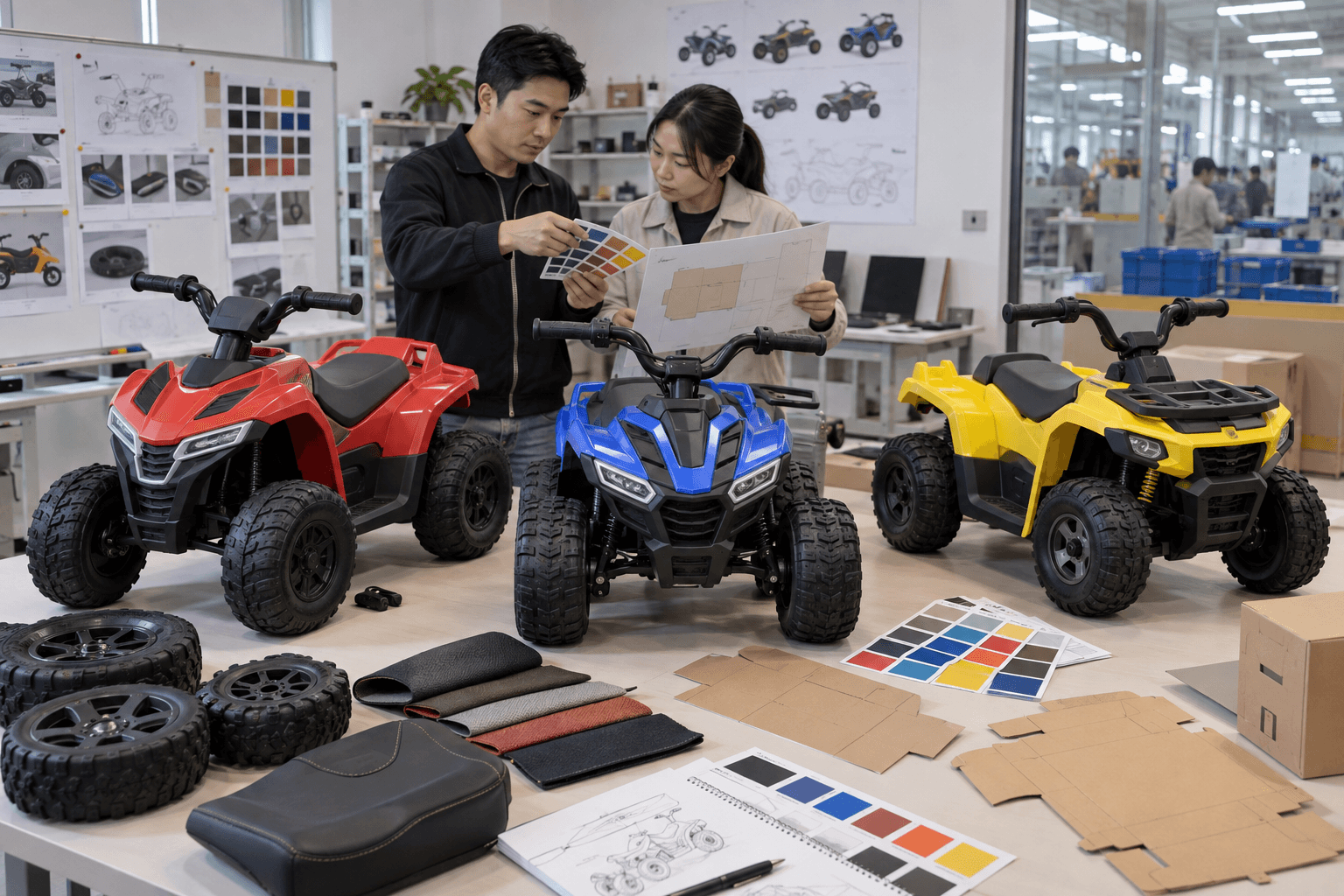
The factory and buyer should share one controlled product identity. Finished models, component revisions, packaging, manuals, spare parts, and service instructions need change notifications and compatibility decisions. Otherwise, a correct answer for the first order can become incorrect after an undocumented substitution.
For kids ATV shipping damage and root-cause analysis, the controlled product file should identify the customer requirement, approved model, components or materials affected, operating conditions, labels and instructions, sample evidence, production checks, packaging, and authorized deviations. Purchasing and quality teams should work from the same revision.
Change control is especially important after sample approval. A supplier may consider two components commercially equivalent even when their ratings, connectors, materials, software behavior, appearance, service compatibility, or evidence differ. Require a written change request that explains the old and proposed item, reason, functional effect, document effect, cost, schedule, and approval.
Control plans should be practical enough to survive a busy production day. Define the sampling frequency, responsible role, measuring or test equipment, record format, reaction plan, and authority to stop or release work. Audit a small selection of completed records against physical units; a completed checkbox is useful only when the method and acceptance boundary were understood.
Factory controls to agree before production
- Approved bill of materials and current component specifications.
- Incoming identity and condition checks for critical parts.
- Work instructions available at the relevant production station.
- In-process checks before assemblies become difficult to inspect.
- End-of-line functions recorded against defined acceptance criteria.
- Nonconforming units isolated, corrected, rechecked, and traceable.
| Gate | Required evidence | Release question |
|---|---|---|
| Specification | Current model, configuration, requirements, and exclusions | Does everyone understand the same product? |
| Sample | Representative unit, test records, photographs, and deviations | Is this the production reference? |
| Materials | Approved suppliers, part identity, incoming results, and status | Do received parts match the frozen file? |
| Production | Instructions, checkpoints, test results, and nonconformity control | Can the factory repeat the approved decision? |
| Shipment | Inspection, pack-out, documents, quantity, and release record | Is the finished lot acceptable to ship? |
8. Inspect the finished order and preserve decision-ready records
Operational readiness should be checked before release: carton and accessory completeness, manual revision, assembly hardware, charger identity, product labels, service-part codes, and escalation contacts. When a shipment or field issue occurs, contain affected stock, define scope, identify cause, correct the process, and verify effectiveness.
The inspection plan for kids ATV shipping damage and root-cause analysis should identify the lot, sampling approach, defect classes, methods, tools, acceptance limits, and escalation rules. Safety- or compliance-related discrepancies require appropriate containment and expert review; they should not be diluted into a general visual defect percentage.
Retain an organized release pack: purchase specification, approved sample record, change approvals, inspection report, photographs, test summaries, packing evidence, shipment identifiers, and open-item disposition. Records should be searchable by model and batch so that a later complaint can be connected to the product that was actually supplied.
A useful inspection report separates facts from recommendations. It shows what was available, what was sampled, what method was used, what was observed, and which requirement determined conformity. When a check could not be completed, record the limitation openly. The buyer can then make a conscious release, hold, rework, or reinspection decision instead of treating missing evidence as a passing result.
Use current primary guidance when the topic affects safety, transport, or market access: ISTA test procedure resources. Confirm applicability for the exact product and date with a qualified professional.
9. Use a staged buyer action plan
A staged plan prevents commercial urgency from bypassing technical decisions. Assign an owner and due date to every open assumption, and do not let a quotation, sample, laboratory file, artwork proof, or inspection report stand alone. Each gate should point to the same model and revision.
- Define the customer, market, channel, product, and decision that the article addresses.
- Convert marketing language into a controlled specification with measurable acceptance criteria.
- Review a representative sample and record assumptions, limitations, and approved deviations.
- Confirm market, test, documentation, packaging, and commercial responsibilities.
- Freeze the product and artwork revision before purchasing production materials.
- Inspect the finished order, close significant findings, and retain release evidence.
- Feed shipment and customer results into the next product and process revision.
When an issue appears, contain the affected scope first. Then distinguish the observed defect from its cause, review whether other models or batches are affected, implement corrective action, and verify that the action worked. Replacing one failed unit may satisfy an immediate customer need, but it does not prove recurrence has been prevented.
After launch, compare the assumptions in the sourcing file with arrival inspection, assembly time, customer questions, returns, warranty parts, damage, and sell-through feedback. Normalize data by units and time in market where possible. This closes the loop between product application and factory control and provides evidence for the next quotation rather than relying on memory or isolated anecdotes.
Continue the buyer workflow with ISTA packaging-validation guide and container-loading guide and factory audit and quality-control guide.
Conclusion
Transport damage improves when teams preserve evidence, describe the physical failure, identify the real load path, correct that mechanism, and verify effectiveness. Replacement alone is service recovery, not prevention.
Frequently asked questions
What photos are needed for a shipping-damage claim?
Capture every carton face, labels, seals, damage, opening sequence, internal packing, product position, loose parts, and product damage.
Can a stronger carton solve all damage?
No. Restraint, clearance, abrasion, inserts, orientation, stacking, moisture, and handling may be the actual causes.
Should damaged cartons be discarded?
Keep representative cartons and packing until the investigation and claim requirements are understood.
What is containment?
It is the immediate control of potentially affected stock or shipments while scope and risk are assessed.
How do we know corrective action worked?
Use defined validation and monitor corrected production and early shipments against measurable acceptance criteria.
Does a passed packaging test guarantee zero damage?
No. It provides evidence for defined conditions; actual distribution routes and handling still vary.
Turn damage evidence into prevention
Share the shipment facts and packaging configuration so the next action addresses the mechanism, not only the symptom.
Send Your Requirements