The short answer
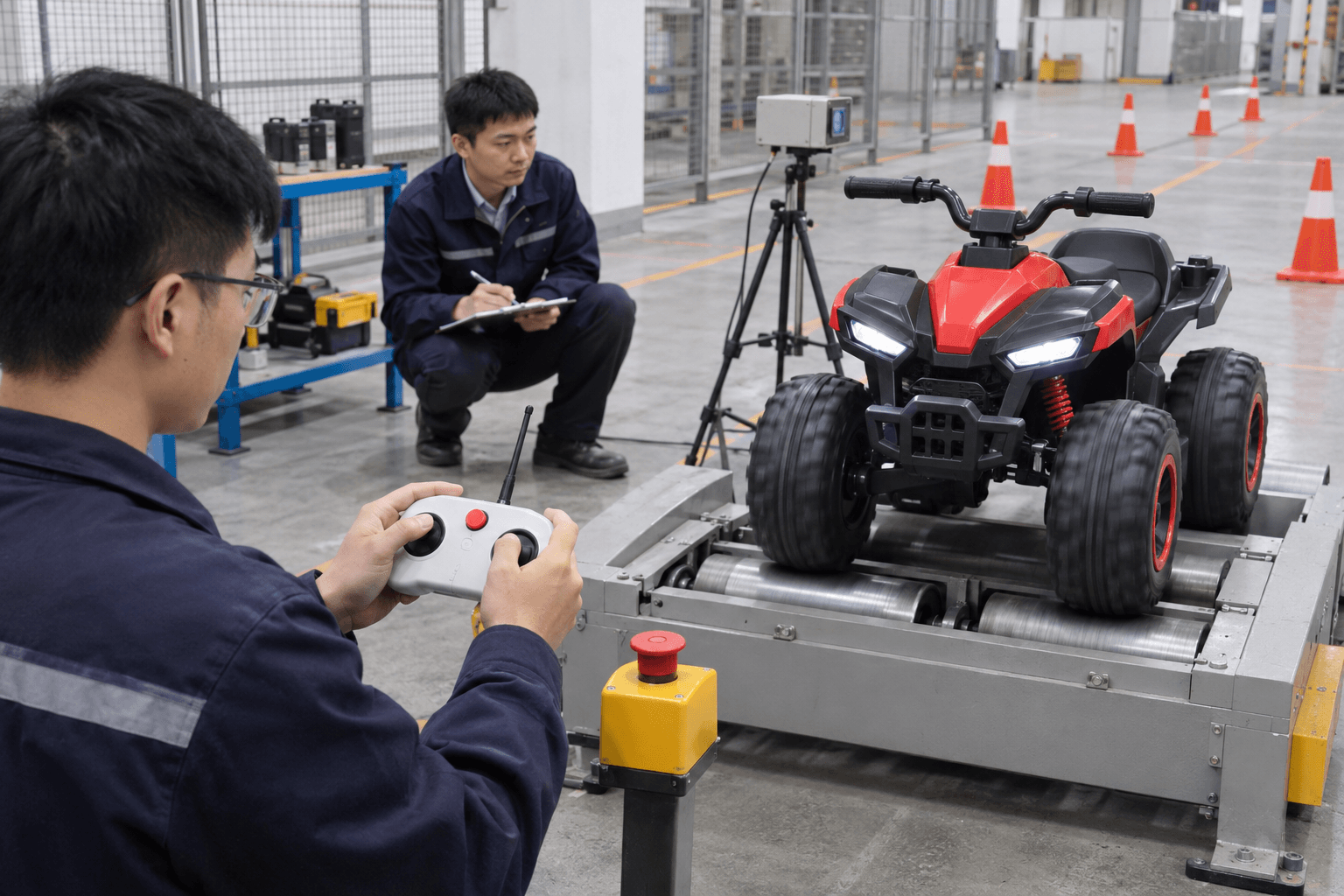
A kids ATV speed limiter or parental stop should be specified as system behavior, not a feature name. Define available speed states, maximum target under stated load and battery conditions, how settings are selected and retained, remote pairing and priority, stop response, range, interference behavior, loss-of-signal response, restart conditions and foreseeable misuse. Validate the design and then verify production with controlled tests.
Remote control and speed modes are common purchase filters for children’s ride-on quads, but supplier descriptions often omit the behavior that matters. “Emergency stop” may mean a temporary command, a latched state or simple power interruption, and different systems can respond differently after signal loss.
This guide helps buyers write observable requirements. It does not define a universal safe speed or certify a design; those decisions depend on the exact product, rider, use and applicable requirements.
1. Define the rider, product and supervision scenario
Record intended age and ability, rider fit, vehicle mass, load, surface, gradient, indoor or outdoor use, expected supervision and maximum operating area. A remote feature cannot compensate for a product that is unsuitable for the rider or environment.
Identify foreseeable interactions: child operating controls while an adult sends a command, multiple products nearby, a dropped remote, low battery, lost pairing, obstruction and restart after a stop. Convert these into design review and test cases.
What to confirm before approval
- Define rider and application.
- List normal and foreseeable interactions.
- Separate supervision from product suitability.
2. Specify speed modes and limiter behavior
State the number of modes, control method, target or limit definition, tolerance, acceleration behavior, forward and reverse treatment, memory after power-off, child access and indication. Record test load, battery state, surface and measurement method.
Review whether mode labels are understandable to customers. A high-low switch may change controller output rather than guarantee a fixed road speed, so consumer claims should match measured evidence and conditions.
What to confirm before approval
- Define every selectable speed state.
- Record conditions and tolerances.
- Control access, indication and restart state.
3. Define parental priority and stop response
Specify which input wins when the child pedal or throttle and parental remote conflict. Describe the stop command, response time or distance method, braking or coast behavior, steering availability and whether motion remains inhibited after the button is released.
Define a deliberate restart sequence. The vehicle should not resume unexpectedly merely because signal returns or a button is released. Review the exact behavior with qualified engineers and safety specialists.
What to confirm before approval
- Set command priority.
- Define measurable stop behavior.
- Require intentional restart conditions.
4. Test pairing, range, interference and multiple vehicles
Document radio technology, pairing process, unique addressing, indicator behavior, expected range and environmental limitations. Test multiple vehicles and remotes nearby so one controller cannot unintentionally operate another unit.
Evaluate realistic obstruction, orientation, low remote battery and common radio environments. Avoid publishing a range number from an ideal open field without stating the method and limitations.
What to confirm before approval
- Verify unique pairing and re-pairing.
- Test multi-vehicle and interference scenarios.
- State range method and limits.
5. Review loss-of-signal and electrical fault states
Define behavior after remote power loss, vehicle receiver fault, communication timeout, low vehicle battery, controller reset, stuck input, disconnected sensor and power cycling. Safe behavior should be reviewed at system level rather than assumed from one component specification.
Inspect wiring, connectors, antenna placement, strain relief and protection. A correct software concept can still fail when production wiring or component substitutions change signal or power behavior.
What to confirm before approval
- List fault states and expected response.
- Review hardware and software together.
- Control receiver, controller and wiring changes.
6. Separate design validation from production testing
Engineering validation should use representative vehicles, defined loads, battery states, surfaces, temperatures and repeated cycles. Record timing, distance, speed, pairing, faults, restart and abnormal observations with sample identity.
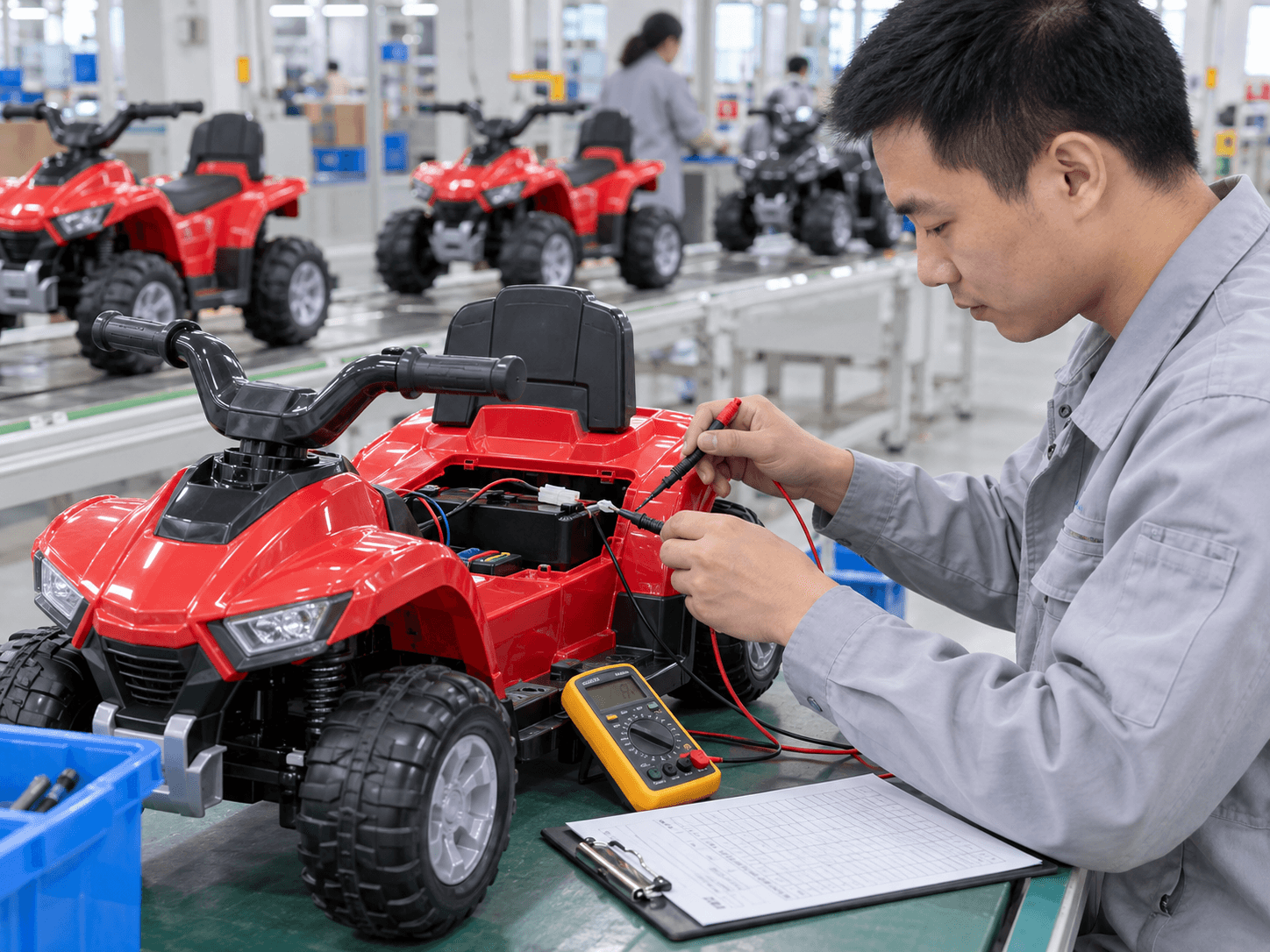
Production testing can confirm remote identity, pairing, command priority, modes and stop function on each unit or approved sample frequency. It cannot replace the deeper design review. Pre-shipment inspection then checks the finished lot against the approved behavior.
What to confirm before approval
- Validate the full behavior matrix.
- Create practical line tests and records.
- Revalidate after critical component or software change.
7. Worked example: apply the decision to a real order
The following scenario is illustrative. It explains a decision method rather than reporting a CubRover customer project, measured test result, certification, or completed shipment.
A sample stops when the remote button is held, but it starts moving again as soon as the button is released while the child pedal remains pressed. The catalog calls the feature an emergency stop.
The buyer rewrites the requirement to define priority, stop state and deliberate restart, then asks engineering to assess and validate the revised behavior. Production checks confirm the approved controller and remote on finished units.
The feature becomes an observable control instead of an ambiguous marketing label.
| State | Buyer question | Evidence |
|---|---|---|
| Speed mode | What output and indication apply? | Measured mode record |
| Conflict | Which command has priority? | Input-conflict test |
| Stop | How does motion stop and stay stopped? | Response and restart test |
| Signal loss | What happens after timeout? | Fault-state validation |
8. Turn the review into a controlled implementation plan
A useful buyer decision has three outputs: an approved requirement, evidence supporting that requirement, and a named person who can release the next activity. Keep these connected by model, configuration, market, document revision, and effective production date. If a supplier gives a conditional answer, preserve the condition in the purchasing record rather than shortening it into an unconditional product claim.
Create a remote-control behavior specification with state diagrams or tables for power-up, pairing, child inputs, parental commands, speed modes, stop, signal loss, low battery, faults and restart. Link it to approved controller, receiver, transmitter, wiring, software revision, manual, labels, line test and service parts.
- Define rider, use and supervision.
- Specify measurable speed-mode behavior.
- Set remote priority, stop and restart states.
- Validate range, interference and faults.
- Control production hardware, software and testing.
Primary resources for the specific source facts and frameworks discussed in this guide: CPSC toy-safety business guidance; CPSC guidance for categorizing youth ATVs.
Continue the related CubRover buyer workflow: parental remote-control guide; soft-start and speed-modes guide; supplier quality agreement guide.
9. Conclusion and buyer handoff
Speed limiters and parental stop functions are control systems. Define states, priority, signal behavior, faults and restart; validate the representative design; and verify the approved hardware and software during production.
Before requesting a quote, share the destination market, selected product platform, target quantity, required configuration, channel, timing, and the decision you need the supplier to support. Attach the current requirement and identify open questions. This gives the factory a clear starting point for discussing samples, evidence, inspection, documents, packaging, and commercial responsibilities.
Frequently asked questions
Is a parental remote the same as an emergency stop?
Not necessarily. Define the actual priority, stop, hold and restart behavior instead of relying on a label.
What speed is safe for a kids ATV?
There is no universal value independent of rider, product, environment and applicable requirements. Obtain qualified model-specific review.
Should the ATV stop when the remote signal is lost?
Loss-of-signal behavior must be deliberately specified, assessed and validated for the exact system.
Can one remote control another vehicle accidentally?
The design should use controlled pairing or addressing and be tested with multiple nearby units.
What should factory testing record?
Vehicle and remote identity, modes, pairing, command priority, stop response, indicators and result.
When is revalidation needed?
After changes to controller, receiver, transmitter, wiring, software, battery, motors or relevant product behavior.
Specify the control behavior before sample approval
Discuss speed modes, remote priority, fault behavior and factory testing with CubRover.
Get a Quote