The short answer
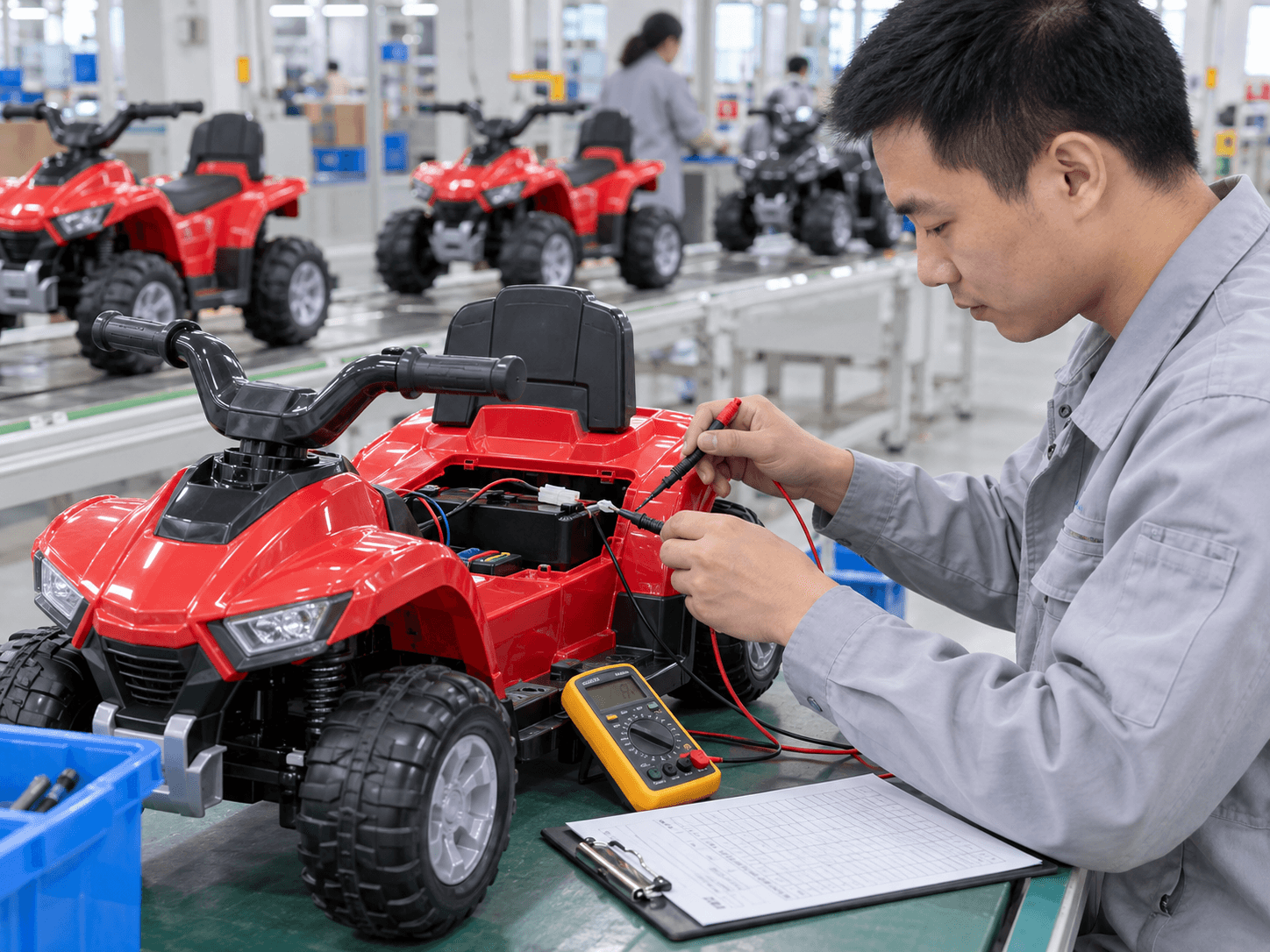
Test kids ATV speed, runtime, and load on the exact production configuration under defined rider or applied load, battery state, surface, gradient, temperature, tire or wheel condition, operating mode, route, measurement method, and repetition count. Record variation, stopping behavior, temperature, noise, protection events, and post-test condition. Publish only claims supported by those conditions.
Speed, runtime, and load capacity are common selling points, yet they are highly condition-dependent. Two tests on the same model can produce different results when battery state, load, surface, temperature, wheels, route, or driving pattern changes.
This guide helps importers create test instructions that factories, laboratories, inspectors, and content teams can understand. It does not provide universal performance targets or encourage unsafe riding tests.
1. Freeze the test configuration
Identify model revision, battery, charger, motors, gearing, controller, software or speed mode, wheels, vehicle mass, accessories, and any option that affects energy use or motion. Photograph labels and confirm the unit is representative of production.
For kids ATV speed, runtime, and load testing, this decision should be translated into measurable requirements rather than left as a sales description. State the responsible person, approved reference, acceptable variation, verification method, and record required for release. If the evidence cannot be connected to the quoted model and revision, treat the point as open rather than confirmed.
Questions buyers should resolve
- Record component part numbers.
- Use a conditioned representative battery.
- Confirm wheel size and drive layout.
- State active lights or sound functions.
- Document sample history and repairs.
At the quotation stage, ask the supplier to mark each point as standard, optional, unavailable, or pending confirmation. Attach the answer to a model code and dated revision. This prevents a useful discussion from becoming an undocumented promise and exposes differences early enough to affect supplier selection, sample cost, tooling, and schedule.
2. Define load, surface, route, and environment
State applied or rider load, safe test method, surface material and condition, gradient, route length, turns, stop-start pattern, ambient temperature, wind where relevant, and supervision. A vague “outdoor test” cannot support a repeatable claim.
For kids ATV speed, runtime, and load testing, this decision should be translated into measurable requirements rather than left as a sales description. State the responsible person, approved reference, acceptable variation, verification method, and record required for release. If the evidence cannot be connected to the quoted model and revision, treat the point as open rather than confirmed.
Questions buyers should resolve
- Use a controlled safe test area.
- Measure gradient rather than estimate.
- Record grass length and moisture if used.
- Keep route and operator method consistent.
- Define exclusion and stop conditions.
During sample review, observe both the expected outcome and the way it is achieved. Photograph identifiers and interfaces, record conditions, repeat variable observations, and note any technician adjustment made before the result. An approval should distinguish an accepted production feature from a one-off sample correction that still needs process control.
3. Measure speed together with control and stopping behavior
Record measurement equipment, location, acceleration distance, steady-state criterion, operating mode, load, repetitions, and results. Observe launch, steering, mode switching, pedal or control release, stopping distance, tracking, wheel slip, and abnormal behavior.
For kids ATV speed, runtime, and load testing, this decision should be translated into measurable requirements rather than left as a sales description. State the responsible person, approved reference, acceptable variation, verification method, and record required for release. If the evidence cannot be connected to the quoted model and revision, treat the point as open rather than confirmed.
Questions buyers should resolve
- Calibrate or verify measuring equipment.
- Repeat runs in both directions if appropriate.
- Record high and low modes separately.
- Observe stopping under stated load.
- Do not optimize speed beyond approved design.
Before purchase-order release, convert the decision into controlled documents: specification, bill of materials or approved part reference, drawing or artwork, work instruction, inspection point, and change-notification rule as applicable. The commercial document should state which revision governs when a chat message, catalog sheet, and sample appear to conflict.
4. Test runtime as an operating profile
Define full-charge preparation, rest time, route, load, mode, stops, features, cutoff endpoint, and pauses. Record voltage or other approved indicators, motor and gearbox temperature observations, controller or connector heat, noise, odor, and the condition at test end.
For kids ATV speed, runtime, and load testing, this decision should be translated into measurable requirements rather than left as a sales description. State the responsible person, approved reference, acceptable variation, verification method, and record required for release. If the evidence cannot be connected to the quoted model and revision, treat the point as open rather than confirmed.
Questions buyers should resolve
- Use the approved charger and charge method.
- Define the runtime endpoint before starting.
- Repeat enough times to understand variation.
- Inspect connectors and drivetrain afterward.
- Report conditions with any result range.
During production, check the earliest point at which a mismatch can be detected economically. Incoming verification may be better for a component identity; an in-process fixture may be better for assembly; an end-of-line test may be better for complete function. Record failed units and their disposition instead of quietly reworking them without trend data.
5. Separate load testing from slope marketing
A static structural load, loaded operation, starting test, durability cycle, and gradient observation answer different questions. Define the requirement, fixture or safe method, duration, acceptance limits, and post-test inspection. Do not convert one short slope demonstration into a universal climbing claim.
For kids ATV speed, runtime, and load testing, this decision should be translated into measurable requirements rather than left as a sales description. State the responsible person, approved reference, acceptable variation, verification method, and record required for release. If the evidence cannot be connected to the quoted model and revision, treat the point as open rather than confirmed.
Questions buyers should resolve
- Name the test type and purpose.
- Use controlled loads and secure methods.
- Record wheel slip and protection events.
- Inspect structure and fasteners afterward.
- Require engineering review for design changes.
Before shipment, compare the finished lot with the approved decision and customer-facing promise. Review whether packaging, manual, labels, accessories, product photographs, online claims, and service parts still describe the same configuration. A technically acceptable product can still create claims when the delivered information sets a different expectation.
6. Build a sample and evidence plan for kids ATV speed, runtime, and load testing
Engineering claims need a controlled configuration and stated test conditions. Battery state, applied load, surface, ambient conditions, controller, motor, gearing, wheels, software mode, measurement method, and sample revision can materially change an observation. A catalog value without these conditions should not become a guaranteed retail promise.
A representative sample should be inspected as a complete system, not as isolated components. Verify identity first, then assembly, operation, abnormal behavior, repeatability, service access, instructions, and packaging. Record the condition before and after testing, because a result without sample history is difficult to reproduce or investigate.
A performance report should make it possible for another qualified team to reproduce the setup. Include photographs of the route and vehicle, equipment IDs, raw results, units, variation, sample condition, observations, and any result excluded with its reason.
Evidence quality also depends on provenance. Mark who created each record, when it was created, which equipment or reference was used, and whether the reviewer was independent from the activity. Keep original files where practical. A cropped photograph, spreadsheet value, or translated summary can support a decision, but it should not obscure the underlying report, sample identity, method, or limitation.
Evidence to retain in the buyer file
- Identify the exact model, revision, option set, and destination market.
- Record the test, review, or approval method before accepting a claim.
- Keep photographs, measurements, results, deviations, and responsible approvals.
- Separate an engineering sample from a production-representative sample.
- Resolve open items before purchase order, artwork, or shipment release.
- Repeat affected checks whenever a critical component or instruction changes.
7. Translate the approved decision into production control
Production control begins with a frozen bill of materials and approved interfaces. Incoming parts must match their specifications; operators need current instructions; critical assembly points require checks; and substitutions need written technical review. A similar-looking battery, charger, controller, connector, motor, or wheel is not automatically interchangeable.
For kids ATV speed, runtime, and load testing, the controlled product file should identify the customer requirement, approved model, components or materials affected, operating conditions, labels and instructions, sample evidence, production checks, packaging, and authorized deviations. Purchasing and quality teams should work from the same revision.
Change control is especially important after sample approval. A supplier may consider two components commercially equivalent even when their ratings, connectors, materials, software behavior, appearance, service compatibility, or evidence differ. Require a written change request that explains the old and proposed item, reason, functional effect, document effect, cost, schedule, and approval.
Control plans should be practical enough to survive a busy production day. Define the sampling frequency, responsible role, measuring or test equipment, record format, reaction plan, and authority to stop or release work. Audit a small selection of completed records against physical units; a completed checkbox is useful only when the method and acceptance boundary were understood.
Factory controls to agree before production
- Approved bill of materials and current component specifications.
- Incoming identity and condition checks for critical parts.
- Work instructions available at the relevant production station.
- In-process checks before assemblies become difficult to inspect.
- End-of-line functions recorded against defined acceptance criteria.
- Nonconforming units isolated, corrected, rechecked, and traceable.
| Gate | Required evidence | Release question |
|---|---|---|
| Specification | Current model, configuration, requirements, and exclusions | Does everyone understand the same product? |
| Sample | Representative unit, test records, photographs, and deviations | Is this the production reference? |
| Materials | Approved suppliers, part identity, incoming results, and status | Do received parts match the frozen file? |
| Production | Instructions, checkpoints, test results, and nonconformity control | Can the factory repeat the approved decision? |
| Shipment | Inspection, pack-out, documents, quantity, and release record | Is the finished lot acceptable to ship? |
8. Inspect the finished order and preserve decision-ready records
Routine line testing confirms that production functions as intended, while engineering validation examines design performance and limits. Pre-shipment inspection samples the finished lot. Buyers should define which activity answers each question instead of expecting a short end-of-line check to replace design validation or regulatory assessment.
The inspection plan for kids ATV speed, runtime, and load testing should identify the lot, sampling approach, defect classes, methods, tools, acceptance limits, and escalation rules. Safety- or compliance-related discrepancies require appropriate containment and expert review; they should not be diluted into a general visual defect percentage.
Retain an organized release pack: purchase specification, approved sample record, change approvals, inspection report, photographs, test summaries, packing evidence, shipment identifiers, and open-item disposition. Records should be searchable by model and batch so that a later complaint can be connected to the product that was actually supplied.
A useful inspection report separates facts from recommendations. It shows what was available, what was sampled, what method was used, what was observed, and which requirement determined conformity. When a check could not be completed, record the limitation openly. The buyer can then make a conscious release, hold, rework, or reinspection decision instead of treating missing evidence as a passing result.
Use current primary guidance when the topic affects safety, transport, or market access: U.S. CPSC Toy Safety Business Guidance. Confirm applicability for the exact product and date with a qualified professional.
9. Use a staged buyer action plan
A staged plan prevents commercial urgency from bypassing technical decisions. Assign an owner and due date to every open assumption, and do not let a quotation, sample, laboratory file, artwork proof, or inspection report stand alone. Each gate should point to the same model and revision.
- Define the customer, market, channel, product, and decision that the article addresses.
- Convert marketing language into a controlled specification with measurable acceptance criteria.
- Review a representative sample and record assumptions, limitations, and approved deviations.
- Confirm market, test, documentation, packaging, and commercial responsibilities.
- Freeze the product and artwork revision before purchasing production materials.
- Inspect the finished order, close significant findings, and retain release evidence.
- Feed shipment and customer results into the next product and process revision.
When an issue appears, contain the affected scope first. Then distinguish the observed defect from its cause, review whether other models or batches are affected, implement corrective action, and verify that the action worked. Replacing one failed unit may satisfy an immediate customer need, but it does not prove recurrence has been prevented.
After launch, compare the assumptions in the sourcing file with arrival inspection, assembly time, customer questions, returns, warranty parts, damage, and sell-through feedback. Normalize data by units and time in market where possible. This closes the loop between product application and factory control and provides evidence for the next quotation rather than relying on memory or isolated anecdotes.
Continue the buyer workflow with wheel, motor, and drive-system guide and battery selection guide and voltage buyer guide.
Conclusion
Good performance testing makes uncertainty visible. Freeze the system, define the conditions, measure speed with control behavior, treat runtime as a profile, distinguish load from gradient questions, and keep claims no stronger than the evidence. That protects both product decisions and customer expectations.
Frequently asked questions
How fast does a kids electric ATV go?
It depends on the exact motors, gearing, controller, battery state, wheels, load, surface, gradient, mode, and conditions. Use a model-specific measured range.
How long does a kids ATV battery last per charge?
Runtime depends on battery, load, drivetrain, surface, temperature, operating pattern, features, condition, and cutoff. A test result needs its conditions.
What load should a kids ATV be tested with?
Use the design requirement, intended user profile, applicable assessment, and safe test method for the exact product. Do not invent one universal load.
Is a slope test the same as a load test?
No. Structural, operational, starting, durability, and gradient tests evaluate different aspects and require separate methods and criteria.
How many test repetitions are needed?
Enough to understand normal variation and answer the decision, based on risk and method. One promotional run is weak evidence.
Can a factory video support a retail performance claim?
It may illustrate behavior but should include configuration and conditions and be supported by controlled records before becoming a claim.
Turn performance claims into reproducible evidence
Share the product, operating conditions, proposed claims, and market. CubRover can structure a transparent sample-test discussion.
Contact Us