The short answer
For a U.S. children’s ride-on toy, map each accessible material and coating to the applicable lead, lead-in-paint, phthalates and toy-safety requirements. Use a CPSC-accepted third-party laboratory where required, document sample selection and component identity, and rely on supplier component evidence only when the CPSC conditions and due-care obligations are met. The importer’s CPC must describe the exact finished product and current production configuration.
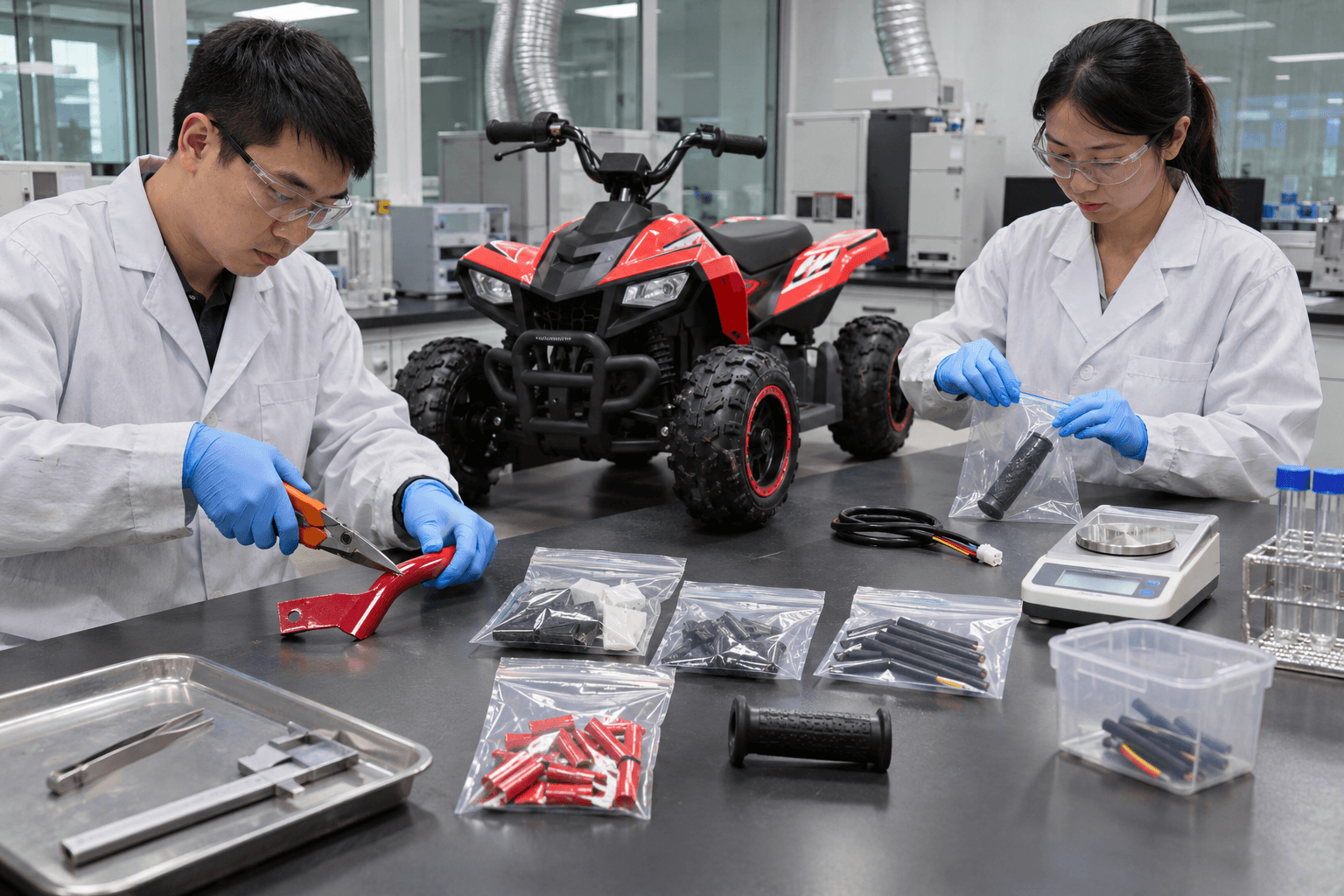
A kids ATV is not one homogeneous sample. Hard plastics, soft grips, cable insulation, painted metal, decals, solder, fasteners and electronics can have different chemical risk profiles and legal citations.
Component testing can reduce duplication when used correctly, but it also creates traceability obligations. The buyer must know which supplier, formulation, color and production period the evidence represents.
1. Map applicable chemical and toy requirements
Confirm the product is a children’s product and children’s toy under the relevant CPSC definitions. List applicable ASTM F963 sections, total lead, lead in paint and similar surface coatings, phthalates, electrically operated toy requirements, tracking labels and any other model-specific rules.
Use correct legal citations in the certification record. Do not copy a generic CPC or laboratory package from a visually similar vehicle without confirming age, materials, functions and evidence scope.
What to confirm before approval
- Confirm children’s product and toy scope.
- Map each rule to the exact configuration.
- Use current legal citations and laboratory requirements.
2. Build an accessible-component material map
List body plastics by resin and color, soft grips, seat covering, cable jackets, decals, coatings, painted frame, metal alloys, solder, adhesives and accessible electronics. Mark components that are inaccessible only after applying the relevant definition and foreseeable-use considerations.
Identify materials CPSC has determined do not require certain testing when untreated or within specified conditions, but do not confuse relief from testing with relief from compliance. Record the basis for every exclusion.
What to confirm before approval
- Identify material, color and supplier.
- Assess accessibility under the correct rule.
- Document every testing determination or exemption.
3. Control sample selection and laboratory instructions
Define whether the laboratory receives finished units, loose production components or both. Preserve model, color, supplier lot and production status. Provide enough material for destructive testing without mixing sources that need separate traceability.
Confirm the laboratory is CPSC-accepted for each required rule and method. A laboratory accepted for one scope is not automatically accepted for every chemical or mechanical test.
What to confirm before approval
- Write a sample-selection record.
- Keep components separated by source and color.
- Verify laboratory acceptance scope.
4. Use supplier component testing with due care
When relying on component-part test reports or certifications, obtain the underlying documentation and required attestations. Check laboratory, test method, component identity, supplier, dates and whether any material change occurred after the tested lot.
The importer remains responsible for the finished product certification. Establish purchase controls that prevent tested paint, plastic or cable from being substituted with an unreviewed equivalent.
What to confirm before approval
- Obtain complete underlying component records.
- Exercise and document due care.
- Prevent silent supplier or formulation changes.
5. Reconnect chemical evidence to the finished ATV and CPC
Some requirements can be assessed at component level; others require the assembled finished product. Maintain a test matrix showing which evidence supports each rule and model variant. Confirm the production vehicle uses the same components and colors represented.
Prepare the CPC from current, valid results and required data. Reconcile model, manufacturing place and date, laboratory, rule citations and contact information with tracking labels and CPSC eFiling data where applicable.
What to confirm before approval
- Maintain a rule-to-report matrix.
- Verify production against approved components.
- Align CPC, tracking labels and eFiling data.
6. Plan material-change and periodic testing controls
Set change triggers for resin, pigment, plasticizer, coating, supplier, recycled content, cable, seat, decal and manufacturing process. Determine required retesting and certification actions with qualified specialists before approving the change.
Use incoming inspection, supplier certificates and production testing plans to maintain a high degree of assurance. Retain required records for the applicable period and make them retrievable by model and batch.
What to confirm before approval
- Define risk-based retest triggers.
- Connect incoming lots to approved evidence.
- Retain certification and testing records.
7. Worked example: apply the decision to a real order
The following scenario is illustrative. It explains a decision method rather than reporting a CubRover customer project, measured test result, certification, or completed shipment.
A 12V quad has red and blue body versions. The red plastic test report names one resin supplier, while production later uses a new blue pigment masterbatch and alternate soft grip without change review.
The importer maps the new components, confirms applicable testing with a CPSC-accepted laboratory, updates the component evidence and CPC inputs, and sets incoming identity checks for the approved sources.
The example avoids both extremes: testing the whole vehicle blindly and assuming one old report covers every future color and supplier.
| Component | Potential review | Identity control |
|---|---|---|
| Painted frame | Lead in coating and applicable toy sections | Paint system and supplier |
| Body plastic | Total lead and relevant toy elements | Resin, pigment and color |
| Soft grip/cable | Phthalates and total lead where applicable | Compound and supplier |
| Finished vehicle | Mechanical/electrical toy requirements | Model, BOM and production batch |
Questions to include in the buyer decision brief
Convert the review into questions that the supplier can answer against one named model and order. The following prompts come from the topic-specific approval checks above. They are intentionally practical: each answer should identify the responsible party, supporting record, open condition, and date by which the buyer can make the next decision.
- Map applicable chemical and toy requirements: Confirm children’s product and toy scope. Map each rule to the exact configuration. Use current legal citations and laboratory requirements.
- Build an accessible-component material map: Identify material, color and supplier. Assess accessibility under the correct rule. Document every testing determination or exemption.
- Control sample selection and laboratory instructions: Write a sample-selection record. Keep components separated by source and color. Verify laboratory acceptance scope.
- Use supplier component testing with due care: Obtain complete underlying component records. Exercise and document due care. Prevent silent supplier or formulation changes.
- Reconnect chemical evidence to the finished ATV and CPC: Maintain a rule-to-report matrix. Verify production against approved components. Align CPC, tracking labels and eFiling data.
- Plan material-change and periodic testing controls: Define risk-based retest triggers. Connect incoming lots to approved evidence. Retain certification and testing records.

8. Turn the review into a controlled implementation plan
A useful buyer decision has three outputs: an approved requirement, evidence supporting that requirement, and a named person who can release the next activity. Keep these connected by model, configuration, market, document revision, and effective production date. If a supplier gives a conditional answer, preserve the condition in the purchasing record rather than shortening it into an unconditional product claim.
Create a chemical and toy-test matrix by model, component, material, color and supplier. Link each applicable rule to a sample-selection record, CPSC-accepted laboratory scope, report, component certification where used, finished-product evidence, CPC field and effective batch. Prevent purchasing changes outside this controlled baseline.
- Map applicable rules and accessible components.
- Approve the laboratory and sample plan.
- Validate component evidence and due care.
- Reconnect reports to the finished product and CPC.
- Control material changes and repeat production.
Primary resources for the specific source facts and frameworks discussed in this guide: CPSC toy-safety FAQs; CPSC phthalates FAQs; CPSC component-part testing FAQs; CPSC initial certification testing guidance.
Continue the related CubRover buyer workflow: U.S. compliance and CPC guide; test-report and variant-coverage guide; repeat-order change-control guide.
9. Conclusion and buyer handoff
CPSIA chemical compliance is strongest when component evidence and finished-product testing are joined by traceability. Map the BOM, use the right laboratory scope and protect the approved materials from unreviewed change.
Before requesting a quote, share the destination market, selected product platform, target quantity, required configuration, channel, timing, and the decision you need the supplier to support. Attach the current requirement and identify open questions. This gives the factory a clear starting point for discussing samples, evidence, inspection, documents, packaging, and commercial responsibilities.
Frequently asked questions
Do all kids ATV components need phthalates testing?
No. Applicability depends on material, accessibility and regulatory determinations, but every exclusion should have a documented basis.
Can the importer use a plastic supplier’s test report?
Potentially, when CPSC component-part rules are met and the importer exercises due care and retains required documentation.
Must the lab be CPSC accepted?
Children’s product tests used for certification must be performed by a CPSC-accepted laboratory for the applicable rule.
Can different colors share one report?
Only when the material, pigment and evidence justify coverage. Color or supplier changes can require review or retesting.
Does component testing replace finished-product testing?
No. Many mechanical, electrical and use-related requirements must be assessed on the finished product.
When is retesting needed?
After a material change that could affect compliance and according to the applicable periodic or production testing plan.
Prepare a U.S. model with controlled component evidence
Ask CubRover about BOM identity, samples, factory controls, inspection and model-specific document coordination.
Get a Quote