The short answer
The most useful recall-prevention process converts public incidents and field complaints into specific design and production controls. For a kids ATV, review pedal return and stopping, wiring and battery protection, charger compatibility, remote-control priority, fastener retention, small batteries, structural durability, warnings and traceability. Validate foreseeable contamination and misuse, inspect production-critical features, and maintain a batch-specific containment and remedy plan.
Recall databases are not design standards, but they reveal how products can fail in real distribution and use. A ride-on pedal that passes a clean bench check may behave differently after debris, moisture, wear or assembly variation.
Importers should not wait for injury reports to connect service complaints. Early signals such as sticking controls, hot connectors, intermittent stopping or repeated loose fasteners deserve structured review by model, batch and use condition.
1. Build a recall and incident signal library
Monitor official recall databases and safety warnings in target markets. Record product type, hazard, failure mode, remedy, affected units and control lesson without assuming the public notice contains the complete root cause.
Combine external signals with internal returns, customer service, dealer reports, warranty parts and factory defects. Normalize descriptions so “keeps moving,” “pedal stuck” and “will not stop” can be analyzed as related control events.
What to confirm before approval
- Review official recalls on a schedule.
- Use consistent failure and hazard codes.
- Link field signals to model and batch.
2. Challenge acceleration, release and stopping behavior
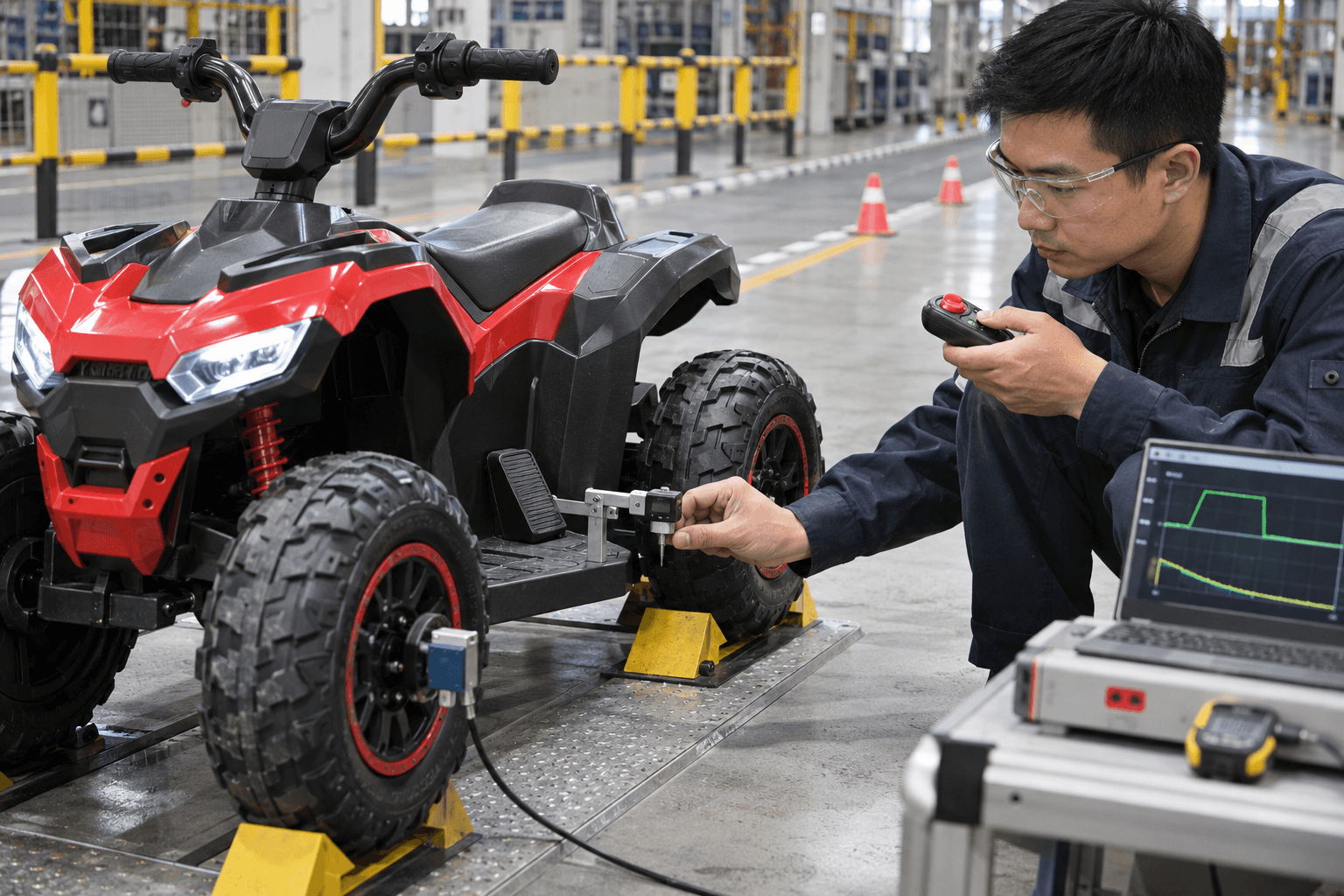
Test pedal travel, return spring, switch, controller response and stopping across operating modes, loads, surfaces and battery conditions. Add foreseeable debris, dust and minor misalignment scenarios where appropriate to the risk assessment.
Measure repeatability rather than recording one pass. Define what happens if the pedal signal sticks, the remote signal is lost or conflicting commands occur. Verify the production controller and wiring match the assessed logic.
What to confirm before approval
- Define pedal and stopping acceptance criteria.
- Test contamination and fault scenarios.
- Record controller and wiring revisions.
3. Control battery, charger, wiring and heat risks
Review battery chemistry, protection, charger profile, connector polarity, wire gauge, routing, fuse or protective devices, motor current and enclosure ventilation as one electrical system. Inspect for pinch, abrasion, loose terminals and incompatible service parts.
Factory testing should include identity and function checks, but it should not be misrepresented as laboratory certification. Trend hot connectors, blown protection, odor, swelling and charging complaints for escalation.
What to confirm before approval
- Approve matched battery and charger systems.
- Inspect wiring protection and connections.
- Escalate heat and charging signals promptly.
4. Review fasteners, structures and accessible hazards
Assess steering, wheel retention, seat and body attachment, axle, frame, suspension where present, sharp edges, pinch points and small parts. Confirm assembly instructions and torque controls for parts installed by the factory or consumer.
Use durability and abuse conditions connected to the intended user and load. Examine failed parts before disposal, preserve fracture surfaces and compare supplier lots so corrective action addresses the cause rather than only replacing the symptom.
What to confirm before approval
- Identify safety-critical fasteners and joints.
- Define durability and abuse checks.
- Preserve failed parts for analysis.
5. Prepare batch-specific containment and remedy options
Maintain production, shipment and customer traceability so the potentially affected scope can be bounded. Define who can stop sales, quarantine inventory, notify authorities and channels, contact consumers and approve repair, replacement or refund proposals.
A repair kit requires validated parts, instructions, tools, user suitability and completion tracking. Run a mock exercise with a realistic defect to expose missing customer data, spare parts or decision authority.
What to confirm before approval
- Define stop-sale and quarantine authority.
- Validate remedy feasibility before launch.
- Run and document mock recall exercises.
6. Verify corrective action in the next production cycle
Separate root cause from escape cause. A pedal may stick because of geometry, contamination tolerance or material choice, while the escape may involve an inadequate test or unrecorded supplier change. Correct both layers.
Verify the change with relevant testing and production evidence, identify the first corrected batch and monitor field performance. Do not close CAPA solely because new parts arrived or a supplier promised improvement.
What to confirm before approval
- Identify root and escape causes.
- Verify effectiveness before closure.
- Track the first corrected batch and field results.
7. Worked example: apply the decision to a real order
The following scenario is illustrative. It explains a decision method rather than reporting a CubRover customer project, measured test result, certification, or completed shipment.
Customer service receives several reports that a ride-on quad moves briefly after pedal release. Individual cases are closed as user error because no injury occurred.
A trend review links the cases to one controller and pedal revision. Inventory is contained, contaminated-pedal and signal-fault tests reproduce the behavior, corrective design and inspection controls are verified, and the first corrected batch is tracked.
The prevention lesson is to treat weak signals as data before they become a larger safety event.
| Signal | Immediate question | Preventive control |
|---|---|---|
| Unexpected motion | Did the pedal or control remain active? | Return and fault-condition testing |
| Heat or odor | Which electrical connection is affected? | System matching and connection inspection |
| Loose part | Was retention or assembly inadequate? | Critical-fastener control |
| Repeated complaint | Is the pattern batch-specific? | Trend analysis and containment |
Questions to include in the buyer decision brief
Convert the review into questions that the supplier can answer against one named model and order. The following prompts come from the topic-specific approval checks above. They are intentionally practical: each answer should identify the responsible party, supporting record, open condition, and date by which the buyer can make the next decision.
- Build a recall and incident signal library: Review official recalls on a schedule. Use consistent failure and hazard codes. Link field signals to model and batch.
- Challenge acceleration, release and stopping behavior: Define pedal and stopping acceptance criteria. Test contamination and fault scenarios. Record controller and wiring revisions.
- Control battery, charger, wiring and heat risks: Approve matched battery and charger systems. Inspect wiring protection and connections. Escalate heat and charging signals promptly.
- Review fasteners, structures and accessible hazards: Identify safety-critical fasteners and joints. Define durability and abuse checks. Preserve failed parts for analysis.
- Prepare batch-specific containment and remedy options: Define stop-sale and quarantine authority. Validate remedy feasibility before launch. Run and document mock recall exercises.
- Verify corrective action in the next production cycle: Identify root and escape causes. Verify effectiveness before closure. Track the first corrected batch and field results.

8. Turn the review into a controlled implementation plan
A useful buyer decision has three outputs: an approved requirement, evidence supporting that requirement, and a named person who can release the next activity. Keep these connected by model, configuration, market, document revision, and effective production date. If a supplier gives a conditional answer, preserve the condition in the purchasing record rather than shortening it into an unconditional product claim.
Maintain a safety signal register tied to SKU, batch, component revision and hazard. Link public recall learning, complaints, returned-part analysis, design risk review, factory controls, shipment inspection, containment decisions, remedy validation, CAPA and effectiveness checks. Review high-severity signals cross-functionally without waiting for frequency to rise.
- Create the external and internal signal library.
- Validate motion, electrical and mechanical hazards.
- Define batch-level containment and remedy authority.
- Correct both root and escape causes.
- Verify the next production and field outcome.
Primary resources for the specific source facts and frameworks discussed in this guide: CPSC recalls and product-safety warnings; CPSC ride-on racer pedal recall example; ACCC recall and unsafe-product guidance.
Continue the related CubRover buyer workflow: complaint and CAPA guide; traceability and recall-readiness guide; speed limiter and parental-stop guide.
9. Conclusion and buyer handoff
Recall prevention is a continuous evidence loop: learn from public events, detect weak field signals, validate realistic failures, control production and verify corrective action. Traceability makes that loop fast enough to protect customers and the business.
Before requesting a quote, share the destination market, selected product platform, target quantity, required configuration, channel, timing, and the decision you need the supplier to support. Attach the current requirement and identify open questions. This gives the factory a clear starting point for discussing samples, evidence, inspection, documents, packaging, and commercial responsibilities.
Frequently asked questions
What kids ATV failures deserve immediate escalation?
Unexpected motion, stopping failure, overheating, smoke, battery damage, steering or wheel loss, accessible small batteries and serious structural failure.
Can a clean pedal test detect debris-related sticking?
Not always. Risk-based testing should consider foreseeable contamination, wear and misalignment conditions.
Does shipment inspection prevent recalls?
It can detect production mismatches and workmanship defects, but it does not replace design validation, testing or post-market monitoring.
What is an escape cause?
It explains why the existing design, supplier, test or inspection system failed to detect or contain the root problem.
Should every complaint trigger a recall?
No. Every safety-relevant complaint should be assessed, trended and escalated according to severity and applicable reporting rules.
How is corrective action verified?
By demonstrating the change works under relevant conditions and monitoring identified corrected batches and field results.
Build safety evidence into the order
Ask CubRover about sample review, factory testing, critical-component control, inspection and traceability planning.
Get a Quote