The short answer
Choose between a kids ATV factory and a trading company by verifying who owns the product design, tooling, manufacturing processes, quality records, supplier relationships, export transaction, and warranty response. A factory can offer direct technical access; a capable trader can coordinate assortment and logistics. The right choice is the organization that can document and deliver the responsibilities your program requires.
Supplier directories often make “factory direct” sound like a complete buying decision. In practice, a manufacturing group may export through a separate company, while a specialist trader may coordinate several qualified factories. The legal and operational relationships matter more than the label.
This guide explains how to compare those arrangements fairly. It does not assume that the direct factory is always cheaper or that an intermediary is automatically unreliable.
1. Map the legal entities and money flow
Request the legal names of the contracting seller, producing site, exporting entity, bank beneficiary, brand owner, and any service company. Ask why they differ and what documents establish the relationship. A different export company may be normal, but the buyer needs an explanation it can verify.
Keep the invoice, purchase contract, bank verification, manufacturer declaration where applicable, and inspection booking consistent. If a payment beneficiary changes, use an independently verified contact process. Do not treat a website name, business-card English name, or marketplace badge as a substitute for the entity that owes the contractual performance.
What to confirm before approval
- Identify seller, manufacturer, exporter, and beneficiary.
- Request explanations for entity differences.
- Verify changes using established contact channels.
2. Ask which processes happen at the site
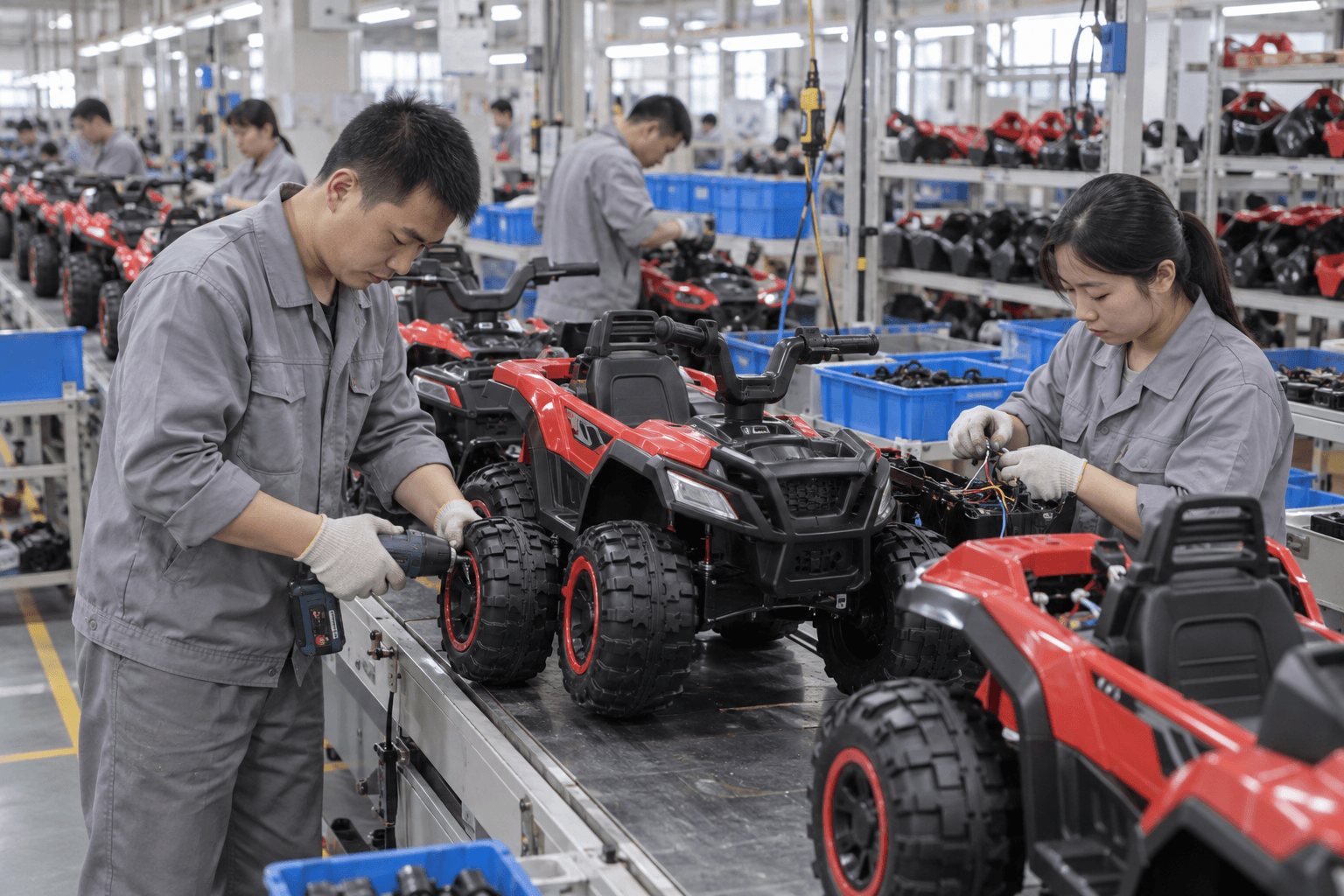
Map molding, metal fabrication, painting, electronics sourcing, subassembly, final assembly, testing, packing, warehousing, and loading. Many factories buy batteries, chargers, motors, or molded parts from specialists. The important question is whether those inputs are specified and controlled.
A trader may arrange final inspection at the producer, while an assembly factory may rely heavily on outsourced parts. Ask to see the actual flow of your selected model and its production records. Process evidence tied to your order is more useful than a large workshop photograph or a claim that everything is made in-house.
What to confirm before approval
- Map owned, outsourced, and subcontracted work.
- Identify control of critical purchased parts.
- Connect site evidence to the selected model.
3. Compare engineering and change-control access
For customized quad programs, evaluate who can explain the battery-charger pairing, motor and gearbox interfaces, wheel changes, controller behavior, tooling limits, packaging effects, and evidence implications. Ask a technical question that requires a concrete component or drawing answer.
Direct access can shorten clarification, but only if the relevant engineer and controlled records are available. A knowledgeable trading company may translate requirements effectively; an unstructured factory sales process can still lose them. Test the response with a small sample-change request and review how the answer reaches the final specification, cost, schedule, and approval file.
What to confirm before approval
- Ask who approves technical changes.
- Require exact part and revision references.
- Test one change through the full response process.
4. Check access to production and defect evidence
Request incoming and line-test examples, nonconformity handling, approved samples, calibration records relevant to checks, batch identity, shipment inspection access, and corrective-action examples with confidential details removed. Confirm whether the seller can obtain producer cooperation after a complaint.
A supplier model is weak when every problem gets passed to another unnamed party. Define one response owner even where several companies perform work. Ask who holds stock, authorizes rework, funds replacement parts, investigates a battery or charger issue, and supplies production records when a shipment or field defect needs traceability.
What to confirm before approval
- Confirm inspection and audit access.
- Assign one accountable response owner.
- Check records and service responsibility after delivery.
5. Normalize commercial benefits and added services
Factories may quote a simpler direct product cost, while traders may bundle mixed assortments, smaller order coordination, language support, supplier management, documents, or local stock. Compare each service and exclusion explicitly rather than assuming all margins represent unnecessary cost.
Calculate order management time, fragmented shipments, sample coordination, travel, quality support, and claims as well as price. A single product with stable volume and technical customization may favor one arrangement; a broad low-volume assortment may favor another. The commercial choice can change as the business grows, so define what evidence would justify changing the sourcing model later.
What to confirm before approval
- Price coordination and consolidation transparently.
- Include buyer-side management effort.
- Compare equivalent quantities, evidence, and terms.
6. Verify capability using a staged order
Begin with entity review, technical clarification, a representative sample, agreed documentation review, factory verification appropriate to risk, and a controlled first order. Use milestones that allow correction before committing the full assortment or seasonal inventory.
A first order should measure response quality as well as product quality: timely document corrections, accurate SKU mapping, disclosure of substitutions, realistic schedule updates, inspection readiness, and service-part identification. These observations provide better supplier evidence than an argument about whether a company fits a single directory category. Record the results for renewal and repeat-order decisions.
What to confirm before approval
- Use a documented first-order scorecard.
- Track communication and execution failures.
- Approve repeat volume from evidence.
7. Worked example: apply the decision to a real order
The following scenario is illustrative. It explains a decision method rather than reporting a CubRover customer project, measured test result, certification, or completed shipment.
Consider an importer selecting one customized 24V model and several standard accessories. Supplier A operates the quad assembly site but cannot consolidate the accessory range. Supplier B is a specialist trader that names its factories and offers combined inspection and shipping.
The buyer splits the comparison into technical control of the customized quad and coordination of the assortment. It asks both suppliers for the same technical change, sample file, inspection access, and claim-response commitment. It then calculates the cost of two shipments and extra buyer coordination rather than comparing product price alone.
A rational outcome may be either supplier or a deliberate split. What matters is that the producer is visible, the seller remains accountable, documents identify the correct parties, and a buyer-approved change can be traced all the way into production. This is an illustrative decision rather than evidence that any supplier model always performs better.
| Question | Evidence | Decision value |
|---|---|---|
| Who produces? | Named site and process map | Verifiable capability |
| Who changes the product? | Engineering access and revision approvals | Controlled customization |
| Who handles defects? | Response owner and quality agreement | Accountability after shipment |
| Who coordinates the assortment? | Service scope and cost | Total program efficiency |
Questions to include in the buyer decision brief
Convert the review into questions that the supplier can answer against one named model and order. The following prompts come from the topic-specific approval checks above. They are intentionally practical: each answer should identify the responsible party, supporting record, open condition, and date by which the buyer can make the next decision.
- Map the legal entities and money flow: Identify seller, manufacturer, exporter, and beneficiary. Request explanations for entity differences. Verify changes using established contact channels.
- Ask which processes happen at the site: Map owned, outsourced, and subcontracted work. Identify control of critical purchased parts. Connect site evidence to the selected model.
- Compare engineering and change-control access: Ask who approves technical changes. Require exact part and revision references. Test one change through the full response process.
- Check access to production and defect evidence: Confirm inspection and audit access. Assign one accountable response owner. Check records and service responsibility after delivery.
- Normalize commercial benefits and added services: Price coordination and consolidation transparently. Include buyer-side management effort. Compare equivalent quantities, evidence, and terms.
- Verify capability using a staged order: Use a documented first-order scorecard. Track communication and execution failures. Approve repeat volume from evidence.

8. Turn the review into a controlled implementation plan
A useful buyer decision has three outputs: an approved requirement, evidence supporting that requirement, and a named person who can release the next activity. Keep these connected by model, configuration, market, document revision, and effective production date. If a supplier gives a conditional answer, preserve the condition in the purchasing record rather than shortening it into an unconditional product claim.
Build a responsibility matrix naming the legal seller and each operational party. Where the supplier cannot disclose a producer, establish whether the resulting limits on audit, report coverage, traceability, and corrective action are acceptable for your order before the commercial commitment.
- Verify entities and contracting roles.
- Map processes for the exact model.
- Test engineering and document access.
- Agree quality and after-sales ownership.
- Review the first order before scaling.
Agree evidence and acceptance before work starts
Write the review method before the sample, factory testing, document check, shipment inspection, or service exercise takes place. Specify the reference, sample selection, conditions, tools, result format, acceptance boundary, and response to a failure. This makes two quotations or results comparable and prevents teams from negotiating the meaning of a pass after money and time have already been spent.
Keep a compact, traceable decision file
Retain the original requirement, dated supplier response, model and component identity, relevant photographs, calculations, reports, deviations, approvals, and release decision. A screenshot can help communication, but retain the underlying record when it matters to the decision. Distinguish a proposed target from a measured value, an engineering sample from a production reference, and an internal check from a third-party assessment.
Use one current revision where possible. Purchasing, engineering, compliance, quality, logistics, sales, and service may need different views of the information, but they should not be making decisions from different versions of the product. When a change is approved, state the first affected batch and what happens to old materials, inventory, artwork, service parts, customer instructions, and pending shipments.
Review cost and timing together with product application
The lowest visible unit price may shift cost into testing, rework, freight, storage, retail setup, support, returns, or obsolete parts. Compare the complete customer requirement and the cost of supplying it consistently. Where a number is uncertain, show the assumption and a reasonable scenario range. Do not turn an illustrative calculation into a supplier promise or a universal benchmark for the category.
Reserve time for unresolved items. A sample modification may require another review; a component change may affect evidence; a carton revision may alter loading; a late document can affect handoff. Put the owner and decision date beside each open item. A useful schedule makes these dependencies visible instead of reporting one finish date that assumes every preceding decision will happen immediately.
Close the loop after delivery
After the first shipment or implementation, compare the approved assumptions with arrival condition, assembly preparation, actual costs, receiving accuracy, customer questions, service cases, and repeat-order results. Separate an isolated event from a recurring pattern using model, batch, channel, and time in use. When a discrepancy appears, contain the affected scope, identify the cause, implement the correction, and verify the next relevant outcome.
Primary resources for the specific source facts and frameworks discussed in this guide: International Trade Administration: common export documents; CPSC toy-safety business guidance.
Continue the related CubRover buyer workflow: factory audit and quality-control guide; China sourcing guide; supplier quality agreement guide.
9. Conclusion and buyer handoff
Factory and trading-company arrangements offer different operating structures. Select from verified entities, process control, technical access, quality evidence, commercial scope, and after-sales ownership. Keep one accountable seller and a visible product record.
Before requesting a quote, share the destination market, selected product platform, target quantity, required configuration, channel, timing, and the decision you need the supplier to support. Attach the current requirement and identify open questions. This gives the factory a clear starting point for discussing samples, evidence, inspection, documents, packaging, and commercial responsibilities.
Frequently asked questions
Is factory-direct always cheaper?
No. Normalize product, volume, consolidation, testing, logistics, buyer effort, and support before comparing total cost.
Can a factory export through another company?
Yes, but verify the relationship, contract, exporter, payment beneficiary, documents, and responsibilities.
Does outsourcing make a supplier a trader?
No. Manufacturers commonly purchase components; the relevant question is process and supplier control.
Can traders support OEM development?
Some can, if they have technical access, manufacturer cooperation, clear rights, and controlled approvals.
What is the strongest factory evidence?
Model-specific process records, live observation, technical answers, traceable samples, and inspection access considered together.
Who should handle a warranty issue?
The agreement should name one accountable seller and define producer support, evidence, cost, and response timing.
Choose a supplier structure you can verify
Send your factory, technical, and service questions to CubRover with the exact product brief.
Send Your Requirements