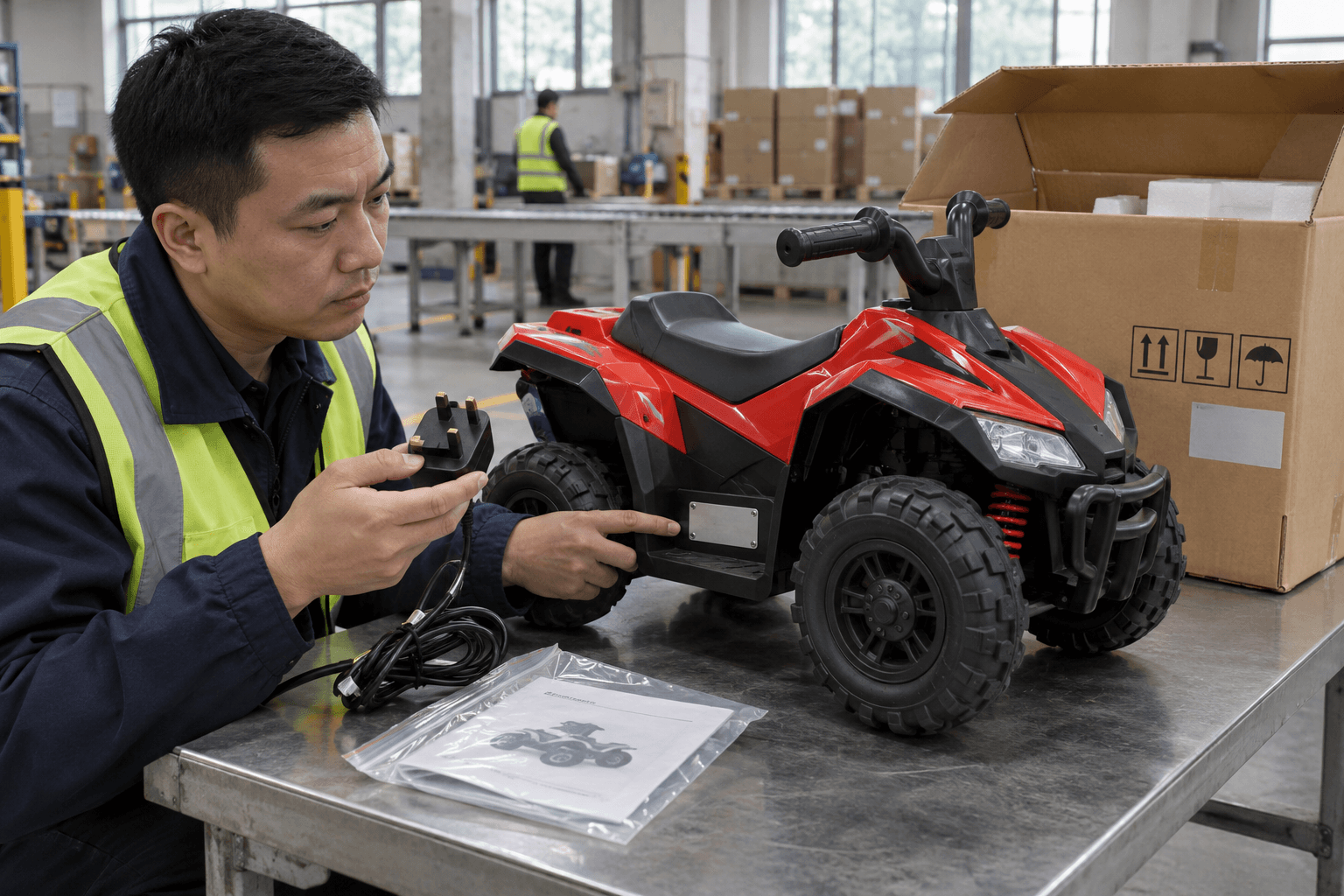
The short answer
Before importing an electric quad into Great Britain, determine whether the exact product is a toy ride-on or falls under another regulatory category. Then confirm the applicable conformity route, technical documentation, declaration, marking, importer name and postal address, product traceability, warnings, instructions, charger and UK plug requirements. Do not rely on the supplier’s marketing name or a CE image alone.
“Kids electric quad” can describe products with very different speed, power, construction and intended use. UK authorities have reported higher-performance electric quads under machinery rules, while lower-speed children’s ride-on products may follow toy requirements. Classification must therefore happen before artwork and testing are frozen.
Importers also need to connect paperwork to the physical product. A valid-looking declaration is not useful when the model, charger, markings or production unit differs. This guide provides a buyer-control workflow and is not legal advice.
1. Classify the exact electric quad and intended use
Record maximum speed, power system, controls, braking behavior, construction, rider position, terrain claims, age grading and intended environment. Compare the facts with current UK requirements and enforcement guidance. Do not classify only from voltage or body shape.
Freeze claims at the same time. Words such as toy, ATV, off-road, high speed or youth vehicle can create inconsistent expectations if the technical file supports another use. Ask qualified UK specialists to confirm uncertain or borderline products.
What to confirm before approval
- Document intended use and performance.
- Review the current regulatory category.
- Align product claims with the classification.
2. Define manufacturer, importer and representative details
Identify the overseas manufacturer and UK importer for the actual commercial flow. Confirm the legal names, registered trade names or marks, postal addresses and where each detail will appear. Marketplace account names are not automatically the responsible economic-operator information.
Approve placement before packaging production. Product, packaging and accompanying-document options depend on the applicable rule and transition provisions, so retain the current legal rationale and artwork proof rather than assuming a generic label is acceptable.
What to confirm before approval
- Name the UK importer and overseas manufacturer.
- Approve address format and placement.
- Keep artwork linked to the applicable rule.
3. Review the conformity route and technical records
Obtain the correct declaration, technical documentation, risk assessment, standards list, reports, drawings, labels, instructions and production-control information for the classified product. Check model numbers, photographs and charger references across the file.
A certificate cover page should not end the review. Confirm issuer, scope, dates, exact samples and limitations. Where notified or approved-body involvement is required, verify the body and role through current official channels.
What to confirm before approval
- Check model-specific declarations and records.
- Verify test-report scope and sample identity.
- Resolve gaps before placing the order.
4. Treat the charger and UK plug as part of the product decision
Confirm input rating, output profile, battery compatibility, plug, fuse, cable, connector, polarity, insulation, markings and instructions for the exact charger. An EU-style plug or travel adapter is not an adequate UK-market plan.
Compare production chargers with the approved sample and evidence during incoming inspection and shipment inspection. Charger substitutions deserve technical and compliance review even when output labels appear similar.
What to confirm before approval
- Approve exact charger and plug references.
- Check battery and connector compatibility.
- Inspect every production and service variant.
5. Control markings, warnings, instructions and language
Create one artwork matrix showing the product identifier, batch or serial reference, conformity marking, manufacturer and importer information, warnings, rating labels and manual language. Identify which items must be permanent and where they appear.
Test label durability on actual molded surfaces and packaging. Review the assembled product after labels are applied; a correct PDF can become obscured, damaged or placed on a replaceable component during production.
What to confirm before approval
- Maintain one approved marking matrix.
- Test durability and real placement.
- Verify manual and product information agree.
6. Build a UK shipment and border-readiness gate
Before release, sample finished vehicles, chargers, manuals and cartons. Compare identity, plug, marks, importer details, batch references, configuration and documents with the approved UK file. Keep photographs and a list of shipment identifiers.
Treat border rejection, recall and enforcement reports as learning signals. Review similar failure modes—plug construction, insulation, markings, documentation or category errors—without assuming a different model automatically shares the same outcome.
What to confirm before approval
- Inspect the finished UK configuration.
- Retain declaration and technical-file access.
- Escalate any mismatch before loading.
7. Worked example: apply the decision to a real order
The following scenario is illustrative. It explains a decision method rather than reporting a CubRover customer project, measured test result, certification, or completed shipment.
A buyer selects a 36V electric quad from a catalog page that calls it a toy. The sample arrives with an EU plug and a declaration for a different model family.
The buyer stops artwork approval, obtains a model-specific classification review, identifies the correct UK regulatory path, revises the charger and markings, and requires production evidence and shipment inspection against the approved sample.
The scenario shows why product category, charger and documentation must be resolved together rather than corrected independently at the port.
| Gate | Buyer question | Evidence |
|---|---|---|
| Classification | Toy or another regulated vehicle category? | Written model review |
| Operator | Who places it on the GB market? | Verified names and addresses |
| Conformity | Which route and records apply? | Declaration and technical file |
| Shipment | Does production match the file? | Inspection and traceability records |

8. Turn the review into a controlled implementation plan
A useful buyer decision has three outputs: an approved requirement, evidence supporting that requirement, and a named person who can release the next activity. Keep these connected by model, configuration, market, document revision, and effective production date. If a supplier gives a conditional answer, preserve the condition in the purchasing record rather than shortening it into an unconditional product claim.
Build a UK configuration sheet that combines classification, intended use, manufacturer and importer details, declaration, standards, reports, charger and plug, labels, manual, batch coding, approved sample and inspection criteria. Reopen the review after performance, battery, charger, controller or marketing changes.
- Classify the exact product and claims.
- Identify economic operators and addresses.
- Review the declaration and technical records.
- Approve charger, plug, markings and instructions.
- Inspect and document the finished UK shipment.
Primary resources for the specific source facts and frameworks discussed in this guide: GOV.UK Toys (Safety) Regulations guidance for Great Britain; GOV.UK product-safety advice for manufacturers and importers.
Continue the related CubRover buyer workflow: ride-on toy versus youth ATV classification guide; technical-file document index; warning-label requirements guide.
9. Conclusion and buyer handoff
A UK electric quad program begins with correct classification. Keep the regulatory route, importer details, charger, markings, technical evidence and production unit connected from quotation through shipment release.
Before requesting a quote, share the destination market, selected product platform, target quantity, required configuration, channel, timing, and the decision you need the supplier to support. Attach the current requirement and identify open questions. This gives the factory a clear starting point for discussing samples, evidence, inspection, documents, packaging, and commercial responsibilities.
Frequently asked questions
Is every children’s electric quad a toy in Great Britain?
No. Classification depends on the exact design, performance, intended use and applicable current rules.
Can a supplier’s CE document prove UK compliance?
Not by itself. Review the applicable route, exact model, evidence, declaration, markings and current UK requirements.
Where should the importer address appear?
Placement depends on the applicable rules and current provisions. Approve the model-specific artwork with qualified advice.
Can an EU plug be supplied with an adapter?
Do not assume so. Confirm the exact UK plug, charger construction, ratings and applicable requirements.
Should the charger be listed in the technical file?
The approved charger and its compatibility, markings and evidence should be controlled with the vehicle configuration.
What should pre-shipment inspection cover?
Model identity, charger and plug, markings, importer details, warnings, manual, accessories, batch code and pack-out.
Prepare a UK-ready kids quad project
Ask CubRover to structure the model, charger, document and inspection questions for your order.
Get a Quote